

Wayground
Jim Crow Laws - Printable Social studies Worksheets grade 8 - Wayground

Jim Crow Laws

Velnesha Mitchell

Created by Velnesha Mitchell

20 questions

8th Grade

Social studies

Updated Oct 2026

Jim Crow Laws is a Grade 8 social studies worksheet that uses 20 multiple-choice questions to build students’ understanding of how segregation was established and enforced in the United States. Students identify the purpose and historical period of Jim Crow Laws, distinguish them from Black Codes, and connect segregation to schools, housing, and public transportation. The questions also assess students’ knowledge of Plessy v. Ferguson, Ida B. Wells-Barnett, the Ku Klux Klan, literacy tests, poll taxes, and grandfather clauses. By choosing among closely related terms, definitions, and historical examples, students practise recognizing how legal and social systems restricted African Americans’ rights after Reconstruction. This free printable worksheet includes a complete answer key and is designed for Grade 8 social studies review, guided practice, or assessment.

Worksheet settings

Font size

S
M
L
XL
WaygroundWorksheets

Jim Crow Laws

Total questions: 20

Name
Class
Date
1.

Which statement was most likely a result of the Jim Crow Laws?

a)

Separate schools were established for white children and black children

b)

Hiram Revels was the first black person elected to the US Senate

c)

Anyone born in the United States is a citizen of the country

d)

All males regardless of race were allowed to vote

2.
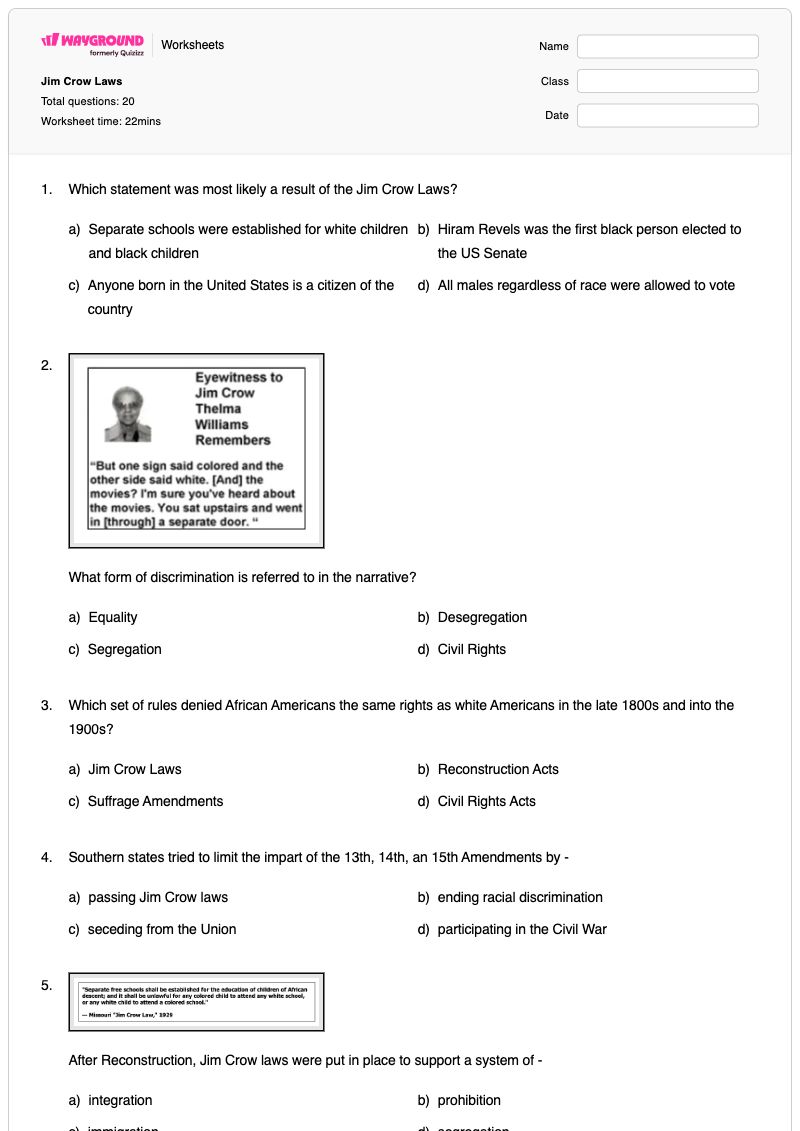
What form of discrimination is referred to in the narrative?

What form of discrimination is referred to in the narrative?

a)

Equality

b)

Desegregation

c)

Segregation

d)

Civil Rights

3.

Which set of rules denied African Americans the same rights as white Americans in the late 1800s and into the 1900s?

a)

Jim Crow Laws

b)

Reconstruction Acts

c)

Suffrage Amendments

d)

Civil Rights Acts

4.

Southern states tried to limit the impart of the 13th, 14th, an 15th Amendments by -

a)

passing Jim Crow laws

b)

ending racial discrimination

c)

seceding from the Union

d)

participating in the Civil War

5.
After Reconstruction, Jim Crow laws were put in place to support a system of -

After Reconstruction, Jim Crow laws were put in place to support a system of -

a)

integration

b)

prohibition

c)

immigration

d)

segregation

6.

Plessy v. Ferguson

a)

a landmark decision of the U.S. Supreme Court that upheld the constitutionality of racial segregation laws for public facilities as long as the segregated facilities were equal in quality

b)

to make a difference in treatment or favor on a basis other than individual merit

c)

Believed equality could be achieved through vocational education; accepted social segregation

d)

Group formed by W. E. B. DuBois and others in 1909 to pursue the goals of economic, educational, and social equality for African Americans; inspired by the Niagara Movement

7.

Ida B. Wells-Barnett

a)

an African American investigative journalist, educator, and co-founder of the National Association for the Advancement of Colored People

b)

Believed equality could be achieved through vocational education; accepted social segregation

c)

Believed in full political, civil, and social rights for African Americans and founded the National Association for the Advancement of Colored People

d)

Laws that enforced segregation in the southern states after Reconstruction

8.

Black Codes are ________________ Reconstruction. Jim Crow Laws are ________________ Reconstruction.

a)

before; during

b)

after; before

c)

during; after

d)

after; during

9.
What areas were racially segregated?

What areas were racially segregated?

a)

Schools

b)

Housing

c)

Public Transportation

d)

All of these answers

10.
Tests given to African Americans at the voting polls.

Tests given to African Americans at the voting polls.

a)

Literacy Tests

b)

Voting tests

c)

Government Tests

d)

Poll tests

11.
Which of the following BEST explains the purpose of the Jim Crow system?

Which of the following BEST explains the purpose of the Jim Crow system?

a)

Keep public facilities cleaner

b)

keep African-Americans as second-class citizens

c)

keep the races pure

d)

keep African-Americans from voting

12.

Where Were Jim Crow Laws Mainly Used?

a)

Eastern Shore

b)

South

c)

North

13.
Beginning as a social club for former Confederates, this organization terrorized African Americans across the country.
a)
Fraternal Order of Elks
b)
Ku Klux Klan
c)
Freemasons
d)
Illuminati
14.
Making people pay an annual fee in order to vote.
a)
Poll tax
b)
etiquette
c)
grandfather clause
d)
literacy
15.
What was the purpose of the grandfather clause?
a)
To allow anyone to vote that had a grandfather born in Georgia.
b)
To allow grandfathers to vote without paying a poll tax.
c)
To allow a veteran or descendant of a veteran to vote.
d)
To allow anyone to vote if a father or grandfather had voted before 1867.
16.

What was the 14th Amendment?

a)

granted American women the right to vote.

b)

abolished slavery in the United States.

c)

defining national citizenship and forbidding the states to restrict the basic rights of citizens or other persons whether black or white.

17.

Jim Crow was...

a)

President of the United States

b)

A former Confederate who became governor of TN

c)

A character played by a white actor in blackface

d)

A leader of the KKK who had significant political power

18.
Segregation in the South was mainly based on 
a)
hair color
b)
religion
c)
race (color of the skin)
d)
economic status
19.
What was the name of this minstrel character?

What was the name of this minstrel character?

a)

Jim Rice

b)

Jim Beam

c)

JImbo

d)

Jim Crow

20.

Which statement was most likely a result of the Jim Crow Laws?

a)

Separate schools were established for white children and black children

b)

Hiram Revels was the first black person elected to the US Senate

c)

Anyone born in the United States is a citizen of the country

d)

All males regardless of race were allowed to vote

WaygroundAnswer Key

Jim Crow Laws

Total questions: 20

1.
a)

Separate schools were established for white children and black children

2.
c)

Segregation

3.
a)

Jim Crow Laws

4.
a)

passing Jim Crow laws

5.
d)

segregation

6.
a)

a landmark decision of the U.S. Supreme Court that upheld the constitutionality of racial segregation laws for public facilities as long as the segregated facilities were equal in quality

7.
a)

an African American investigative journalist, educator, and co-founder of the National Association for the Advancement of Colored People

8.
c)

during; after

9.
d)

All of these answers

10.
a)

Literacy Tests

11.
b)

keep African-Americans as second-class citizens

12.
b)

South

13.
b) Ku Klux Klan
14.
a) Poll tax
15.
d) To allow anyone to vote if a father or grandfather had voted before 1867.
16.
c)

defining national citizenship and forbidding the states to restrict the basic rights of citizens or other persons whether black or white.

17.
c)

A character played by a white actor in blackface

18.
c) race (color of the skin)
19.
d)

Jim Crow

20.
a)

Separate schools were established for white children and black children

FAQs

What does the Jim Crow Laws worksheet cover, and how does it help students learn the concept?

This Grade 8 social studies worksheet uses 20 multiple-choice questions to assess how Jim Crow Laws established and maintained racial segregation after Reconstruction. Students distinguish Jim Crow Laws from Black Codes, identify examples such as segregated schools and public transportation, and connect restrictions such as literacy tests, poll taxes, and grandfather clauses to the denial of equal rights.

How can I use this Jim Crow Laws worksheet to teach segregation after Reconstruction?

Introduce the worksheet by having students organize the key terms into a sequence: Black Codes during Reconstruction, followed by Jim Crow Laws after Reconstruction. Then use the multiple-choice items as guided discussion prompts, asking students to explain why examples such as Plessy v. Ferguson, literacy tests, and poll taxes supported segregation and restricted African Americans’ rights.

What mistakes should I watch for when students complete this Jim Crow Laws worksheet?

Watch for students reversing the worksheet’s chronology by placing Jim Crow Laws during Reconstruction instead of after it, or confusing Black Codes with Jim Crow Laws. Students may also mix up poll taxes, literacy tests, and grandfather clauses, or select a person or organization when a question asks for a court decision, law, or form of discrimination.

How do I assign and grade this Jim Crow Laws worksheet?

You can assign this worksheet as a printable PDF or as a digital quiz on Wayground, and it includes a complete answer key for checking the 20 multiple-choice responses. Printable student work can also be graded by scanning it with the Wayground for Teachers app.

How can I differentiate this Jim Crow Laws worksheet for my students?

Use the worksheet’s Advanced Settings to adjust font spacing or increase the font size so the multiple-choice questions and answer options are easier to navigate. You can also select a dyslexia-friendly font or translate the worksheet into another language while preserving its focus on segregation, voting restrictions, and Jim Crow-era history.

Where can I find more worksheets like this on Wayground?

Wayground offers a comprehensive collection of free printable worksheets and practice problems across subjects, with downloadable PDFs and answer keys to support mastery of essential skills and concepts. Browse more resources at https://wayground.com/en-us/worksheets.