This free printable Grade 4 science worksheet helps students distinguish potential energy from kinetic energy and explain how energy changes. The 11 multiple-choice questions address energy stored in objects at rest, movement-related kinetic energy, the effect of height on potential energy, and the effect of speed on kinetic energy. Students also identify everyday examples, interpret true-or-false statements, and select the correct energy change during a hand collision and as a rock falls.
Use it to check whether students can apply energy vocabulary to objects, movement, height, and illustrated situations rather than simply recall definitions. The worksheet provides a focused practice opportunity after instruction or a quick formative assessment before moving to more complex energy concepts. It is available as a free printable worksheet with a complete answer key for efficient review and grading.
Worksheet settings
Font size
S
M
L
XL
Worksheets
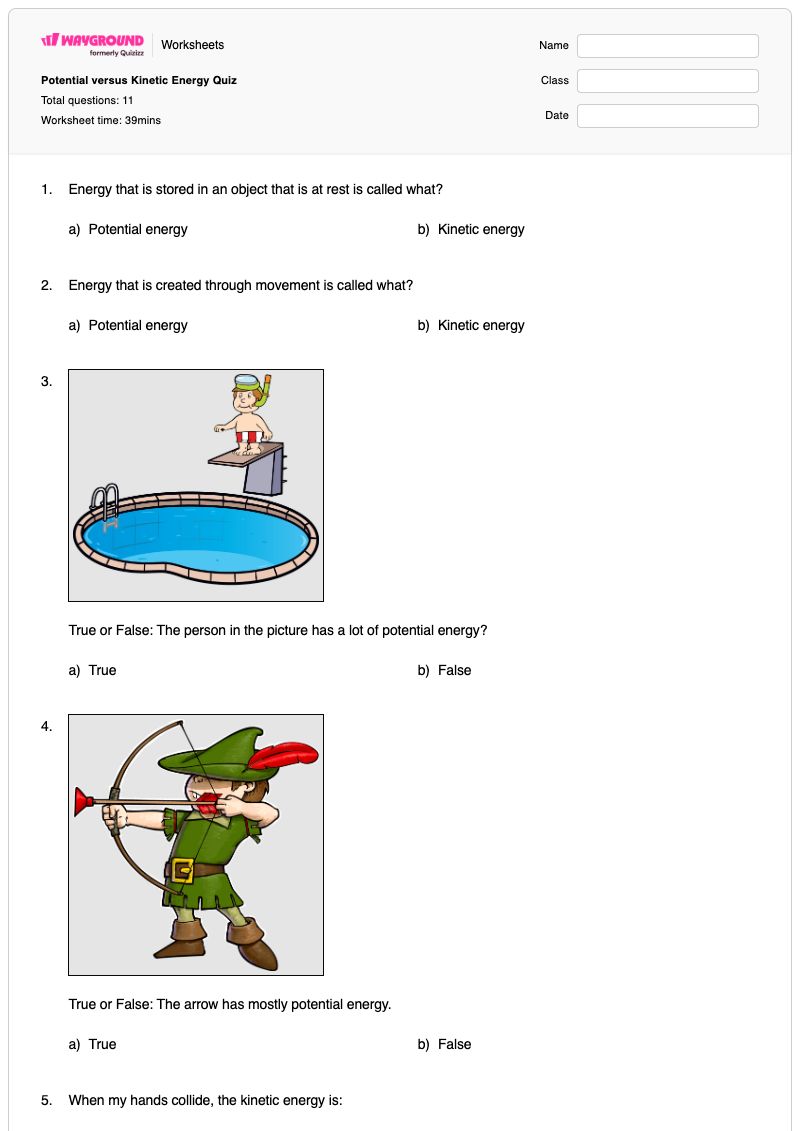
Potential versus Kinetic Energy Quiz
Total questions: 11
Name
Class
Date
1.
Energy that is stored in an object that is at rest is called what?
a)
Potential energy
b)
Kinetic energy
2.
Energy that is created through movement is called what?
a)
Potential energy
b)
Kinetic energy
3.
True or False: The person in the picture has a lot of potential energy?
a)
True
b)
False
4.
True or False: The arrow has mostly potential energy.
a)
True
b)
False
5.
When my hands collide, the kinetic energy is:
a)
transferred to another person
b)
converted into potential energy
c)
transferred to my ear
d)
converted into sound energy
6.
I have the most potential energy if I am:
a)
5 feet high
b)
10 feet high
c)
15 feet high
d)
20 feet high
7.
How can I gain potential energy? (choose the best answer)
a)
Run a mile
b)
Climb a mountain
c)
Go down the stairs
8.
The faster an object moves, the ________ kinetic energy it has.
a)
more
b)
less
c)
none of the above
d)
all of the above
9.
Which is the best example that something has kinetic energy?
a)
A car parked on a steep hill
b)
A tennis ball rolling across the court
c)
A picture hanging on the wall
d)
A piece of coal before it's burned
10.
Where would this tossed baseball have the least amount of kinetic energy?
a)
point W
b)
point X
c)
point y
d)
point z
11.
Explain what happens to the potential energy of a rock as it falls off the side of a cliff.
a)
The kinetic energy decreases as the potential energy increases.
b)
The kinetic energy decreases as the potential energy decreases.
c)
The potential energy decreases as the kinetic energy increases.
d)
The potential energy decreases as the kinetic energy decreases.
Answer Key
Potential versus Kinetic Energy Quiz
Total questions: 11
1.
a)
Potential energy
2.
b)
Kinetic energy
3.
a) True
4.
a) True
5.
d) converted into sound energy
6.
d) 20 feet high
7.
b)
Climb a mountain
8.
a) more
9.
b)
A tennis ball rolling across the court
10.
b)
point X
11.
c) The potential energy decreases as the kinetic energy increases.
140 %
Browse by subjects
Browse by grades
Browse by format
FAQs
What does the Potential versus Kinetic Energy Quiz help Grade 4 students learn?
This 11-question multiple-choice worksheet helps students distinguish potential energy stored in an object at rest from kinetic energy associated with movement. It also asks students to compare potential energy at different heights, relate faster movement to greater kinetic energy, identify real-world examples, and track energy changes during a collision and a falling rock.
How can I use this worksheet to teach potential and kinetic energy?
Introduce the two terms with examples of an elevated or stationary object and a moving object, then have students explain which type of energy each example represents. As students complete the multiple-choice items, pause to discuss why height affects potential energy, why speed affects kinetic energy, and how the worksheet’s collision and falling-rock questions show energy changing from one form to another.
What mistakes should I watch for when students complete this energy worksheet?
Students may reverse the definitions by labeling stored energy as kinetic or movement-related energy as potential. They may also overlook that greater height means more potential energy, that greater speed means more kinetic energy, or that the hand-collision item describes kinetic energy being converted into sound energy. For the falling-rock question, check that they recognize potential energy decreases while kinetic energy increases.
How do I assign and grade the Potential versus Kinetic Energy Quiz?
The worksheet is available as a printable PDF and as a digital quiz on Wayground, and it includes a complete answer key for all 11 multiple-choice questions. For printable submissions, scan student work with the Wayground for Teachers app to streamline grading. The printable format can also support schools that are reducing screen time.
How can I differentiate this potential and kinetic energy worksheet for my students?
In the worksheet’s Advanced Settings, adjust font spacing or choose a larger font size to make the 11 multiple-choice items easier to read. You can also enable a dyslexia-friendly font or translate the worksheet into another language while keeping its energy examples and answer choices intact.
Where can I find more free worksheets from Wayground?
Wayground offers a broad collection of free printable worksheets and practice problems across subjects, including downloadable PDFs and answer keys to support essential skills and concepts. Browse more resources at https://wayground.com/en-us/worksheets.


 Worksheets


