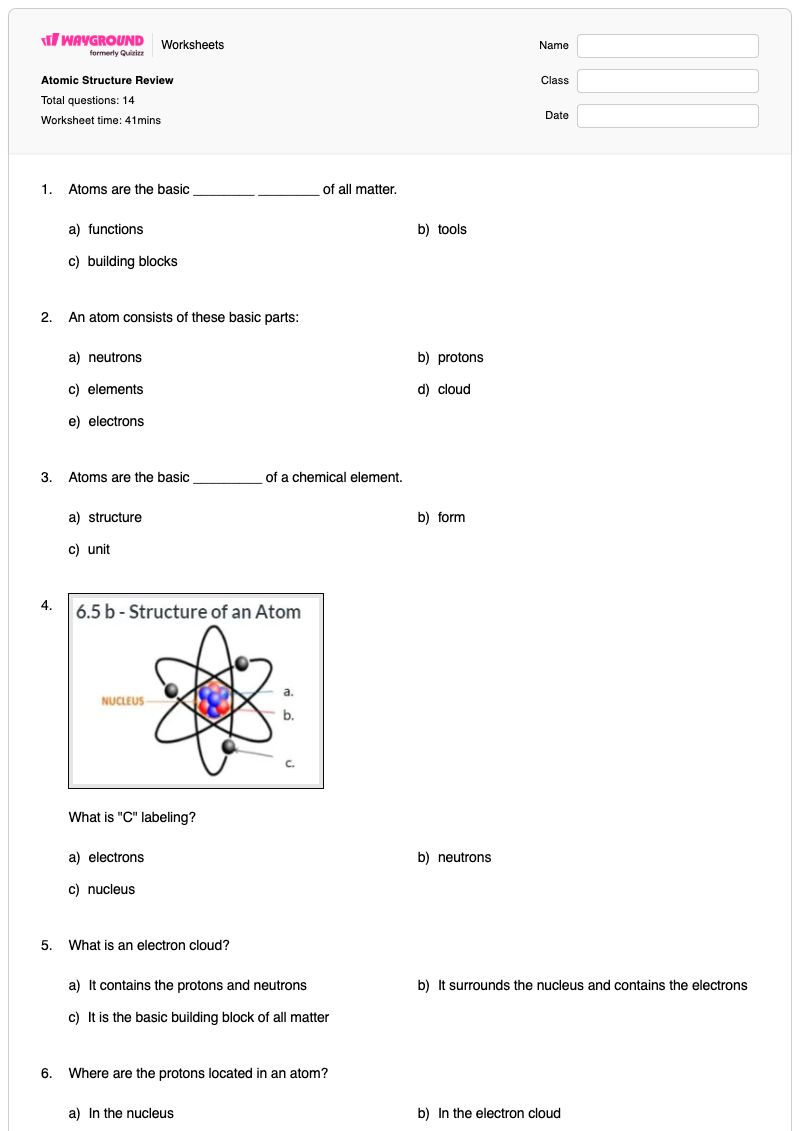
Atomic Structure Review is a Grade 6 science worksheet that builds foundational understanding of atoms and their parts. Students answer 13 multiple-choice questions and one multiple-select question about atoms as the building blocks of matter, the nucleus, electron cloud, protons, neutrons, and electrons. The worksheet also checks understanding of particle charges, atomic number, neutral atoms, and the capacity of the first electron shell.
This free printable worksheet helps students connect atomic structure vocabulary with basic scientific relationships. They identify the particles in an atom, locate protons and electrons, distinguish positive, negative, and neutral charges, and determine why an atom has no net charge when its protons and electrons are equal. It is suitable for Grade 6 science review, independent practice, or a quick formative assessment, and it includes a complete answer key for efficient checking.
Worksheet settings
Font size
S
M
L
XL
Worksheets
Atomic Structure Review
Total questions: 14
Name
Class
Date
1.
Atoms are the basic ________ ________ of all matter.
a)
functions
b)
tools
c)
building blocks
2.
An atom consists of these basic parts:
a)
neutrons
b)
protons
c)
elements
d)
cloud
e)
electrons
3.
Atoms are the basic _________ of a chemical element.
a)
structure
b)
form
c)
unit
4.
What is "C" labeling?
a)
electrons
b)
neutrons
c)
nucleus
5.
What is an electron cloud?
a)
It contains the protons and neutrons
b)
It surrounds the nucleus and contains the electrons
c)
It is the basic building block of all matter
6.
Where are the protons located in an atom?
a)
In the nucleus
b)
In the electron cloud
c)
In the empty space
7.
What is the charge of an electron?
a)
Neutral
b)
Postive
c)
Negative
8.
What is the charge of a neutron?
a)
Positive
b)
Neutral
c)
Negative
9.
What is the charge of a proton?
a)
Positive
b)
Neutral
c)
Negative
10.
No two elements are exactly the same. True or False?
a)
True
b)
False
11.
For an atom to be neutral (no charge), it must have an equal number of _____ and ______.
a)
protons and neutrons
b)
protons, neutrons, and electrons
c)
protons and electrons
12.
An atom's atomic number comes from its number of ________.
a)
electrons
b)
protons
c)
neutrons
13.
When an atom has an equal number of protons and electrons, it is considered __________.
a)
neutral
b)
ion
c)
charged
14.
The first ring or shell of the electron cloud can hold a total of how many electrons?
a)
unlimited number
b)
2
c)
1
Answer Key
Atomic Structure Review
Total questions: 14
1.
c)
building blocks
2.
e)
electrons
, a)
neutrons
, b)
protons
3.
c)
unit
4.
a)
electrons
5.
b)
It surrounds the nucleus and contains the electrons
6.
a)
In the nucleus
7.
c)
Negative
8.
b)
Neutral
9.
a)
Positive
10.
a)
True
11.
c)
protons and electrons
12.
b)
protons
13.
a)
neutral
14.
b)
2
140 %
Browse by subjects
Browse by grades
Browse by format
FAQs
What does the Atomic Structure Review worksheet cover?
This Grade 6 science worksheet uses 13 multiple-choice questions and one multiple-select question to assess atomic structure. Students identify protons, neutrons, and electrons; distinguish the nucleus from the electron cloud; match each particle with its charge; and apply relationships involving neutral atoms, atomic number, and the first shell’s capacity of two electrons.
How can I use this worksheet to teach atomic structure?
Introduce an atom model by having students locate the nucleus and electron cloud, then connect each particle to its charge and location. Use the worksheet’s multiple-choice items for guided discussion, asking students to explain why protons belong in the nucleus and why equal numbers of protons and electrons make an atom neutral. Review the multiple-select item separately so students practice identifying all three basic particles rather than choosing only one.
What mistakes should I watch for when students complete this atomic structure worksheet?
Students may confuse the electron cloud with the nucleus, assign a charge of positive or negative to a neutron, or select neutrons instead of protons when identifying an atom’s atomic number. Watch for students who think neutrality requires equal protons and neutrons rather than equal protons and electrons. On the multiple-select question, some students may omit one of the three particles or incorrectly include an element or cloud as a basic part of an atom.
How do I assign and grade the Atomic Structure Review worksheet?
On Wayground, this worksheet is available as a printable PDF and as a digital quiz, and it includes a complete answer key for all 14 questions. You can grade printable submissions by scanning student work with the Wayground for Teachers app, or use the digital version for online responses and review.
How can I differentiate this atomic structure worksheet for my students?
Under the worksheet’s Advanced Settings, adjust font spacing or choose a larger font size to make the atomic-structure questions and answer choices easier to read. You can also enable a dyslexia-friendly font or translate the worksheet into another language, while keeping the multiple-choice and multiple-select format intact.
Where can I find more worksheets like this on Wayground?
Wayground offers a comprehensive collection of free printable worksheets and practice problems across subjects, with downloadable PDFs and answer keys to help students master essential skills and concepts. Browse more resources at https://wayground.com/en-us/worksheets.

 Worksheets