

Wayground
Supply and Demand Practice - Printable Social studies Worksheets 12th Grade - Wayground

Supply and Demand Practice

Amy Ricardo

Created by Amy Ricardo

22 questions

12th Grade

Social studies

Updated Sep 2026

Supply and Demand Practice is a free printable Grade 12 social studies worksheet that builds students’ ability to apply the laws of supply and demand. Across 22 items, students answer 15 multiple-choice questions, complete four fill-in-the-blank statements, select multiple correct responses in two questions, and complete one drawing task. The questions focus on how price affects quantity supplied and demanded, distinguishing movement along a curve from a curve shift, and identifying factors that change supply or demand. Students also practise applying these relationships to substitutes, complements, shortages, surpluses, equilibrium price, and producer responses to market conditions. Examples involving popular goods and changing resource costs require students to connect real-world changes with increases or decreases in supply and demand. This worksheet works for guided instruction, independent practice, or a formative check of students’ ability to interpret core market relationships. It includes a complete answer key for efficient review and grading.

Worksheet settings

Font size

S
M
L
XL
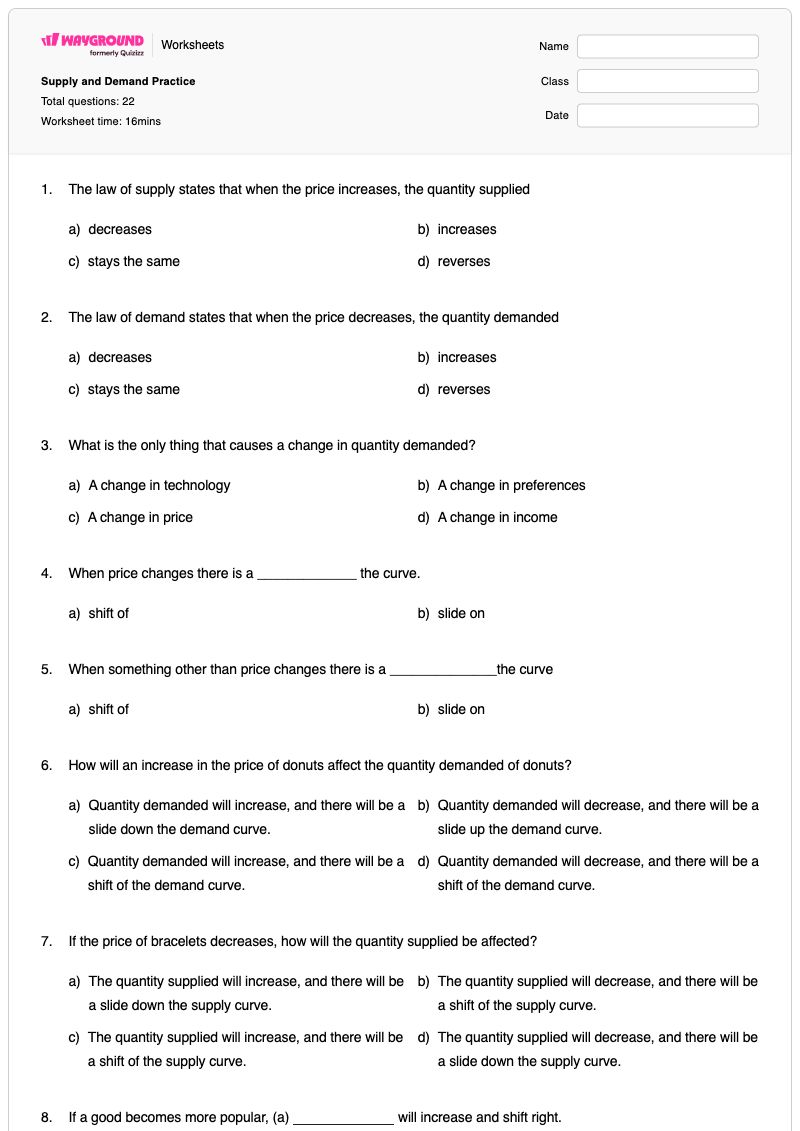
WaygroundWorksheets

Supply and Demand Practice

Total questions: 22

Name
Class
Date
1.

The law of supply states that when the price increases, the quantity supplied

a)

decreases

b)

increases

c)

stays the same

d)

reverses

2.

The law of demand states that when the price decreases, the quantity demanded

a)

decreases

b)

increases

c)

stays the same

d)

reverses

3.

What is the only thing that causes a change in quantity demanded?

a)

A change in technology

b)

A change in preferences

c)

A change in price

d)

A change in income

4.

When price changes there is a _____________ the curve.

a)

shift of

b)

slide on

5.

When something other than price changes there is a ______________the curve

a)

shift of

b)

slide on

6.

How will an increase in the price of donuts affect the quantity demanded of donuts?

a)

Quantity demanded will increase, and there will be a slide down the demand curve.

b)

Quantity demanded will decrease, and there will be a slide up the demand curve.

c)

Quantity demanded will increase, and there will be a shift of the demand curve.

d)

Quantity demanded will decrease, and there will be a shift of the demand curve.

7.

If the price of bracelets decreases, how will the quantity supplied be affected?

a)

The quantity supplied will increase, and there will be a slide down the supply curve.

b)

The quantity supplied will decrease, and there will be a shift of the supply curve.

c)

The quantity supplied will increase, and there will be a shift of the supply curve.

d)

The quantity supplied will decrease, and there will be a slide down the supply curve.

8.

If a good becomes more popular, (a)   will increase and shift right.

9.

If the cost of a resource used to make a good increases, (a)   will decrease and shift left.

10.

What are substitutes?

a)

Goods that are bought together

b)

Goods that can be used in place of one another

c)

Goods that are in higher demand when incomes rise

d)

Goods that are in higher demand when incomes fall

11.

What are complements?

a)

Goods that are bought together

b)

Goods that can be used in place of one another

c)

Goods that are in higher demand when incomes rise

d)

Goods that are in higher demand when incomes fall

12.

A shortage occurs when:

a)

Quantity demanded is more than quantity supplied.

b)

Quantity demanded is less than quantity supplied.

c)

Price is higher than equilibrium price.

d)

Price is lower than equilibrium price.

13.

A surplus occurs when:

a)

Quantity demanded is more than quantity supplied.

b)

Quantity demanded is less than quantity supplied.

c)

Price is higher than equilibrium price.

d)

Price is lower than equilibrium price.

14.

When there is a shortage, producers will:

a)

increase price

b)

decrease price

c)

leave the price the same

15.

When there is a surplus, producers will:

a)

increase price

b)

decrease price

c)

leave the price the same

16.
In the Victoria Housing Market, will a surplus or shortage occur at $1000?

In the Victoria Housing Market, will a surplus or shortage occur at $1000?

a)

Shortage

b)

Surplus

17.
In the Victoria Housing Market, will a surplus or shortage occur at $400?

In the Victoria Housing Market, will a surplus or shortage occur at $400?

a)

Shortage

b)

Surplus

18.
In the Victoria Housing Market the equilibrium price is .

In the Victoria Housing Market the equilibrium price is (a)   .

19.
In the Victoria Housing Market, the equilibrium quantity is rental units.

In the Victoria Housing Market, the equilibrium quantity is (a)   rental units.

20.

Scenario: A lot of new people move to Victoria.

Decide which curve will shift and draw the shift and mark the new equilibrium with dotted lines.

Scenario: A lot of new people move to Victoria. Decide which curve will shift and draw the shift and mark the new…
21.
If the demand for housing increases and shifts to the right, the equilibrium price will:

If the demand for housing increases and shifts to the right, the equilibrium price will:

a)

increase

b)

decrease

22.
If the demand for housing increases and shifts to the right, the equilibrium quantity will:

If the demand for housing increases and shifts to the right, the equilibrium quantity will:

a)

increase

b)

decrease

WaygroundAnswer Key

Supply and Demand Practice

Total questions: 22

1.
b)

increases

2.
b)

increases

3.
c)

A change in price

4.
b)

slide on

5.
a)

shift of

6.
b)

Quantity demanded will decrease, and there will be a slide up the demand curve.

7.
d)

The quantity supplied will decrease, and there will be a slide down the supply curve.

8.
demand
9.
supply
10.
b)

Goods that can be used in place of one another

11.
a)

Goods that are bought together

12.
a)

Quantity demanded is more than quantity supplied.

, d)

Price is lower than equilibrium price.

13.
b)

Quantity demanded is less than quantity supplied.

, c)

Price is higher than equilibrium price.

14.
a)

increase price

15.
b)

decrease price

16.
b)

Surplus

17.
a)

Shortage

18.
$600
19.
15
20.
n/a
21.
a)

increase

22.
a)

increase

FAQs

What does the Supply and Demand Practice worksheet cover?

This Grade 12 worksheet uses multiple-choice, fill-in-the-blank, multiple-select, and drawing items to practise applying the laws of supply and demand. Students distinguish a slide along a curve caused by a price change from a shift caused by another factor, then apply those ideas to substitutes, complements, shortages, surpluses, and producer price responses.

How can I use this worksheet to teach supply and demand?

Introduce the law of supply and the law of demand first, then have students explain why a price change produces movement along a curve rather than a shift. Use the fill-in-the-blank items on popularity and resource costs to connect nonprice factors to demand and supply shifts, and discuss the multiple-select shortage and surplus items before students complete the worksheet independently.

What mistakes should I watch for when students complete this supply and demand worksheet?

Watch for students confusing a change in quantity demanded or supplied with a change in demand or supply. Common errors include selecting a curve shift when price changes, reversing the effects of popularity and resource costs, confusing substitutes with complements, or identifying a shortage and surplus without checking whether quantity demanded is greater or less than quantity supplied.

How do I assign and grade this supply and demand worksheet?

The worksheet is available as a printable PDF and as a digital quiz on Wayground, and it includes a complete answer key for the 15 multiple-choice, four fill-in-the-blank, two multiple-select, and one drawing item. For printable submissions, you can scan student work with the Wayground for Teachers app to support grading.

How can I differentiate this supply and demand worksheet for my students?

Use the worksheet’s Advanced Settings to adjust font spacing and font size for the multiple-choice, fill-in-the-blank, multiple-select, and drawing items. You can also enable a dyslexia-friendly font or translate the worksheet into another language, helping students access the supply-and-demand vocabulary and directions.

Where can I find more worksheets like this on Wayground?

Wayground offers a comprehensive collection of free printable worksheets and practice problems across subjects, with downloadable PDFs and answer keys to help students master essential skills and concepts. Browse more resources at https://wayground.com/en-us/worksheets.