

Wayground
Bohr and Lewis Dot model - Printable Science Worksheets grade 9 - Wayground

Bohr and Lewis Dot model

Samantha Gale

Created by Samantha Gale

18 questions

9th Grade

Science

Updated Oct 2026

Bohr and Lewis Dot model is a Grade 9 science worksheet that builds foundational knowledge of atomic models through 18 multiple-choice questions. Students identify what Bohr models and Lewis Dot structures represent, distinguish energy levels from the valence shell, recall electron capacities for the first two energy levels, and recognize the roles of electrons, the nucleus, and the periodic table. The worksheet also asks students to apply these ideas to specific examples, including determining the number of Lewis dots for helium and the number of valence electrons in phosphorus. These questions help students connect periodic-table organization to atomic structure and prepare for later work with chemical bonding and electron behavior. This free printable worksheet includes a complete answer key, making it useful for Grade 9 science review, independent practice, or a quick check of students’ understanding of Bohr and Lewis representations.

Worksheet settings

Font size

S
M
L
XL
WaygroundWorksheets

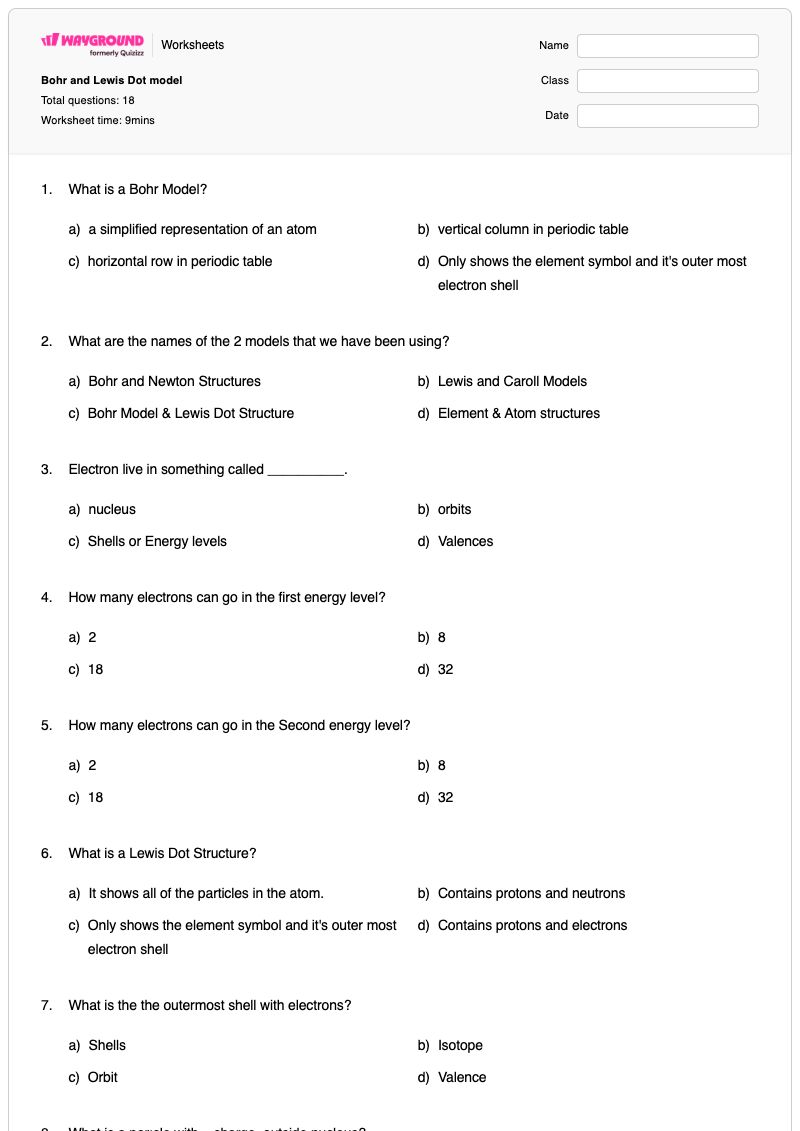
Bohr and Lewis Dot model

Total questions: 18

Name
Class
Date
1.

What is a Bohr Model?

a)

a simplified representation of an atom

b)

vertical column in periodic table

c)

horizontal row in periodic table

d)

Only shows the element symbol and it's outer most electron shell

2.

What are the names of the 2 models that we have been using?

a)

Bohr and Newton Structures

b)

Lewis and Caroll Models

c)

Bohr Model & Lewis Dot Structure

d)

Element & Atom structures

3.

Electron live in something called __________.

a)

nucleus

b)

orbits

c)

Shells or Energy levels

d)

Valences

4.

How many electrons can go in the first energy level?

a)

2

b)

8

c)

18

d)

32

5.

How many electrons can go in the Second energy level?

a)

2

b)

8

c)

18

d)

32

6.

What is a Lewis Dot Structure?

a)

It shows all of the particles in the atom.

b)

Contains protons and neutrons

c)

Only shows the element symbol and it's outer most electron shell

d)

Contains protons and electrons

7.

What is the the outermost shell with electrons?

a)

Shells

b)

Isotope

c)

Orbit

d)

Valence

8.

What is a par;cle with – charge, outside nucleus?

a)

proton

b)

neutron

c)

quark

d)

electron

9.

What is the chart called where all the elements are organized?

a)

Periodic Table

b)

Valence Chart

c)

Bohr Chart

d)

Lewis Chart

10.

What is the drawing of an atom that only has the symbol and the valence electrons?

a)

Lewis Dot Diagram

b)

Bohr Diagram

c)

Thompson Diagram

d)

Dalton Diagram

11.

Each column of the Periodic Table are known by this number

a)

Period

b)

Group

c)

Family

d)

Transition Metals

12.
What's a valence electron?
a)
electrons in the second energy level
b)
electrons in the outermost energy level
c)
the atomic number
d)
electrons in the first level
13.
How many dots would a Lewis Dot structure of Helium have?
a)
1
b)
2
c)
8
d)
0
14.
How many valence electrons are in Phosphorus?
a)
15
b)
4
c)
5
d)
31
15.
The majority of an atom's mass exists where?
a)
In the nucleus
b)
In the electron cloud
c)
In the space between the nucleus and the electrons
d)
In the neutrons
16.
Is this a correct dot diagram for fluorine (F)

Is this a correct dot diagram for fluorine (F)

a)

Yes

b)

No

17.
Is this a correct dot diagram for magnesium (Mg)

Is this a correct dot diagram for magnesium (Mg)

a)

Yes

b)

No

18.
How many electrons should Nitrogen have around its Lewis dot model?
a)
1
b)
3
c)
4
d)
5
WaygroundAnswer Key

Bohr and Lewis Dot model

Total questions: 18

1.
a)

a simplified representation of an atom

2.
c)

Bohr Model & Lewis Dot Structure

3.
c)

Shells or Energy levels

4.
a)

2

5.
b)

8

6.
c)

Only shows the element symbol and it's outer most electron shell

7.
d)

Valence

8.
d)

electron

9.
a)

Periodic Table

10.
a)

Lewis Dot Diagram

11.
b)

Group

12.
b) electrons in the outermost energy level
13.
b) 2
14.
c) 5
15.
a) In the nucleus
16.
a)

Yes

17.
a)

Yes

18.
d) 5

FAQs

What does the Bohr and Lewis Dot model worksheet cover?

This Grade 9 science worksheet uses 18 multiple-choice questions to assess how students identify and distinguish Bohr models from Lewis Dot structures. It also checks understanding of electron shells or energy levels, first- and second-level electron capacities, valence electrons, periodic-table groups, and Lewis Dot examples such as helium and phosphorus.

How can I use this worksheet to teach Bohr models and Lewis Dot structures?

Introduce the worksheet by comparing what each model displays: the Bohr model represents an atom using energy levels, while a Lewis Dot structure shows the element symbol and its valence electrons. After students complete the multiple-choice items, have them explain why helium has two Lewis dots and why phosphorus has five valence electrons, using the periodic table to support their reasoning.

What mistakes should I watch for on this Bohr and Lewis Dot model worksheet?

Watch for students confusing the Bohr model with the Lewis Dot structure, especially by choosing an answer that describes only the outermost electron shell for both models. Students may also confuse shells or energy levels with the valence shell, mistake a group for a period on the periodic table, or select phosphorus’s atomic number instead of its five valence electrons.

How do I assign and grade this Bohr and Lewis Dot model worksheet?

The worksheet is available as a printable PDF and as a digital quiz on Wayground, and it includes a complete answer key for all 18 multiple-choice questions. Printable submissions can be graded by scanning student work with the Wayground for Teachers app, while the digital quiz can be assigned for online response collection and grading.

How can I differentiate this Bohr and Lewis Dot model worksheet for my students?

Use the worksheet’s Advanced Settings to adjust font spacing or increase the font size so the 18 multiple-choice questions and answer options are easier to read. You can also enable a dyslexia-friendly font or translate the worksheet into another language when those options support access to the atomic-structure vocabulary.

Where can I find more worksheets like this on Wayground?

Wayground offers a broad collection of free printable worksheets and practice problems across subjects, with downloadable PDFs and answer keys to support essential skills and concepts. Browse more resources at https://wayground.com/en-us/worksheets.