

Wayground
Geometry Chapter 2 Review - Printable Math Worksheets grade 10 - Wayground

Geometry Chapter 2 Review

Kimberly Brightmore

Created by Kimberly Brightmore

17 questions

10th Grade

Math

Updated Oct 2025

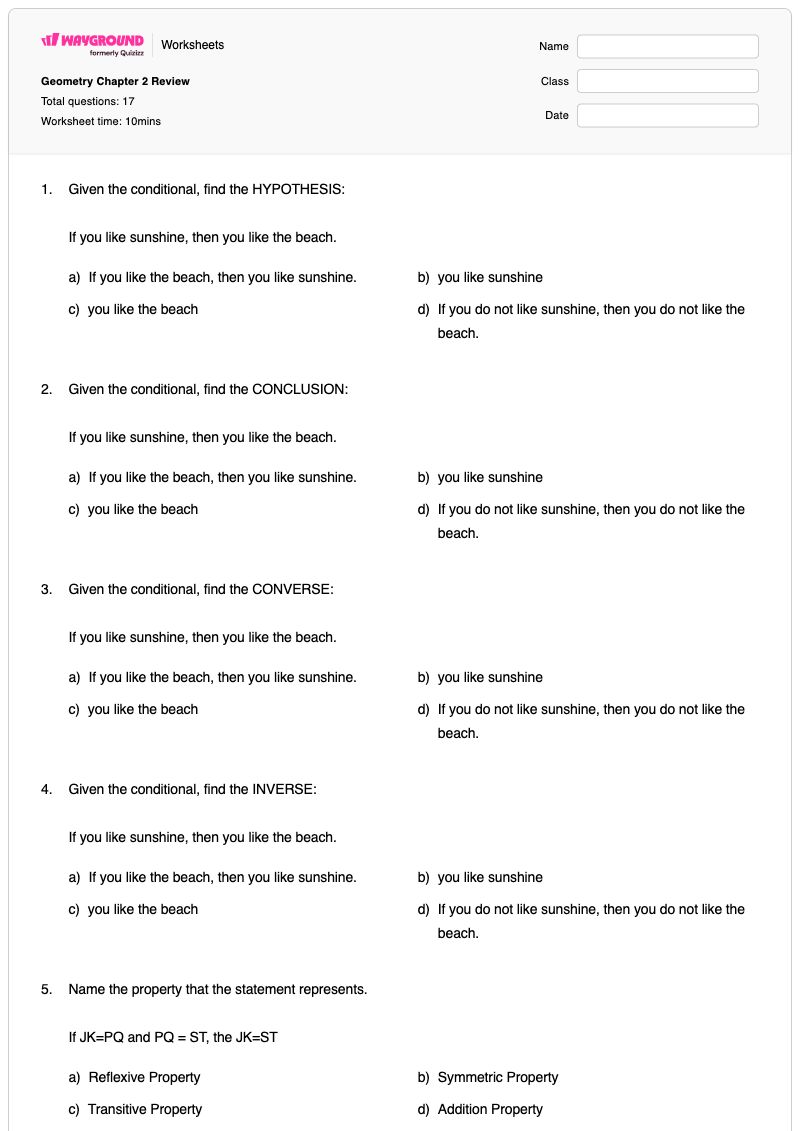
Geometry Chapter 2 Review is a Grade 10 mathematics worksheet that strengthens students’ understanding of conditional statements and algebraic properties of equality. Across 17 questions—14 multiple-choice and 3 fill-in-the-blank items—students identify hypotheses and conclusions, construct converses, inverses, contrapositives, and biconditionals, and name properties such as transitive, symmetric, addition, subtraction, reflexive, and multiplication. This free printable worksheet gives students focused practice recognizing how statements and equations change while preserving their mathematical meaning. The fill-in-the-blank items also require students to complete symbolic statements, including reflexive and multiplication-property examples, rather than only selecting answers. It is designed for Grade 10 geometry review, independent practice, homework, or a chapter check, and includes a complete answer key for efficient teacher review and grading.

Worksheet settings

Font size

S
M
L
XL
WaygroundWorksheets

Geometry Chapter 2 Review

Total questions: 17

Name
Class
Date
1.

Given the conditional, find the HYPOTHESIS:


If you like sunshine, then you like the beach.

a)

If you like the beach, then you like sunshine.

b)

you like sunshine

c)

you like the beach

d)

If you do not like sunshine, then you do not like the beach.

2.

Given the conditional, find the CONCLUSION:


If you like sunshine, then you like the beach.

a)

If you like the beach, then you like sunshine.

b)

you like sunshine

c)

you like the beach

d)

If you do not like sunshine, then you do not like the beach.

3.

Given the conditional, find the CONVERSE:


If you like sunshine, then you like the beach.

a)

If you like the beach, then you like sunshine.

b)

you like sunshine

c)

you like the beach

d)

If you do not like sunshine, then you do not like the beach.

4.

Given the conditional, find the INVERSE:


If you like sunshine, then you like the beach.

a)

If you like the beach, then you like sunshine.

b)

you like sunshine

c)

you like the beach

d)

If you do not like sunshine, then you do not like the beach.

5.

Name the property that the statement represents.


If JK=PQ and PQ = ST, the JK=ST

a)

Reflexive Property

b)

Symmetric Property

c)

Transitive Property

d)

Addition Property

e)

Subtraction Property

6.

Name the property that the statement represents.


If XY=AB, then XY+CD=AB+CD.

a)

Reflexive Property

b)

Symmetric Property

c)

Transitive Property

d)

Addition Property

e)

Subtraction Property

7.

Name the property that the statement represents.  If

 m∠P=m∠Qm\angle P=m\angle Q , then  m∠Q=m∠Pm\angle Q=m\angle P 

a)

Reflexive Property

b)

Symmetric Property

c)

Transitive Property

d)

Addition Property

e)

Subtraction Property

8.

Given the conditional, find the INVERSE:


If x+1 is even, then x is odd.

a)

If x is odd, then x+1 is even.

b)

x+1 is even iff x is odd.

c)

If x is not odd, then x+1 is not even.

d)

If x+1 is not even, then x is not odd.

9.

Given the conditional, find the CONTRAPOSITIVE:


If x+1 is even, then x is odd.

a)

If x is odd, then x+1 is even.

b)

x+1 is even iff x is odd.

c)

If x is not odd, then x+1 is not even.

d)

If x+1 is not even, then x is not odd.

10.

Given the conditional, find the BICONDITIONAL:


If x+1 is even, then x is odd.

a)

If x is odd, then x+1 is even.

b)

x+1 is even iff x is odd.

c)

If x is not odd, then x+1 is not even.

d)

If x+1 is not even, then x is not odd.

11.

Given the conditional, find the CONVERSE:


If x+1 is even, then x is odd.

a)

If x is odd, then x+1 is even.

b)

x+1 is even iff x is odd.

c)

If x is not odd, then x+1 is not even.

d)

If x+1 is not even, then x is not odd.

12.

Use the property to complete the statement. Symmetric Property: If  m∠DEF=m∠MJCm\angle DEF=m\angle MJC  , then (a)   .

Use only letters. No spaces.

13.

Use the property to complete the statement.

Reflexive Property: ST = (a)   .

14.

Use the property to complete the statement.

Multiplication Property: If AB=10, then 5(AB) = (a)   .

15.

Name the property that the statement represents.  If

 AX+BY=RS+BYAX+BY=RS+BY , then  AX=RSAX=RS 

a)

Reflexive Property

b)

Symmetric Property

c)

Transitive Property

d)

Addition Property

e)

Subtraction Property

16.

Name the property that the statement represents.


If y=s and y=x+z, then s=x+z.

a)

Reflexive Property

b)

Substitution Property

c)

Transitive Property

d)

Addition Property

e)

Subtraction Property

17.

Name the property that the statement represents.


If MC=HS, then HS=MC.

a)

Reflexive Property

b)

Substitution Property

c)

Transitive Property

d)

Addition Property

e)

Symmetric Property

WaygroundAnswer Key

Geometry Chapter 2 Review

Total questions: 17

1.
b)

you like sunshine

2.
c)

you like the beach

3.
a)

If you like the beach, then you like sunshine.

4.
d)

If you do not like sunshine, then you do not like the beach.

5.
c)

Transitive Property

6.
d)

Addition Property

7.
b)

Symmetric Property

8.
d)

If x+1 is not even, then x is not odd.

9.
c)

If x is not odd, then x+1 is not even.

10.
b)

x+1 is even iff x is odd.

11.
a)

If x is odd, then x+1 is even.

12.
MJC = DEF, mMJC=mDEF, m
13.
ST, st, S T
14.
50
15.
e)

Subtraction Property

16.
b)

Substitution Property

17.
e)

Symmetric Property

FAQs

What does the Geometry Chapter 2 Review worksheet cover?

This Grade 10 math worksheet uses 14 multiple-choice and 3 fill-in-the-blank questions to practice identifying hypotheses, conclusions, converses, inverses, contrapositives, and biconditionals. Students also classify and complete statements using properties of equality, including transitive, symmetric, addition, subtraction, reflexive, and multiplication properties.

How can I use this worksheet to teach conditional statements and properties of equality?

Introduce the conditional-statement items by having students mark the “if” clause as the hypothesis and the “then” clause as the conclusion, then model how switching or negating the clauses creates related statements. After that, use the property-identification questions to compare what changes in each equation, and finish with the fill-in-the-blank items so students apply the properties in symbolic form.

What mistakes should I watch for when students complete this geometry review?

Students may confuse the converse with the inverse or contrapositive, especially in the items involving “x+1 is even” and “x is odd.” They may also select transitive, symmetric, addition, or subtraction property based on surface appearance instead of the operation performed, and may enter incomplete notation in the fill-in-the-blank questions, such as omitting the repeated segment or angle expression.

How do I assign and grade the Geometry Chapter 2 Review worksheet?

The 17-question review is available as a printable PDF and as a digital quiz on Wayground, and it includes a complete answer key. For printable submissions, you can scan student work with the Wayground for Teachers app to support faster grading.

How can I differentiate this worksheet for my students?

Use the worksheet’s Advanced Settings to adjust font spacing or choose a larger font size for the symbolic multiple-choice and fill-in-the-blank items. You can also enable a dyslexia-friendly font or translate the worksheet into another language when that supports access to the conditional-statement and properties-of-equality questions.

Where can I find more worksheets like this on Wayground?

Wayground offers a comprehensive collection of free printable worksheets and practice problems across all subjects, with downloadable PDFs and answer keys to help students master essential skills and concepts. Browse more resources at https://wayground.com/en-us/worksheets.