
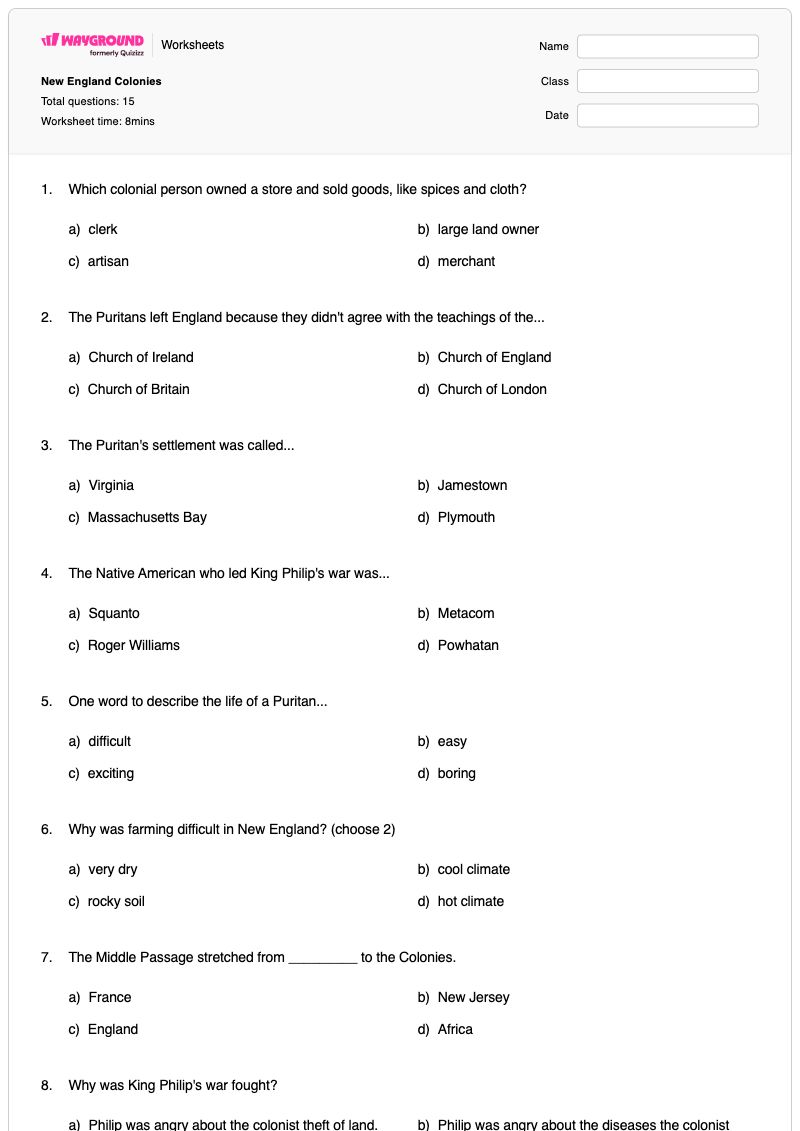

New England Colonies is a Grade 5 social studies worksheet that reviews how geography, religion, government, work, trade, and conflict shaped life in the New England Colonies. Students identify the Puritans’ reasons for leaving England, the Massachusetts Bay settlement, John Winthrop’s goals, the roles of merchants and artisans, and the meaning of self-government. They also examine why farming was difficult, which goods were exported, and how town commons supported colonial communities.
The worksheet uses 12 multiple-choice questions and 3 multiple-select questions, including items about Metacom and King Philip’s War, the Middle Passage, indentured servants, and colonists expelled for challenging Puritan leaders. It is designed for Grade 5 classroom practice, review, or assessment of key New England Colonies vocabulary and historical details. This free printable worksheet includes a complete answer key for efficient checking and feedback.
Worksheet settings
Font size
S
M
L
XL
Worksheets
New England Colonies
Total questions: 15
Name
Class
Date
1.
Which colonial person owned a store and sold goods, like spices and cloth?
a)
clerk
b)
large land owner
c)
artisan
d)
merchant
2.
The Puritans left England because they didn't agree with the teachings of the...
a)
Church of Ireland
b)
Church of England
c)
Church of Britain
d)
Church of London
3.
The Puritan's settlement was called...
a)
Virginia
b)
Jamestown
c)
Massachusetts Bay
d)
Plymouth
4.
The Native American who led King Philip's war was...
a)
Squanto
b)
Metacom
c)
Roger Williams
d)
Powhatan
5.
One word to describe the life of a Puritan...
a)
difficult
b)
easy
c)
exciting
d)
boring
6.
Why was farming difficult in New England? (choose 2)
a)
very dry
b)
cool climate
c)
rocky soil
d)
hot climate
7.
The Middle Passage stretched from _________ to the Colonies.
a)
France
b)
New Jersey
c)
England
d)
Africa
8.
Why was King Philip's war fought?
a)
Philip was angry about the colonist theft of land.
b)
Philip was angry about the diseases the colonist brought with them.
c)
Philip was angry about the way the colonist hunted.
d)
Philip was angry about the way the colonist talked.
9.
John Winthrop wanted his colony to be...
a)
fun and exciting.
b)
a good example of Christian living.
10.
Which are exports of the New England Colonies? (choose all that apply)
a)
animal furs
b)
ships
c)
fruit
d)
whale oil
11.
An indentured servant...
a)
signed a contract to work for 5 years in exchange for passage to the new world.
b)
was taken against their will.
12.
In the New England Colonies, each town created its own laws and the citizens agreed to follow those laws. This is called...
a)
self-care
b)
fair trade
c)
self-government
13.
Towns in New England were centered around the town _____.
a)
common
b)
center
c)
store
d)
place
14.
Skilled workers who made things with their hands were called ______.
a)
merchants
b)
large land owners
c)
artisans
d)
store owners
15.
Choose the two colonists who were expelled for speaking out against Puritan leaders.
a)
Anne Jone
b)
Anne Hutchinson
c)
William Williamson
d)
Roger Williams
Answer Key
New England Colonies
Total questions: 15
1.
d)
merchant
2.
b)
Church of England
3.
c)
Massachusetts Bay
4.
b)
Metacom
5.
a)
difficult
6.
b)
cool climate
, c)
rocky soil
7.
d)
Africa
8.
a)
Philip was angry about the colonist theft of land.
9.
b)
a good example of Christian living.
10.
a)
animal furs
, b)
ships
, d)
whale oil
11.
a)
signed a contract to work for 5 years in exchange for passage to the new world.
12.
c)
self-government
13.
a)
common
14.
c)
artisans
15.
b)
Anne Hutchinson
, d)
Roger Williams
140 %
Browse by subjects
Browse by grades
Browse by format
FAQs
What does the New England Colonies worksheet cover, and how does it help students learn?
This Grade 5 worksheet uses 12 multiple-choice and 3 multiple-select questions to assess specific knowledge about New England colonial life. Students connect the region’s cool climate and rocky soil to difficult farming, identify colonial roles such as merchants and artisans, recognize exports, and review Puritan settlement, self-government, Metacom, King Philip’s War, the Middle Passage, and indentured servants.
How can I use this New England Colonies worksheet to teach the unit?
Use the questions after introducing a timeline and map of the New England Colonies, then pause to discuss why the region’s climate and soil affected farming and trade. Ask students to explain how examples such as town laws, the town common, John Winthrop’s goal, and the roles of Anne Hutchinson and Roger Williams reveal features of colonial society before they complete the multiple-select items independently.
What mistakes should I watch for when students complete this New England Colonies worksheet?
Watch for students confusing Massachusetts Bay with Plymouth, Metacom with other Native American or colonial figures, and merchants with artisans. In the multiple-select questions, students may choose only one reason farming was difficult or overlook one New England export; they should select both cool climate and rocky soil, and identify animal furs, ships, and whale oil.
How do I assign and grade this New England Colonies worksheet?
On Wayground, assign it as a printable PDF or as a digital quiz; both versions include a complete answer key for the 15 questions. Printable submissions can be graded by scanning student work with the Wayground for Teachers app, while the digital quiz supports direct online responses.
How can I differentiate this New England Colonies worksheet for my students?
In the worksheet’s Advanced Settings, adjust font spacing or choose a larger font size to make the multiple-choice and multiple-select items easier to read. You can also enable a dyslexia-friendly font or translate the worksheet text into another language, helping students access the historical vocabulary and question directions.
Where can I find more worksheets like this on Wayground?
Wayground offers a broad collection of free printable worksheets and practice problems across subjects, with downloadable PDFs and answer keys to support essential skills and concepts. Browse more resources at https://wayground.com/en-us/worksheets.