
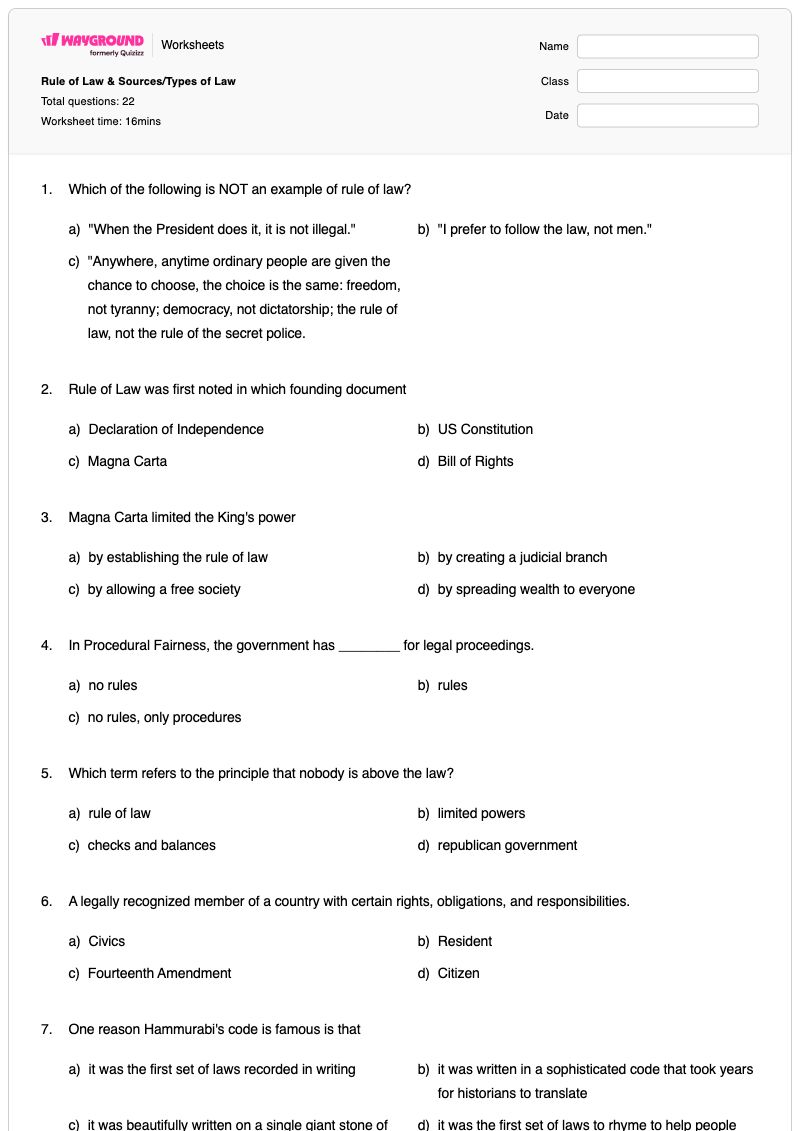

Rule of Law & Sources/Types of Law is a Grade 7–8 social studies worksheet that helps students connect the rule of law to historical documents, civic principles, and legal terminology. Across 22 questions—21 multiple choice and 1 multiple-select—students identify examples and nonexamples of rule of law, explain how the Magna Carta limited a monarch’s power, and recognize the significance of Hammurabi’s Code. They also review citizenship, procedural fairness, and the principle that no person is above the law.
The worksheet further asks students to distinguish legal categories, including case law and constitutional law, and to identify the Constitution as the foundation of U.S. laws and principles. Questions about the Magna Carta, Bill of Rights, and Hammurabi’s Code help students connect historical sources of law with modern civic ideas. This free printable worksheet includes a complete answer key and can support independent practice, review, or an introductory assessment in middle school social studies.
Worksheet settings
Font size
S
M
L
XL
Worksheets
Rule of Law & Sources/Types of Law
Total questions: 22
Name
Class
Date
1.
Which of the following is NOT an example of rule of law?
a)
"When the President does it, it is not illegal."
b)
"I prefer to follow the law, not men."
c)
"Anywhere, anytime ordinary people are given the chance to choose, the choice is the same: freedom, not tyranny; democracy, not dictatorship; the rule of law, not the rule of the secret police.
2.
Rule of Law was first noted in which founding document
a)
Declaration of Independence
b)
US Constitution
c)
Magna Carta
d)
Bill of Rights
3.
Magna Carta limited the King's power
a)
by establishing the rule of law
b)
by creating a judicial branch
c)
by allowing a free society
d)
by spreading wealth to everyone
4.
In Procedural Fairness, the government has ________ for legal proceedings.
a)
no rules
b)
rules
c)
no rules, only procedures
5.
Which term refers to the principle that nobody is above the law?
a)
rule of law
b)
limited powers
c)
checks and balances
d)
republican government
6.
A legally recognized member of a country with certain rights, obligations, and responsibilities.
a)
Civics
b)
Resident
c)
Fourteenth Amendment
d)
Citizen
7.
One reason Hammurabi's code is famous is that
a)
it was the first set of laws recorded in writing
b)
it was written in a sophisticated code that took years for historians to translate
c)
it was beautifully written on a single giant stone of polished basalt
d)
it was the first set of laws to rhyme to help people remember them
8.
Which modern idiom refers to Hammurabi's Code?
a)
An eye for an eye, and a tooth for a tooth
b)
It's raining cats and dogs.
c)
Break a leg!
d)
The wisdom of an old man brings wealth.
9.
What is Hammurabi's Code?
a)
a collection of 282 laws believed to be the first written laws
b)
a group of soldiers and noblemen who lived in ancient Mesopotamia
c)
the ancient idea that a punishment should fit the crime
d)
the punishment for stealing sheep from a nobleman in ancient Mesopotamia
10.
Why was King John forced to sign the Magna Carta?
a)
to increase the power of the monarchy
b)
to end taxation in England
c)
to force the monarchy to give up power
d)
to weaken the power of nobles
11.
The Magna Carta means...
a)
Grand Document
b)
Glorious Constitution
c)
Great Charter
d)
Magnificent Constitution
12.
The Magna Carta is similar to what American document?
a)
The Mayflower Compact
b)
The Declaration of the Rights of Man and Citizen
c)
The Bill of Rights
d)
The Nicene Creed
13.
Which of the following documents embodies the fundamental laws and principles of the United States?
a)
Bill of Rights
b)
Magna Charter
c)
Constitution
d)
Declaration of Independence
14.
law established by the outcome of former cases
a)
case law
b)
civil law
c)
common law
d)
constitutional law
15.
the interpretation and implementation of the U.S. Constitution
a)
case law
b)
civil law
c)
common law
d)
constitutional law
16.
legal precedence based on customs and prior legal decisions; used in civil cases
a)
case law
b)
civil law
c)
common law
d)
constitutional law
17.
law concerned with private relations between members of a community rather than criminal, military, or religious affairs
a)
criminal law
b)
civil law
c)
common law
d)
constitutional law
18.
law that deals with crimes and the punishments associated with those crimes
a)
criminal law
b)
civil law
c)
Magna Carta
d)
Code of Hammurabi
19.
law that deals with the actions and well-being of persons who are not yet adults
a)
criminal law
b)
juvenile law
c)
Magna Carta
d)
Code of Hammurabi
20.
the written law enacted by a legislature, as distinguished from unwritten law or common law
a)
regulation
b)
juvenile law
c)
military law
d)
statutory law
21.
laws that have been developed to meet the needs of the military
a)
regulation
b)
juvenile law
c)
military law
d)
statutory law
22.
a rule an agency of the executive branch makes to enforce a law
a)
regulation
b)
type
c)
source
d)
statutory law
Answer Key
Rule of Law & Sources/Types of Law
Total questions: 22
1.
a) "When the President does it, it is not illegal."
2.
c)
Magna Carta
3.
a)
by establishing the rule of law
4.
b)
rules
5.
a)
rule of law
6.
d) Citizen
7.
a)
it was the first set of laws recorded in writing
8.
a) An eye for an eye, and a tooth for a tooth
9.
a)
a collection of 282 laws believed to be the first written laws
10.
c) to force the monarchy to give up power
11.
c) Great Charter
12.
c) The Bill of Rights
13.
c) Constitution
14.
a)
case law
15.
d)
constitutional law
16.
c)
common law
17.
b)
civil law
18.
a)
criminal law
19.
b)
juvenile law
20.
d)
statutory law
21.
c)
military law
22.
a)
regulation
140 %
Browse by subjects
Browse by grades
Browse by format
FAQs
What does the Rule of Law & Sources/Types of Law worksheet cover?
This Grade 7–8 social studies worksheet uses 21 multiple-choice questions and 1 multiple-select question to assess rule of law, procedural fairness, citizenship, Hammurabi’s Code, the Magna Carta, and U.S. legal documents. Students also classify terms such as case law and constitutional law, building their ability to connect legal concepts with their historical sources and definitions.
How can I use this worksheet to teach the rule of law and sources of law?
Introduce the worksheet by defining rule of law and asking students to explain why no person—including a president—is above the law. Then use the Magna Carta and Hammurabi’s Code questions to build a brief historical sequence before having students distinguish the Constitution, Bill of Rights, case law, and constitutional law. Review the multiple-select procedural-fairness item as a class so students can explain why legal proceedings require rules.
What mistakes should I watch for when students complete this law worksheet?
Students may confuse the Magna Carta with the Constitution or Bill of Rights, overlook that the worksheet identifies the Magna Carta as the earliest founding document connected to the rule of law, or interpret “Great Charter” incorrectly. They may also select “an eye for an eye” without recognizing that it is the idiom linked to Hammurabi’s Code, or confuse case law—law established through former cases—with constitutional law, which concerns interpreting and implementing the U.S. Constitution. Monitor the multiple-select question carefully because its correct response requires identifying rules for legal proceedings.
How do I assign and grade this Rule of Law worksheet?
Wayground provides this worksheet as a printable PDF and as a digital quiz, and it includes a complete answer key for checking all 22 questions. For printable submissions, you can scan student work with the Wayground for Teachers app to support grading and review.
Which historical documents and legal ideas does this worksheet connect?
The worksheet links Hammurabi’s Code and the Magna Carta to the development of written laws and limits on government power. It then connects those ideas to the U.S. Constitution and Bill of Rights while asking students to distinguish related civic terms such as limited powers, citizenship, procedural fairness, case law, and constitutional law.
Where can I find more worksheets like this on Wayground?
Wayground offers a comprehensive collection of free printable worksheets and practice problems across subjects, with downloadable PDFs and answer keys to help students master essential skills and concepts. Browse more resources at https://wayground.com/en-us/worksheets.