

Wayground
What is a Horror Genre? (Assessment) - Printable ELA Worksheets 8th Grade - Wayground

What is a Horror Genre? (Assessment)

Maria Soto

Created by Maria Soto

11 questions

8th Grade

ELA

Updated Nov 2025

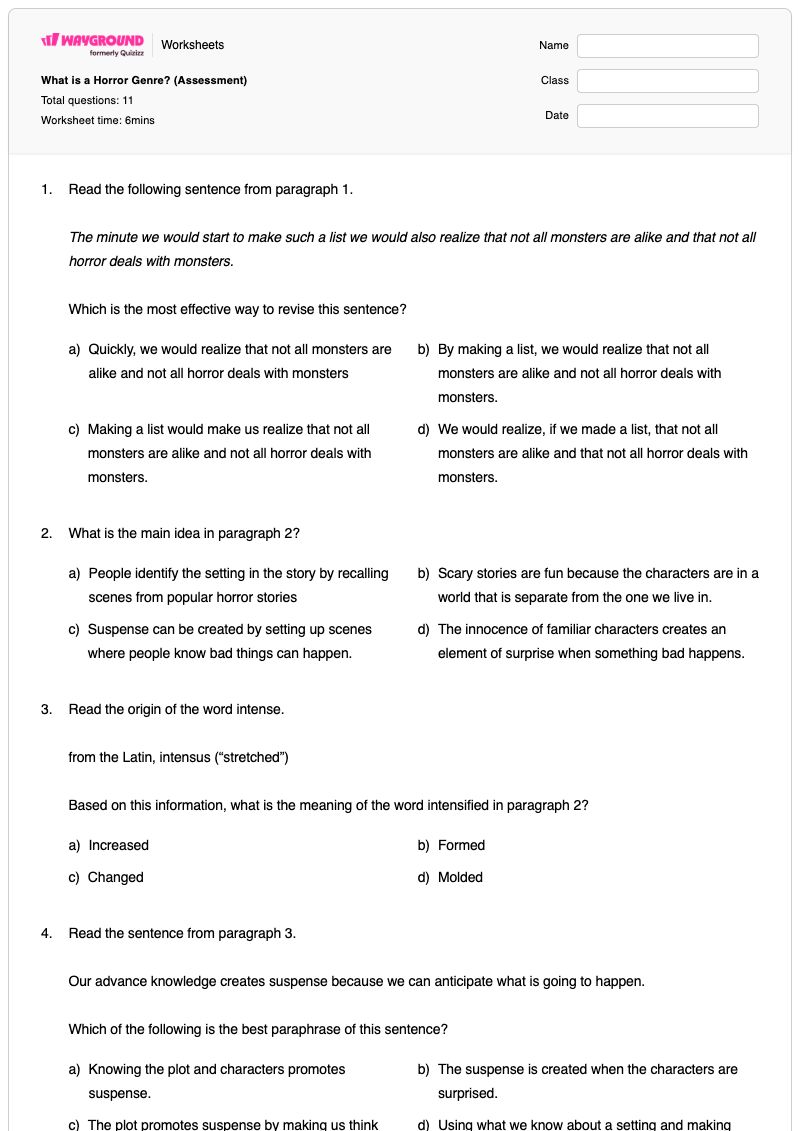
This Grade 8 English assessment uses a reading selection about the horror genre to build close-reading and literary analysis skills. Students answer 11 questions—10 multiple choice and one multiple-select item—about how horror creates suspense, how the source of horror shapes a story, and how themes such as dangerous knowledge develop. The assessment also asks students to identify paragraph main ideas, determine the author’s purpose and viewpoint, interpret a word using its Latin origin, paraphrase a sentence, revise awkward sentences, and trace the order of details. This free printable worksheet is useful for checking whether students can support their understanding of a nonfiction-style discussion of horror with specific ideas from the text. Its varied question formats give teachers evidence of both selected-response comprehension and the ability to identify two supporting details for an author’s claim. An answer key is included for efficient review, independent practice, or end-of-lesson assessment.

Worksheet settings

Font size

S
M
L
XL
WaygroundWorksheets

What is a Horror Genre? (Assessment)

Total questions: 11

Name
Class
Date
1.

Read the following sentence from paragraph 1.


The minute we would start to make such a list we would also realize that not all monsters are alike and that not all horror deals with monsters.


Which is the most effective way to revise this sentence?

a)

Quickly, we would realize that not all monsters are alike and not all horror deals with monsters

b)

By making a list, we would realize that not all monsters are alike and not all horror deals with monsters.

c)

Making a list would make us realize that not all monsters are alike and not all horror deals with monsters.

d)

We would realize, if we made a list, that not all monsters are alike and that not all horror deals with monsters.

2.

What is the main idea in paragraph 2?

a)

People identify the setting in the story by recalling scenes from popular horror stories

b)

Scary stories are fun because the characters are in a world that is separate from the one we live in.

c)

Suspense can be created by setting up scenes where people know bad things can happen.

d)

The innocence of familiar characters creates an element of surprise when something bad happens.

3.

Read the origin of the word intense.


from the Latin, intensus (“stretched”)


Based on this information, what is the meaning of the word intensified in paragraph 2?

a)

Increased

b)

Formed

c)

Changed

d)

Molded

4.

Read the sentence from paragraph 3.


Our advance knowledge creates suspense because we can anticipate what is going to happen.


Which of the following is the best paraphrase of this sentence?

a)

Knowing the plot and characters promotes suspense.

b)

The suspense is created when the characters are surprised.

c)

The plot promotes suspense by making us think about what will happen next.

d)

Using what we know about a setting and making predictions about it creates suspense.

5.

Read the sentences from paragraph 5 in the selection.


An outside force may invade the character and then force the evil out again. The vampire attacks the victim, but then the victim becomes the vampire and attacks others.


Which is the most effective way to revise these sentences?

a)

The first thing is, the outside force gets into the character, then the victim becomes the attacker.

b)

An outside force invades the character to get the evil out first. After the vampire attacks the victim the victim attacks him back.

c)

In the beginning scene the outside force gets the evil to come out followed by the victim being attacked and becoming the attacker

d)

First, an outside force pushes the evil out. Then, the vampire attacks the victim, concluding with the victim becoming the vampire and attacking others.

6.

Which two facts support the author’s claim that horror can be categorized by the source of the horror?

a)

. . . the ghosts turn out to be squirrels in the attic . . .

b)

Some horror comes from inside the characters.

c)

The vampire attacks the victim, but then the victim becomes a vampire and attacks others.

d)

Dr. Frankenstein’s need for knowledge turns him into the kind of person who creates a monster

e)

We are not surprised to find old houses, abandoned castles, damp cellars, or dark forests as important elements in the horror story

7.

What is the main idea of paragraph 6?

a)

There are common themes throughout the horror genre.

b)

Searching for knowledge can lead to bad outcomes in horror stories.

c)

The horror genre concentrates on the conflict between good and evil

d)

Society believes that new knowledge is always good for the horror genre.

8.

The author most likely feels that horror —

a)

is a fun alternative to typical fiction and literature

b)

examines how characters can be altered based on setting and time

c)

uses suspense and gives the audience knowledge that the characters lack

d)

introduces fantastic characters and unusual themes to otherwise ordinary stories

9.

The author most likely wrote this article to —

a)

persuade people to watch or read the horror genre

b)

encourage people to analyze horror plots and how they are created

c)

compare the most famous horror characters in history

d)

provide information about popular horror stories from a long time ago

10.

Which of the following details happened first in the selection?

a)

Horror films and literature can cause the audience to focus more on the story than the actual characters.

b)

Horror fiction often causes the audience to question the characters’ intentions of finding answers.

c)

Horror fiction has many characteristics, one of which is the flow of how the story is told.

d)

The feeling of fear from horror fiction can come from believing that the story could be real.

11.

Which of the following details happened last in the selection?

a)

Horror films and literature can cause the audience to focus more on the story than the actual characters.

b)

Horror fiction often causes the audience to question the characters’ intentions of finding answers.

c)

Horror fiction has many characteristics, one of which is the flow of how the story is told.

d)

The feeling of fear from horror fiction can come from believing that the story could be real.

WaygroundAnswer Key

What is a Horror Genre? (Assessment)

Total questions: 11

1.
d)

We would realize, if we made a list, that not all monsters are alike and that not all horror deals with monsters.

2.
c)

Suspense can be created by setting up scenes where people know bad things can happen.

3.
a)

Increased

4.
d)

Using what we know about a setting and making predictions about it creates suspense.

5.
d)

First, an outside force pushes the evil out. Then, the vampire attacks the victim, concluding with the victim becoming the vampire and attacking others.

6.
c)

The vampire attacks the victim, but then the victim becomes a vampire and attacks others.

, d)

Dr. Frankenstein’s need for knowledge turns him into the kind of person who creates a monster

7.
b)

Searching for knowledge can lead to bad outcomes in horror stories.

8.
c)

uses suspense and gives the audience knowledge that the characters lack

9.
b)

encourage people to analyze horror plots and how they are created

10.
c)

Horror fiction has many characteristics, one of which is the flow of how the story is told.

11.
b)

Horror fiction often causes the audience to question the characters’ intentions of finding answers.

FAQs

What does the “What is a Horror Genre?” assessment help Grade 8 students practice?

This 11-question assessment asks students to analyze how horror stories create suspense, including the use of anticipation, settings, and information the audience knows before the characters do. Its multiple-choice and multiple-select questions also assess main idea, author’s purpose and viewpoint, vocabulary in context, paraphrasing, sentence revision, supporting evidence, and sequencing details from the selection.

How can I use this worksheet to teach students how horror creates suspense?

Have students read the selection first and mark details showing how anticipation or a gap between audience and character knowledge creates suspense. Then use the questions about paragraph main ideas, paraphrasing, and the author’s viewpoint to discuss how those details connect to the article’s explanation of horror. Finish by asking students to justify the two selected details that support categorizing horror by its source.

What mistakes should I watch for when students complete this horror genre assessment?

Students may choose a specific example instead of the main idea of a paragraph, confuse a paraphrase with a sentence that merely repeats one detail, or select only one supporting fact in the multiple-select question. They may also miss that “intensified” means increased from the Latin root information, or reverse the first-and-last detail questions by relying on memory instead of tracing the selection’s sequence.

How do I assign and grade this horror genre worksheet?

The assessment is available as a printable PDF and as a digital quiz on Wayground, and it includes a complete answer key for all 11 questions. For printable submissions, you can grade student work by scanning it with the Wayground for Teachers app.

How can I differentiate this horror genre assessment for my students?

In the worksheet’s Advanced Settings, adjust font spacing or choose a larger font size to make the reading selection and answer choices easier to navigate. You can also apply a dyslexia-friendly font or translate the worksheet into another language while keeping its paragraph-analysis, sentence-revision, and evidence questions intact.

Where can I find more worksheets like this on Wayground?

Wayground offers a comprehensive collection of free printable worksheets and practice problems across subjects, with downloadable PDFs and answer keys to support essential skills and concepts. Browse more resources at https://wayground.com/en-us/worksheets.