Volume of Irregular Objects Lab Questions is a Grade 6 science worksheet that builds practical measurement knowledge through 12 varied items: three fill-in-the-blank questions, seven multiple-choice questions, and two multiple-select questions. Students identify the meniscus, recognize how a container should be positioned for an accurate volume reading, choose tools for measuring liquids, regular solids, and irregular solids, and match measurement units to each type of volume.
The worksheet also asks students to compare the volumes of familiar objects and interpret water-displacement results, including calculating the combined volume of a button and a key. These questions help students distinguish between direct measurement with a ruler and displacement measurement with a beaker or graduated cylinder while reading values in cubic centimeters and milliliters. It is a free printable worksheet for Grade 6 science instruction, review, or assessment and includes a complete answer key.
Worksheet settings
Font size
S
M
L
XL
Worksheets
Volume of Irregular Objects Lab Questions
Total questions: 12
Name
Class
Date
1.
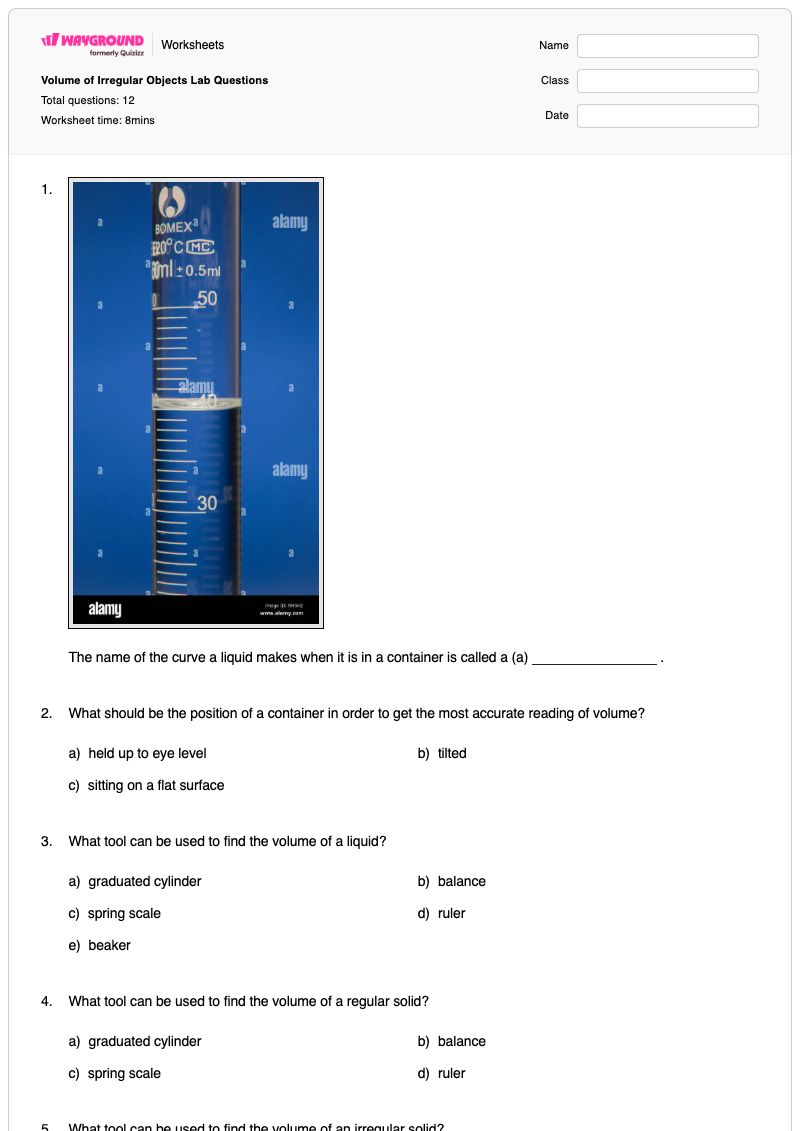
The name of the curve a liquid makes when it is in a container is called a (a) .
2.
What should be the position of a container in order to get the most accurate reading of volume?
a)
held up to eye level
b)
tilted
c)
sitting on a flat surface
3.
What tool can be used to find the volume of a liquid?
a)
graduated cylinder
b)
balance
c)
spring scale
d)
ruler
e)
beaker
4.
What tool can be used to find the volume of a regular solid?
a)
graduated cylinder
b)
balance
c)
spring scale
d)
ruler
5.
What tool can be used to find the volume of an irregular solid?
a)
beaker
b)
balance
c)
spring scale
d)
ruler
e)
graduated cylinder
6.
What unit is used when measuring the volume of a liquid?
a)
milliliter
(mL)
b)
cubic centimeter (cm3)
7.
What unit is used when measuring the volume of a regular solid?
a)
milliliter
(mL)
b)
cubic centimeter (cm3)
8.
What unit is used when measuring the volume of an irregular solid?
a)
milliliter
(mL)
b)
cubic centimeter (cm3)
9.
Which object (eraser, golf ball, small marble, or big marble) had the greatest volume?
(a)
10.
Which object (eraser, golf ball, small marble, or big marble) had the lowest volume?
(a)
11.
What is the volume of Spongebob Squarepants based on the displacement of the water in the graduated cylinder.
a)
1 cm3
b)
52 cm3
c)
102 cm3
d)
2 cm3
12.
What is the volume of the Button + the Key?
a)
3 cm3
b)
5 cm3
c)
27 cm3
d)
11 cm3
Answer Key
Volume of Irregular Objects Lab Questions
Total questions: 12
1.
meniscus
2.
c)
sitting on a flat surface
3.
a)
graduated cylinder
, e)
beaker
4.
d)
ruler
5.
a)
beaker
, e)
graduated cylinder
6.
a)
milliliter
(mL)
7.
b)
cubic centimeter (cm3)
8.
b)
cubic centimeter (cm3)
9.
golf ball
10.
eraser
11.
d)
2 cm3
12.
b)
5 cm3
140 %
Browse by subjects
Browse by grades
Browse by format
FAQs
What does the Volume of Irregular Objects Lab Questions worksheet cover?
This Grade 6 science worksheet practices selecting appropriate tools and units for liquid, regular-solid, and irregular-solid volume, along with reading the meniscus and interpreting water displacement. Its 12 items use fill-in-the-blank, multiple-choice, and multiple-select formats, including questions about comparing object volumes and finding the combined volume of a button and a key.
How can I use this worksheet to teach volume measurement and water displacement?
Introduce the worksheet by reviewing the meniscus, the required container position, and the difference between measuring a regular solid with a ruler and an irregular solid by displacement. As students work through the tool-and-unit questions, ask them to justify each choice before using the displacement items to discuss how a change in water level represents an object’s volume.
What mistakes should I watch for when students complete this volume worksheet?
Watch for students choosing a balance, spring scale, or ruler when the item asks for a liquid or irregular-solid volume, and for students mixing up milliliters with cubic centimeters. In the multiple-select questions, students may select only one valid tool, and in the displacement questions they may report the starting water level instead of the volume represented by the change in level or fail to combine the button and key volumes.
How do I assign and grade this volume worksheet?
The worksheet is available as a printable PDF and as a digital quiz on Wayground, and it includes a complete answer key for the fill-in-the-blank, multiple-choice, and multiple-select items. For printable submissions, you can grade student work by scanning it with the Wayground for Teachers app.
How can I differentiate this worksheet for my students?
Use the worksheet’s Advanced Settings to adjust font spacing or choose a larger font size so the measurement terms and answer choices are easier to follow. You can also enable a dyslexia-friendly font or translate the worksheet into another language while keeping its volume-tool, unit, and water-displacement questions intact.
Where can I find more worksheets like this on Wayground?
Wayground offers a comprehensive collection of free printable worksheets and practice problems across all subjects, with downloadable PDFs and answer keys to support essential skills and concepts. Browse more resources at https://wayground.com/en-us/worksheets.

 Worksheets

