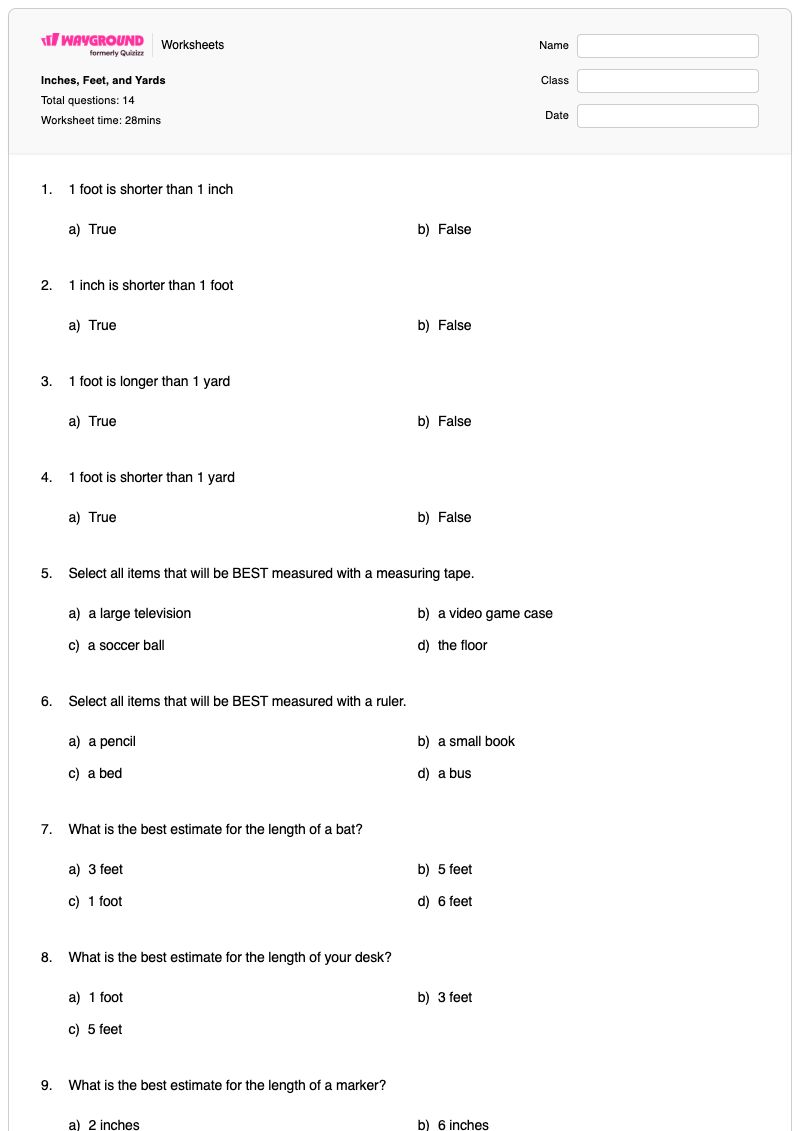
Inches, Feet, and Yards is a free printable Grade 2 mathematics worksheet with an answer key for practicing length comparisons, measurement tools, and reasonable estimates. Students complete 14 questions—12 multiple-choice items and 2 multiple-select items—that ask them to compare inches, feet, yards, centimeters, and meters; choose whether a ruler or measuring tape is more suitable; and estimate the lengths or heights of familiar objects such as a marker, notebook, desk, bat, and classroom door.
This worksheet helps students connect unit size with real-world measurement decisions. They identify that inches are shorter than feet, feet are shorter than yards, and centimeters are shorter than meters, then apply those relationships when selecting tools and judging approximate lengths. The multiple-select format also checks whether students can recognize several appropriate objects for a measuring tape or ruler rather than selecting only one answer. Use it for independent practice, review, or a quick assessment after introducing customary and metric length concepts.
Worksheet settings
Font size
S
M
L
XL
Worksheets
Inches, Feet, and Yards
Total questions: 14
Name
Class
Date
1.
1 foot is shorter than 1 inch
a)
True
b)
False
2.
1 inch is shorter than 1 foot
a)
True
b)
False
3.
1 foot is longer than 1 yard
a)
True
b)
False
4.
1 foot is shorter than 1 yard
a)
True
b)
False
5.
Select all items that will be BEST measured with a measuring tape.
a)
a large television
b)
a video game case
c)
a soccer ball
d)
the floor
6.
Select all items that will be BEST measured with a ruler.
a)
a pencil
b)
a small book
c)
a bed
d)
a bus
7.
What is the best estimate for the length of a bat?
a)
3 feet
b)
5 feet
c)
1 foot
d)
6 feet
8.
What is the best estimate for the length of your desk?
a)
1 foot
b)
3 feet
c)
5 feet
9.
What is the best estimate for the length of a marker?
a)
2 inches
b)
6 inches
c)
10 inches
10.
What is the best estimate for the length of a your notebook?
a)
8 inches
b)
2 inches
c)
24 inches
d)
15 inches
11.
How tall is our classroom door?
a)
8 feet
b)
12 feet
c)
6 feet
12.
About how tall is our classroom door?
a)
1 meter
b)
2 meters
c)
4 meters
d)
8 meters
13.
Which words make the sentence true?
1 centimeter is _______ 1 meter.
a)
longer than
b)
shorter than
c)
the same as
14.
Emma shows her friend how to use a ruler to measure length. Which sentence is true?
a)
1 foot is a shorter length than 1 inch.
b)
1 inch is a shorter length than 1 foot.
c)
1 inch is the same length as 1 foot.
d)
Inches are not used to measure length.
Answer Key
Inches, Feet, and Yards
Total questions: 14
1.
b)
False
2.
a)
True
3.
b)
False
4.
a)
True
5.
a)
a large television
, d)
the floor
, c)
a soccer ball
6.
a)
a pencil
, b)
a small book
7.
a)
3 feet
8.
b)
3 feet
9.
b)
6 inches
10.
a)
8 inches
11.
a)
8 feet
12.
b)
2 meters
13.
b)
shorter than
14.
b)
1 inch is a shorter length than 1 foot.
140 %
Browse by subjects
Browse by grades
Browse by format
FAQs
What does the Inches, Feet, and Yards worksheet cover?
This Grade 2 worksheet practices comparing inches, feet, yards, centimeters, and meters; choosing between a ruler and measuring tape; and estimating the lengths or heights of familiar objects. Its 14 items use true-or-false-style multiple choice, regular multiple choice, and multiple select questions so students apply unit relationships to objects such as a marker, desk, notebook, bat, and classroom door.
How can I use this worksheet to teach comparing inches, feet, and yards?
Introduce the worksheet by having students physically compare or visualize an inch, a foot, and a yard, then discuss why a pencil is better suited to a ruler while a floor is better suited to a measuring tape. Complete the unit-comparison items together before asking students to justify estimates such as a notebook being about 8 inches or a classroom door being about 8 feet. Review the two multiple-select questions as a class so students explain why more than one object can fit each measurement tool.
What mistakes should I watch for when students complete this measurement worksheet?
Watch for students reversing the relationships between units, especially selecting that a foot is shorter than an inch or that a foot is longer than a yard. In the multiple-select items, students may choose only one correct object or select a bed or bus for a ruler instead of recognizing the worksheet’s intended tool choices. Students may also confuse a reasonable estimate with an exact measurement, such as choosing 24 inches for a notebook or 8 meters for a classroom door.
How do I assign and grade the Inches, Feet, and Yards worksheet?
You can assign this worksheet as a printable PDF or as a digital quiz on Wayground, and it includes a complete answer key for all 14 questions. Printable submissions can be graded by scanning student work with the Wayground for Teachers app. The printable format also gives schools an option for practicing length concepts with less screen use.
How can I differentiate this worksheet for my students?
Use the worksheet’s Advanced Settings to adjust font spacing or choose a larger font size, making the unit comparisons, object choices, and estimate options easier to read. You can also enable a dyslexia-friendly font or translate the worksheet into another language when those options support access to the measurement vocabulary and multiple-select directions.
Where can I find more free worksheets like this on Wayground?
Wayground offers a broad collection of free printable worksheets and practice problems across subjects, with downloadable PDFs and answer keys to support essential skills and concepts. Browse more resources at https://wayground.com/en-us/worksheets.


 Worksheets