

Wayground
Minerals, Rocks, and Soils - Printable Social studies Worksheets grade 3 - Wayground

Minerals, Rocks, and Soils

Brittany Pitner

Created by Brittany Pitner

16 questions

3rd Grade

Social studies

Updated Mar 2026

Minerals, Rocks, and Soils is a Grade 3 science worksheet with 16 multiple-choice questions that helps students identify and compare observable rock and soil properties. Students classify rocks by size, texture, and luster; connect scratch testing to hardness; and distinguish soil types such as sand, clay, silt, and loam by how they feel and how they support plant growth. The worksheet also asks students to apply evidence about weathering and erosion. They analyze how wind, waves, and moving water change rocks, sand, and soil, including the formation of arches, beach particles, ripples, dunes, and soil movement down hills. It is a free printable worksheet with a complete answer key for Grade 3 science practice, review, or assessment.

Worksheet settings

Font size

S
M
L
XL
WaygroundWorksheets

Minerals, Rocks, and Soils

Total questions: 16

Name
Class
Date
1.
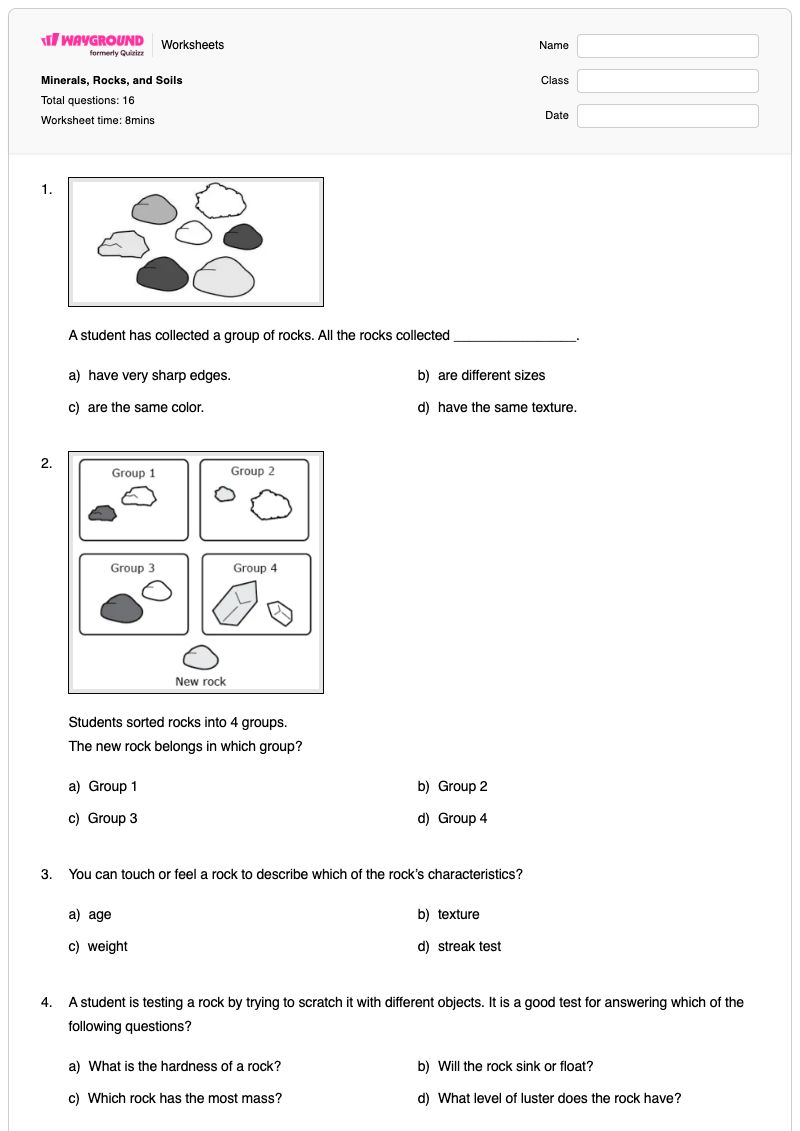
A student has collected a group of rocks. All the rocks collected ________________.

A student has collected a group of rocks. All the rocks collected ________________.

a)

have very sharp edges.

b)

are different sizes

c)

are the same color.

d)

have the same texture.

2.
Students sorted rocks into 4 groups. The new rock belongs in which group?

Students sorted rocks into 4 groups.

The new rock belongs in which group?

a)

Group 1

b)

Group 2

c)

Group 3

d)

Group 4

3.

You can touch or feel a rock to describe which of the rock’s characteristics?

a)

age

b)

texture

c)

weight

d)

streak test

4.

A student is testing a rock by trying to scratch it with different objects. It is a good test for answering which of the following questions?

a)

What is the hardness of a rock?

b)

Will the rock sink or float?

c)

Which rock has the most mass?

d)

What level of luster does the rock have?

5.
The chart shows some properties of four different rocks. Which of the following rocks can be grouped together using their…

The chart shows some properties of four different rocks.


Which of the following rocks can be grouped together using their luster?

a)

1 and 2

b)

2 and 4

c)

1 and 3

d)

3 and 4

6.

A student is investigating the textures of soils. Which soil feels the roughest?

a)

clay

b)

sand

c)

dirt

d)

silt

7.

Sophia is blindfolded. She feels a soil. It feels powdery, soft, and she cannot feel any particles in between her fingers. What soil is she most likely feeling?

a)

sand

b)

loam

c)

clay

d)

rock

8.

Which is the best type of soil for growing vegetables?

a)

sand

b)

clay

c)

loam

d)

silt

9.

Which type of soil feels smooth when you rub it between your fingers?

a)

sand

b)

humus

c)

clay

d)

loam

10.
Use the picture to answer the following question Which statement explains how the features MOST LIKELY formed?

Use the picture to answer the following question

Which statement explains how the features MOST LIKELY formed?

a)

Workers blasted the rock to create a road

b)

An artist carved the rock to see the beautiful view.

c)

Wind made the arch by weathering rock.

d)

Water formed the river by weathering rock.

11.

Which BEST describes the action of wind and waves on a beach?

a)

They decrease the size of the sand particles.

b)

They have no effect on rocks on the beach.

c)

They increase the hardness of rocks on the beach.

12.

When water runs down a hill of loose soil, it will cause what change to the soil?

a)

Soil from the top of the hill will be moved to the bottom.

b)

The hill will collect more soil and become taller.

c)

The particles of the soil will come together to make rocks.

d)

The solid particles of soil will melt and flow up the hill.

13.

Students observed that in one corner of the playground was a patch of smooth, flat soil. After several days, they noticed that ripples had formed across the sand. What was the most likely cause of this change?

a)

Wind blowing

b)

Ice freezing

c)

Water moving

d)

Snow falling

14.

What happens when strong winds blow sand against large rocks?

a)

The rock grows much bigger.

b)

The rock starts to melt.

c)

Tiny pieces of rock break off.

d)

Plants grow on top of the rock.

15.
Dunes are large piles of sand that move slowly on beaches. What causes the dunes to move from place to place?

Dunes are large piles of sand that move slowly on beaches. What causes the dunes to move from place to place?

a)

Rushing rivers

b)

Blowing winds

c)

Freezing water

d)

Breaking rock

16.

A sharp, jagged rock falls into a fast-moving river. How will the moving water change the rock over time?

a)

The rock will get smoother.

b)

The rock will get heavier.

c)

The rock will melt.

d)

The rock will get bigger.

WaygroundAnswer Key

Minerals, Rocks, and Soils

Total questions: 16

1.
b)

are different sizes

2.
c)

Group 3

3.
b)

texture

4.
a)

What is the hardness of a rock?

5.
b)

2 and 4

6.
b)

sand

7.
c)

clay

8.
c)

loam

9.
c)

clay

10.
c)

Wind made the arch by weathering rock.

11.
a)

They decrease the size of the sand particles.

12.
a)

Soil from the top of the hill will be moved to the bottom.

13.
a)

Wind blowing

14.
c)

Tiny pieces of rock break off.

15.
b)

Blowing winds

16.
a)

The rock will get smoother.

FAQs

What does the Minerals, Rocks, and Soils worksheet cover?

This Grade 3 science worksheet uses 16 multiple-choice questions to assess rock properties, soil textures and types, and weathering and erosion. Students interpret observations such as a rock’s texture, hardness, or luster; identify sand, clay, and loam from descriptions; and explain how wind and water move or wear down Earth materials.

How can I use this worksheet to teach rock properties, soil types, and weathering?

Introduce the worksheet by having students observe or feel sample rocks and soils, then discuss properties such as texture, hardness, luster, and particle size. As students complete the multiple-choice items, ask them to justify answers with evidence—for example, why scratching tests hardness, why loam supports vegetables, or how wind creates ripples, dunes, and weathered rock features.

What mistakes should I watch for when students complete this worksheet?

Students may confuse a property with the test used to observe it, such as choosing a streak test instead of texture when describing what they can feel. They may also mix up soil types—especially clay, sand, and loam—or reverse the effects of wind and water by saying that erosion adds soil to the top of a hill rather than moving it downhill.

How do I assign and grade this worksheet?

This worksheet is available as a printable PDF and as a digital quiz on Wayground, so you can choose the format that fits your Grade 3 science lesson. It includes a complete answer key, and printable submissions can be graded by scanning student work with the Wayground for Teachers app.

How can I differentiate the rock, soil, and weathering worksheet for my students?

Use the worksheet’s Advanced Settings to adjust font spacing or increase the font size so the multiple-choice choices and science scenarios are easier to follow. You can also enable a dyslexia-friendly font or translate the worksheet into another language to support access to the rock-property, soil-type, and weathering questions.

Where can I find more worksheets like this on Wayground?

Wayground offers a comprehensive collection of free printable worksheets and practice problems across subjects, with downloadable PDFs and answer keys to help students master essential skills and concepts. Browse more resources at https://wayground.com/en-us/worksheets.