Monohybrid Cross/Punnett Square Practice is a Grade 9–12 science worksheet with nine multiple-choice questions on interpreting simple genetic crosses. Students identify dominant and recessive traits in pea examples, classify genotypes as heterozygous or homozygous dominant/recessive, determine expected percentages of offspring phenotypes, and interpret the outcome of crossing two heterozygous tall pea plants.
This free printable worksheet helps students connect allele relationships to observable traits and use Punnett-square reasoning to evaluate genotype and phenotype outcomes. The questions move between identifying genetic terminology, selecting probability percentages, and recognizing the expected 75% tall/25% short result from a heterozygous cross. It includes a complete answer key for efficient review, independent practice, or a quick formative assessment.
Worksheet settings
Font size
S
M
L
XL
Worksheets
Monohybrid Cross/Punnett Square Practice
Total questions: 9
Name
Class
Date
1.
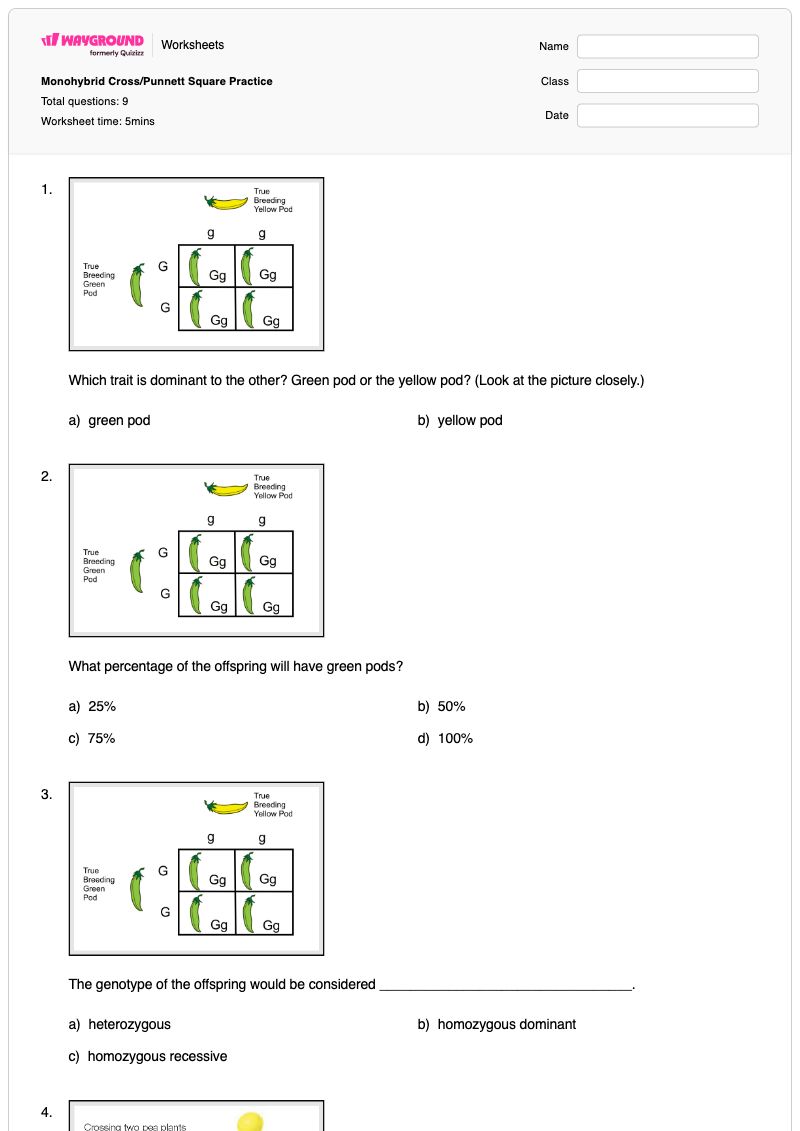
Which trait is dominant to the other? Green pod or the yellow pod? (Look at the picture closely.)
a)
green pod
b)
yellow pod
2.
What percentage of the offspring will have green pods?
a)
25%
b)
50%
c)
75%
d)
100%
3.
The genotype of the offspring would be considered _________________________________.
a)
heterozygous
b)
homozygous dominant
c)
homozygous recessive
4.
What is the percentage of yellow peas?
a)
25%
b)
50%
c)
75%
d)
100%
5.
What percentage of peas will be green?
a)
25%
b)
50%
c)
75%
d)
100%
6.
Two heterozgyous tall pea plants are crossed. What is the expected phenotypic outcome for the offspring?
a)
100% tall
b)
50% tall, 50% short
c)
75% tall, 25% short
d)
100% short
7.
The yellow pod's genotype is ______________________________________.
a)
heterozygous
b)
homozygous dominant
c)
homozygous recessive
8.
The green pod's genotype is ________________________.
a)
heterozygous
b)
homozygous dominant
c)
homozygous recessive
9.
If one allele for a trait is dominant and the other allele is recessive, which trait will be visible? The dominant allele or the recessive allele?
a)
Dominant will be visible because it is blocked by the recessive allele.
b)
Dominant will be visible because it hides or blocks the recessive allele.
c)
Recessive will be visible because it is blocked by the dominant allele.
d)
Recessive will be visible because it hides or blocks the dominant allele.
Answer Key
Monohybrid Cross/Punnett Square Practice
Total questions: 9
1.
a)
green pod
2.
d)
100%
3.
a)
heterozygous
4.
c)
75%
5.
a)
25%
6.
c)
75% tall, 25% short
7.
c)
homozygous recessive
8.
b)
homozygous dominant
9.
b)
Dominant will be visible because it hides or blocks the recessive allele.
140 %
Browse by subjects
Browse by grades
Browse by format
FAQs
What does the Monohybrid Cross/Punnett Square Practice worksheet cover?
This Grade 9–12 science worksheet uses nine multiple-choice questions to assess monohybrid-cross reasoning. Students identify dominant and recessive pea traits, distinguish heterozygous from homozygous genotypes, calculate phenotype percentages, and interpret the 75% tall/25% short outcome for two heterozygous tall pea plants.
How can I use this worksheet to teach monohybrid crosses and Punnett squares?
First review how dominant and recessive alleles affect the visible trait, then model how a Punnett square connects allele combinations to genotype and phenotype. Use the pea-pod questions to have students explain why a genotype is heterozygous or homozygous, and finish with the tall-plant item to discuss how the predicted percentage is derived.
What mistakes should I watch for when students complete this worksheet?
Watch for students confusing genotype labels—heterozygous, homozygous dominant, and homozygous recessive—with the visible phenotype of the pea pod. Students may also select a percentage without matching it to the specific cross, or reverse the relationship between dominant and recessive traits when answering why the dominant trait is visible.
How do I assign and grade this monohybrid cross worksheet?
The worksheet is available on Wayground as a printable PDF and as a digital quiz, and it includes a complete answer key. Grade printable submissions by scanning student work with the Wayground for Teachers app, or use the digital quiz for online response collection and grading.
How can I differentiate this worksheet for my students?
For the nine multiple-choice genetics items, use the worksheet’s Advanced Settings to adjust font spacing and font size for easier reading. You can also apply a dyslexia-friendly font or translate the worksheet into another language when those options support access to the genotype, phenotype, and percentage questions.
Where can I find more worksheets like this on Wayground?
Wayground offers a comprehensive collection of free printable worksheets and practice problems across all subjects, including downloadable PDFs with answer keys. Browse more resources at https://wayground.com/en-us/worksheets.


 Worksheets


