
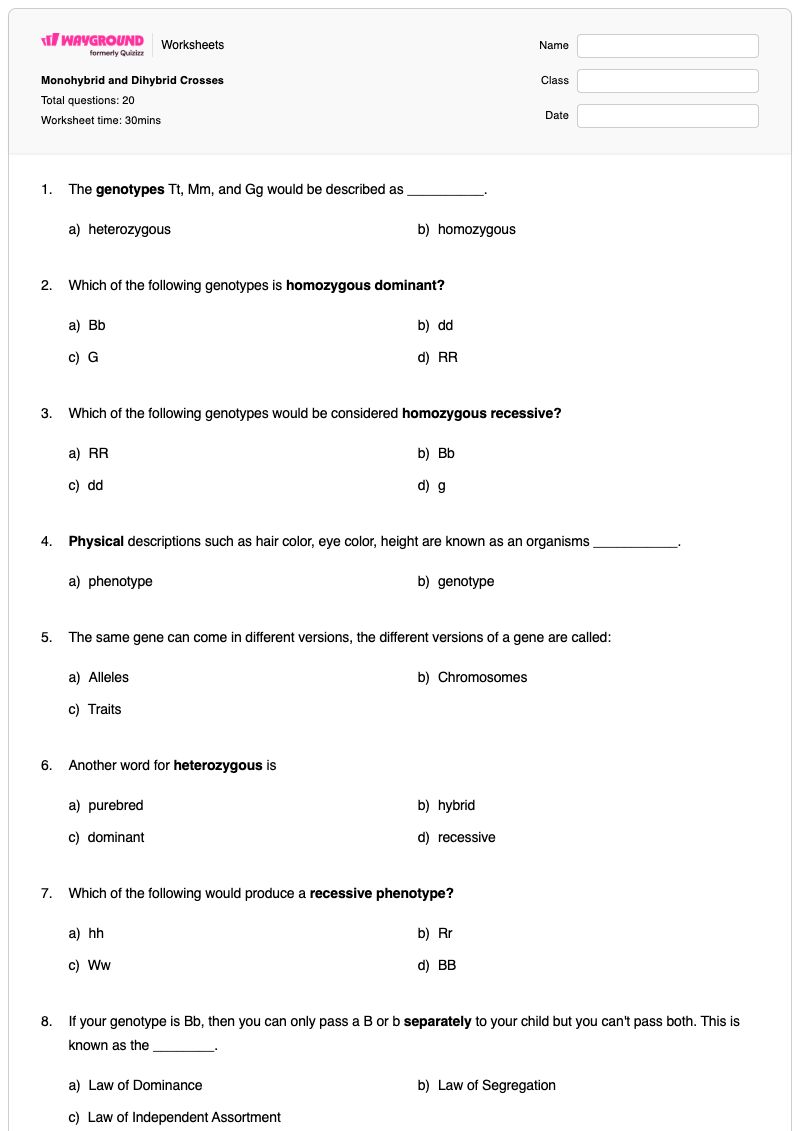

Monohybrid and Dihybrid Crosses is a free printable science worksheet for students in Grades 9–12. Its 20 multiple-choice questions build foundational genetics knowledge by asking students to classify genotypes as homozygous or heterozygous, distinguish genotype from phenotype, identify alleles, and apply the laws of dominance, segregation, and independent assortment.
Students also interpret monohybrid Punnett square results, including dominant and recessive traits, phenotypic and genotypic ratios, inheritance probabilities, and the meaning of a monohybrid cross. The worksheet provides focused practice connecting genetic vocabulary to cross outcomes, making it useful for guided instruction, independent review, or a formative check before more advanced heredity problems. It is available as a free printable worksheet with a complete answer key.
Worksheet settings
Font size
S
M
L
XL
Worksheets
Monohybrid and Dihybrid Crosses
Total questions: 20
Name
Class
Date
1.
The genotypes Tt, Mm, and Gg would be described as __________.
a)
heterozygous
b)
homozygous
2.
Which of the following genotypes is homozygous dominant?
a)
Bb
b)
dd
c)
G
d)
RR
3.
Which of the following genotypes would be considered homozygous recessive?
a)
RR
b)
Bb
c)
dd
d)
g
4.
Physical descriptions such as hair color, eye color, height are known as an organisms ___________.
a)
phenotype
b)
genotype
5.
The same gene can come in different versions, the different versions of a gene are called:
a)
Alleles
b)
Chromosomes
c)
Traits
6.
Another word for heterozygous is
a)
purebred
b)
hybrid
c)
dominant
d)
recessive
7.
Which of the following would produce a recessive phenotype?
a)
hh
b)
Rr
c)
Ww
d)
BB
8.
If your genotype is Bb, then you can only pass a B or b separately to your child but you can't pass both. This is known as the ________.
a)
Law of Dominance
b)
Law of Segregation
c)
Law of Independent Assortment
9.
The ___________ states that a recessive allele is only expressed when a dominant allele is not present.
a)
Law of Dominance
b)
Law of Inheritance
10.
Different traits are inherited independently of each other
a)
Law of independent assortment
b)
Genetics law
11.
What is the phenotypic ratio for the monohybrid cross between blue and brown eyes?
a)
3:1
b)
2:2
c)
0:2:1
d)
1:2:1
12.
Based on the genotypes present in this Monohybrid Punnett square, which eye color is dominant?
a)
brown
b)
blue
13.
Based on the results in the monohybrid punnett square, what is the percent chance of having a child with blue eyes?
a)
75%
b)
50%
c)
25%
d)
0%
14.
Based on the results in the monohybrid punnett square, what is the genotypic ratio?
a)
1:2:1
b)
0:2:2
c)
0:0:4
d)
none
15.
What is the term for a cross that involves just one trait, such as pod shape?
a)
test cross
b)
dihybrid cross
c)
monohybrid cross
d)
homozygous cross
16.
What goes in box 1?
a)
AABb
b)
AABB
c)
aabb
d)
AaBB
17.
This image is an example of a ________ cross.
a)
Monohybrid
b)
Dihybrid
c)
Purebred
d)
Heterozygous
18.
What are the possible genotypes for this cross?
a)
TT=25%, Tt=50%, tt=25%
b)
all tall
c)
TT=75%, tt=25%
d)
Tt=100%
19.
In cacti, long arms (A) are dominant to short arms (a). Suppose 2 heterozygous cacti are crossed. What percentage of their offspring are expected to have short arms?
a)
0%
b)
25%
c)
75%
d)
100%
20.
In watermelons, green rinds (G) are dominant to striped rinds (g). What is the genotype of a heterozygous green watermelon?
a)
GG
b)
Gg
c)
gg
d)
green
Answer Key
Monohybrid and Dihybrid Crosses
Total questions: 20
1.
a)
heterozygous
2.
d)
RR
3.
c)
dd
4.
a)
phenotype
5.
a)
Alleles
6.
b)
hybrid
7.
a)
hh
8.
b)
Law of Segregation
9.
a)
Law of Dominance
10.
a)
Law of independent assortment
11.
b)
2:2
12.
a)
brown
13.
c)
25%
14.
a)
1:2:1
15.
c)
monohybrid cross
16.
a)
AABb
17.
b)
Dihybrid
18.
a)
TT=25%, Tt=50%, tt=25%
19.
b)
25%
20.
b)
Gg
140 %
Browse by subjects
Browse by grades
Browse by format
FAQs
What does the Monohybrid and Dihybrid Crosses worksheet cover?
This Grade 9–12 science worksheet uses 20 multiple-choice questions to practice classifying genotypes, distinguishing genotype from phenotype, identifying alleles, and applying the laws of dominance, segregation, and independent assortment. Students also interpret monohybrid Punnett square results by identifying dominant traits, calculating inheritance percentages, and determining phenotypic and genotypic ratios.
How can I use this worksheet to teach monohybrid and dihybrid crosses?
Introduce the vocabulary first by having students explain the difference between genotype, phenotype, homozygous, heterozygous, and allele. Then use the Punnett square questions to model how students move from genotypes to phenotypes, ratios, and probability, asking them to justify why a result such as 1:2:1 is genotypic while a phenotype ratio describes observable traits. Finish with the questions identifying the laws of segregation and independent assortment as a bridge to cross analysis.
What mistakes should I watch for when students complete this genetics worksheet?
Watch for students reversing genotype and phenotype, or labeling a mixed pair such as Bb as homozygous instead of heterozygous. Students may also confuse homozygous dominant with homozygous recessive, treat a recessive phenotype as possible when a dominant allele is present, or select a phenotypic ratio when a question asks for a genotypic ratio. In the Punnett square items, check that they convert the outcomes into the requested percentage or ratio rather than simply counting alleles.
How do I assign and grade the Monohybrid and Dihybrid Crosses worksheet?
The worksheet is available as a printable PDF and as a digital quiz on Wayground, and it includes a complete answer key for the 20 multiple-choice questions. For printed submissions, you can grade student work by scanning it with the Wayground for Teachers app. The printable format can also support schools that are reducing screen time.
How can I differentiate this worksheet for my students?
Use the worksheet’s Advanced Settings to adjust font spacing or font size so the genetics vocabulary and answer choices are easier to read. You can also select a dyslexia-friendly font or translate the worksheet into another language, while keeping the multiple-choice format and Punnett square interpretation tasks intact.
Where can I find more free worksheets like this on Wayground?
Wayground offers a comprehensive collection of free printable worksheets and practice problems across subjects, with downloadable PDFs and answer keys to help students master essential skills and concepts. Browse more resources at https://wayground.com/en-us/worksheets.