

Wayground
models and simulations - Printable Math Worksheets grade 6 - Wayground

models and simulations

22 questions

6th Grade

Math

Updated Mar 2026

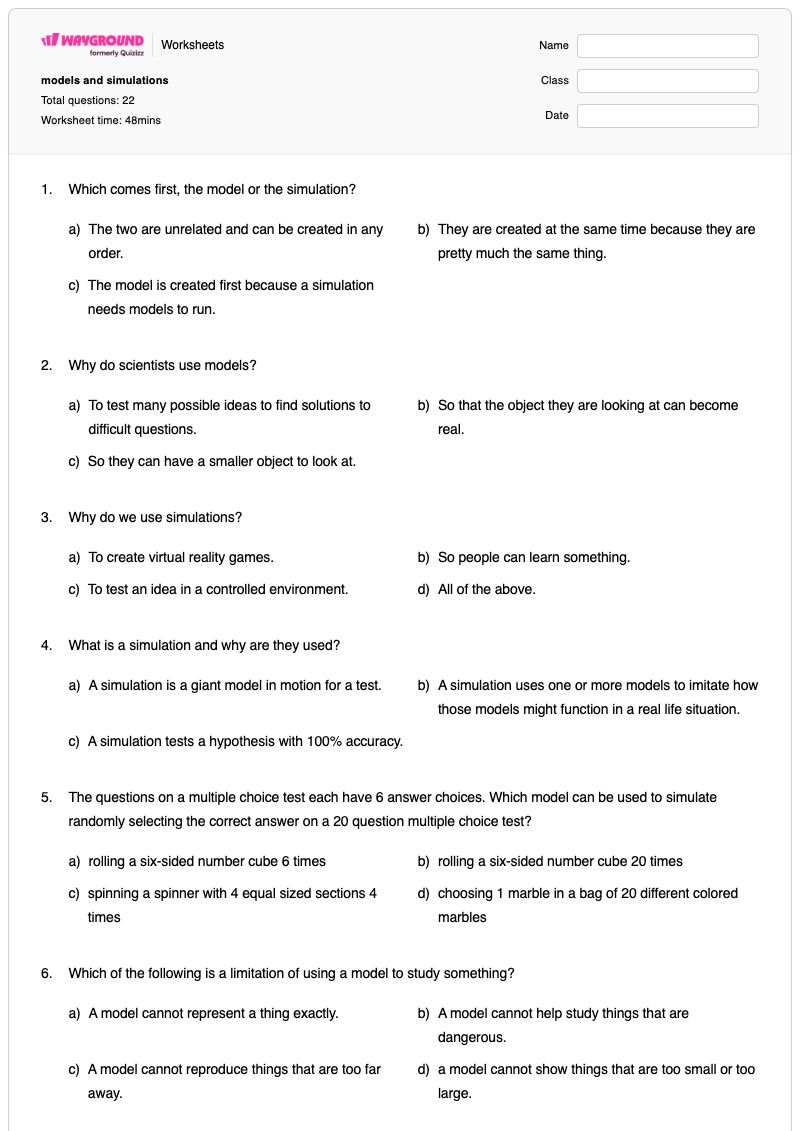
This Grade 6 worksheet gives students focused practice distinguishing models from simulations and explaining how each supports investigation. Across 22 multiple-choice questions, students identify definitions, determine that models are created before simulations, recognize scale models, classify examples such as a globe and a roller-coaster virtual tour, and select suitable models for real-world situations. Students also consider why scientists use models, including safety, manageability, and studying objects that are too large, small, distant, dangerous, or no longer available. Application questions ask students to choose a six-sided number cube to simulate random answers on a 20-question test and match familiar objects to what they represent, such as a coffee filter for a kidney. This free printable worksheet is designed for Grade 6 classroom practice, review, or formative assessment and includes a complete answer key.

Worksheet settings

Font size

S
M
L
XL
WaygroundWorksheets

models and simulations

Total questions: 22

Name
Class
Date
1.

Which comes first, the model or the simulation?

a)

The two are unrelated and can be created in any order.

b)

They are created at the same time because they are pretty much the same thing.

c)

The model is created first because a simulation needs models to run.

2.

Why do scientists use models?

a)

To test many possible ideas to find solutions to difficult questions.

b)

So that the object they are looking at can become real.

c)

So they can have a smaller object to look at.

3.

Why do we use simulations?

a)

To create virtual reality games.

b)

So people can learn something.

c)

To test an idea in a controlled environment.

d)

All of the above.

4.

What is a simulation and why are they used?

a)

A simulation is a giant model in motion for a test.

b)

A simulation uses one or more models to imitate how those models might function in a real life situation.

c)

A simulation tests a hypothesis with 100% accuracy.

5.
The questions on a multiple choice test each have 6 answer choices. Which model can be used to simulate randomly selecting the correct answer on a 20 question multiple choice test?
a)
rolling a six-sided number cube 6 times
b)
rolling a six-sided number cube 20 times
c)
spinning a spinner with 4 equal sized sections 4 times
d)
choosing 1 marble in a bag of 20 different colored marbles
6.
Which of the following is a limitation of using a model to study something?
a)
A model cannot represent a thing exactly.
b)
A model cannot help study things that are dangerous.
c)
A model cannot reproduce things that are too far away.
d)
a model cannot show things that are too small or too large.
7.
Scientists often use visual or mathematical representations to investigate items that are very large, very small, or otherwise difficult to study.  What are these visual or mathematical representations called?
a)
experiments
b)
hypotheses
c)
models
d)
observations
8.
A scientist wants to see what would happen if a truck's tires slipped on ice.  What would the scientist use to test how the truck's tires would function in this example?
a)
a system
b)
a simulation
c)
a conceptual model
d)
a mathematical model
9.
What kind of model allows a scientist to understand a large object by studying the object at a smaller size?
a)
a simulation
b)
a scale model
c)
a conceptual model
d)
a mathematical model
10.
a globe
a globe
a)
model
b)
simulation
c)
trial
d)
standardized
11.
Virtual Tour of a roller coaster
a)
model
b)
simulation
c)
standardized procedures 
d)
replications
12.

Models can be helpful in scientific investigations because

a)

it may not be possible to work with the real thing.

b)

they can be smaller and more manageable than the real thing.

c)

they can be safer to work with than the real thing.

d)

all of the above

13.

The kidneys are organs that filter wastes out of the blood stream. Which of the following objects could best be used to make a simple model of a kidney?

a)

block of wood

b)

coffee filter

c)

plastic bag

d)

water pump

14.

A tennis ball could be used to represent the sun because it's round and yellow. Which of the following could also be used to model the sun?

a)

a light bulb

b)

an empty cup

c)

an eraser

d)

a Kleenex box

15.
What is the advantage of creating a model of a dinosaur?
a)
they are too large to easily study 
b)
they are too complicated to study
c)
Real dinosaurs cannot be studied because they are extinct
d)
The model is safer to work with. 
16.
All of the statements below are correct except one. Mark the one that is incorrect.
a)
Models must be exactly like what is being modeled.
b)
Models communicate information.
c)
Models can be constructed.
d)
Models can be drawings with labels.
17.
True or False--A model can never be revised.
a)
true
b)
false
18.
Scientists use ___________ to understand how systems work.
a)
models
b)
figures
c)
process
d)
energy
19.
Scientists use a ___ to represent something that has too many parts, is too big, or is too small to investigate in real life.
a)
cars, dolls, people
b)
model
c)
scale
d)
telescope
20.
Is a simulation an active learning technique?
a)
Yes
b)
No
21.
Why does virtual reality enhance instruction?
a)
It tally's rewards to help with classroom management
b)
It allows teachers to communicate with parents
c)
It provides a deeper understanding with realistic 3D imagery
d)
All of the above
22.
Which of the following is NOT a constraint of VR?
a)
It can only be used for Science and Geography
b)
It can be costly
c)
Developing lessons/experiences can be time consuming
d)
Resistance to new technology from teachers
WaygroundAnswer Key

models and simulations

Total questions: 22

1.
c)

The model is created first because a simulation needs models to run.

2.
a)

To test many possible ideas to find solutions to difficult questions.

3.
d)

All of the above.

4.
b)

A simulation uses one or more models to imitate how those models might function in a real life situation.

5.
b) rolling a six-sided number cube 20 times
6.
a) A model cannot represent a thing exactly.
7.
c) models
8.
b) a simulation
9.
b) a scale model
10.
a) model
11.
b) simulation
12.
d)

all of the above

13.
b)

coffee filter

14.
a)

a light bulb

15.
c) Real dinosaurs cannot be studied because they are extinct
16.
a) Models must be exactly like what is being modeled.
17.
b) false
18.
a) models
19.
b) model
20.
a) Yes
21.
c) It provides a deeper understanding with realistic 3D imagery
22.
a) It can only be used for Science and Geography

FAQs

What does this models and simulations worksheet cover?

This 22-question multiple-choice worksheet teaches students to distinguish models from simulations and explain how each is used in scientific investigations. Students apply the distinction by identifying examples, recognizing scale models, selecting suitable representations such as a coffee filter for a kidney, and choosing a simulation method for a 20-question random-answer test.

How can I use this worksheet to teach the difference between models and simulations?

Introduce a model as a representation and a simulation as an activity or system that uses models to imitate how something may function in a real-life situation. Before students work independently, discuss why a model is created first and use examples from the worksheet, such as a globe and a roller-coaster virtual tour. Then ask students to justify why a simulation is appropriate for testing truck tires slipping on ice.

What mistakes should I watch for when students complete this worksheet?

Students may treat models and simulations as interchangeable, reverse their order, or choose a model when a simulation is needed to test how something functions. Watch for confusion between scale, conceptual, and mathematical models, as well as the misconception that a model can represent the real thing exactly. In the random-selection item, students may choose six rolls instead of matching the 20 rolls to the 20 test questions.

How do I assign and grade this worksheet?

You can assign this models and simulations worksheet as a printable PDF or as a digital quiz on Wayground. It includes a complete answer key for checking the 22 multiple-choice responses, and printable submissions can be graded by scanning student work with the Wayground for Teachers app. The printable format can also support classrooms that are reducing screen time.

How can I differentiate this models and simulations worksheet for my students?

Use the worksheet’s Advanced Settings to adjust font spacing and font size so the multiple-choice questions and answer options are easier to scan. You can also enable a dyslexia-friendly font or translate the worksheet into another language, depending on your learners’ needs.

Where can I find more free worksheets from Wayground?

Wayground offers a broad collection of free printable worksheets and practice problems across subjects, with downloadable PDFs and answer keys to support essential skills and concepts. Browse more resources at https://wayground.com/en-us/worksheets.