
Wayground
Chemical Bonds - Printable Science Worksheets grade 10 - Wayground

Chemical Bonds

Sabrina Stephens

By Sabrina Stephens

20 questions

10th - 10th Grade

Science

941 plays

Updated Oct 2026

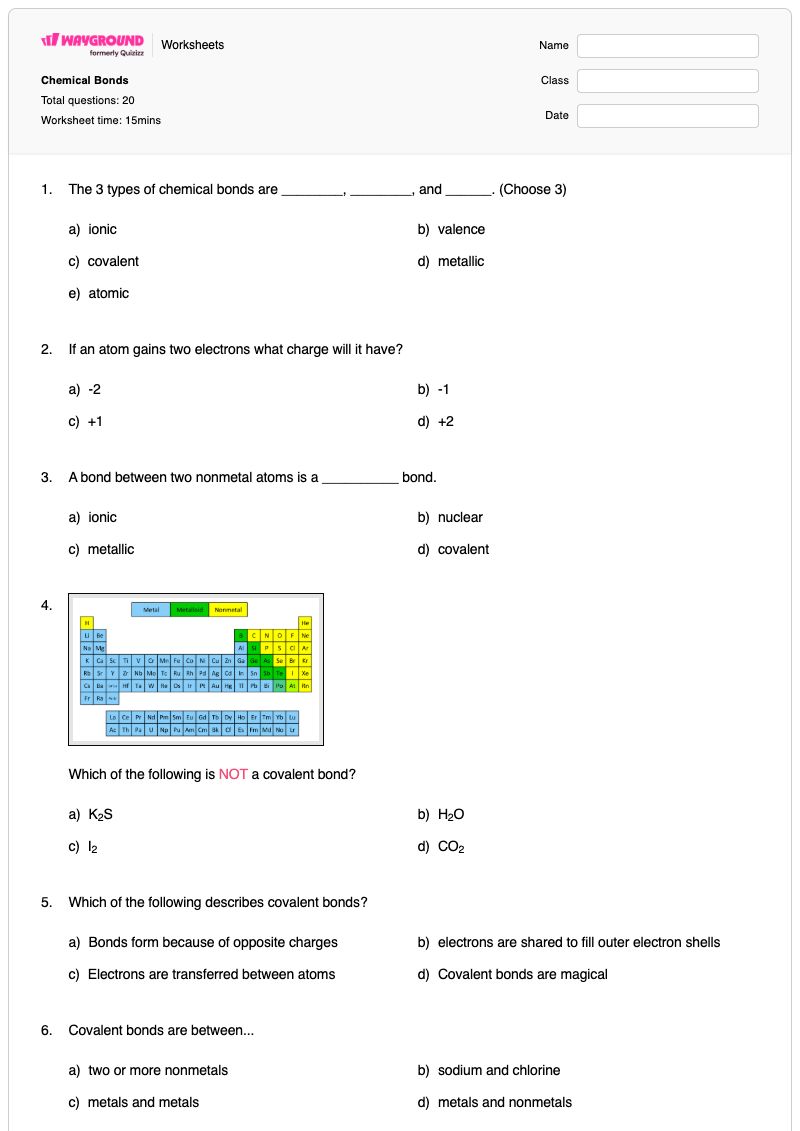
Chemical Bonds is a free printable Grade 10 science worksheet that helps students distinguish ionic, covalent, and metallic bonds. Across 20 questions—2 multiple-select and 18 multiple-choice items—students identify bond types from the elements or formulas involved, determine whether electrons are transferred or shared, and connect electron gain with ion charge. The worksheet also reinforces key vocabulary and properties, including cations and anions, the octet rule, attraction between oppositely charged ions, and the higher melting points associated with ionic compounds. Examples such as H₂O, I₂, CO₂, K₂S, NH₃, KCl, and NaCl require students to apply classification rules rather than recall isolated definitions. It is suitable for Grade 10 classroom practice, review, or formative assessment, and includes a complete answer key for efficient checking.

Worksheet settings

Font size

S
M
L
XL
WaygroundWorksheets

Chemical Bonds

Total questions: 20

Name
Class
Date
1.

The 3 types of chemical bonds are ________, ________, and ______. (Choose 3)

a)

ionic

b)

valence

c)

covalent

d)

metallic

e)

atomic

2.
If an atom gains two electrons what charge will it have?
a)
-2
b)
-1
c)
+1
d)
+2
3.

A bond between two nonmetal atoms is a __________ bond.

a)

ionic

b)

nuclear

c)

metallic

d)

covalent

4.
Which of the following is NOT a covalent bond?

Which of the following is NOT a covalent bond?

a)

K2S

b)

H2O

c)

I2

d)

CO2

5.

Which of the following describes covalent bonds?

a)

Bonds form because of opposite charges

b)

electrons are shared to fill outer electron shells

c)

Electrons are transferred between atoms

d)

Covalent bonds are magical

6.
Covalent bonds are between...
a)
two or more nonmetals
b)
sodium and chlorine
c)
metals and metals
d)
metals and nonmetals
7.

Ionic bonds form between ---

a)

nonmetals.

b)

metals and nonmetals.

8.
What is the name for an ion with a negative charge?
a)
cation
b)
anion
c)
onion
d)
union
9.

Which compound has high melting point?

a)

Ionic

b)

Covalent

10.

The octet rules states that most elements want to have _____ valence electrons.

a)

2

b)

4

c)

6

d)

8

11.
Which of the following is NOT an ionic bond?

Which of the following is NOT an ionic bond?

a)

NH3

b)

KCl

c)

K3N

d)

NaCl

12.

A bond between a metal atom and a nonmetal atom is a __________ bond.

a)

ionic

b)

atomic

c)

metallic

d)

covalent

13.
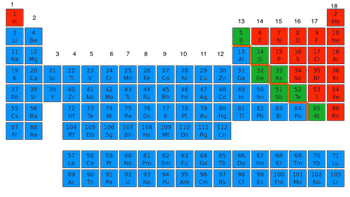
Where are metals located on the periodic table?
a)
Blue
b)
Green
c)
Red
14.
An ionic bond forms when atoms ___________ electrons.
a)
gain
b)
share
c)
increase
d)
transfer
15.
What happens when two oppositely charged ions are pushed together?

What happens when two oppositely charged ions are pushed together?

a)

they will repel (move apart)

b)

they will be attracted to each other (move together)

16.
What is a valence electron?
a)
The sum of neutrons and protons.
b)
The # of electrons in the last shell.
c)
A type of bond.
d)
A popular compound.
17.
What is the name for an ion with a positive charge?
a)
cation
b)
anion
c)
onion
d)
union
18.

Which of the following is true about Ionic Bonds? (select ALL TRUE options)

a)

High melting point

b)

Low melting point

c)

Can dissolve in water

d)

Cannot dissolve in water

e)

Can conduct electricity

19.

For nonmetals, its easier to _____ electrons to have a full outer shell.

a)

gain

b)

lose

c)

share

20.
In a covalent bond, one or more electrons are?
In a covalent bond, one or more electrons are? 
a)
shared 
b)
lost 
c)
gained 
d)
transferred 
WaygroundAnswer Key

Chemical Bonds

Total questions: 20

1.
a)

ionic

, c)

covalent

, d)

metallic

2.
a) -2
3.
d)

covalent

4.
a)

K2S

5.
b)

electrons are shared to fill outer electron shells

6.
a) two or more nonmetals
7.
b)

metals and nonmetals.

8.
b) anion
9.
a)

Ionic

10.
d)

8

11.
a)

NH3

12.
a)

ionic

13.
a) Blue
14.
d) transfer
15.
b)

they will be attracted to each other (move together)

16.
b) The # of electrons in the last shell.
17.
a) cation
18.
a)

High melting point

, c)

Can dissolve in water

, e)

Can conduct electricity

19.
a)

gain

20.
a) shared 

FAQs

What does the Chemical Bonds worksheet cover?

This Grade 10 worksheet uses 2 multiple-select and 18 multiple-choice questions to assess how students classify ionic, covalent, and metallic bonds. Students apply rules about metals and nonmetals, electron transfer or sharing, ion charge, the octet rule, and compound examples such as K₂S, H₂O, NH₃, KCl, and NaCl.

How can I use this worksheet to teach ionic and covalent bonds?

Introduce the lesson by having students compare whether atoms are metals or nonmetals and whether their electrons are transferred or shared. Then use the formula-based items, such as K₂S, H₂O, and NH₃, as prompts for students to explain why each compound represents an ionic or covalent bond before completing the multiple-choice review independently.

What mistakes should I watch for when students complete this chemical bonds worksheet?

Watch for students reversing electron transfer and electron sharing, or identifying a bond from the compound name without checking whether it contains metals and nonmetals. Students may also confuse anions with cations, choose covalent for ionic examples such as KCl or NaCl, or overlook that gaining two electrons produces a −2 charge.

How do I assign and grade the Chemical Bonds worksheet?

You can assign this Chemical Bonds worksheet as a printable PDF or as a digital quiz on Wayground. It includes a complete answer key, and printable submissions can be graded by scanning student work with the Wayground for Teachers app. The printable format also supports instruction when your school is reducing screen time.

How can I differentiate this chemical bonds worksheet for my students?

In the worksheet’s Advanced Settings, adjust font spacing or choose a larger font size to make the 20 bond-classification questions and chemical formulas easier to read. You can also apply a dyslexia-friendly font or translate the worksheet into another language when those changes support access to the ionic and covalent bond vocabulary.

Where can I find more worksheets like this on Wayground?

Wayground offers a comprehensive collection of free printable worksheets and practice problems across subjects, with downloadable PDFs and answer keys to help students master essential skills and concepts. Browse more resources at https://wayground.com/en-us/worksheets.