Non Standard Units Measurement is a Grade 1 mathematics worksheet that helps students measure and compare objects using nonstandard units. Across 14 questions—13 multiple choice and 1 fill-in-the-blank—students count matchsticks, paper clips, cubes, Peeps, jelly beans, and blocks to determine length or height. They also decide whether measurements are accurate, compare the lengths of pictured objects, and identify when to use cubes and string.
This worksheet gives students practice connecting a visual measurement to a numerical answer while reinforcing that units should be placed end to end without gaps or overlaps. It is useful for introducing informal measurement, checking understanding after a lesson, or providing independent practice with familiar classroom and everyday objects. The resource is a free printable worksheet with a complete answer key, making it easy to review students’ counting, comparison, and measurement reasoning.
Worksheet settings
Font size
S
M
L
XL
Worksheets
Non Standard Units Measurement
Total questions: 14
Name
Class
Date
1.
How many matchsticks long is the paintbrush shown below?
a)
5
b)
6
c)
7
d)
8
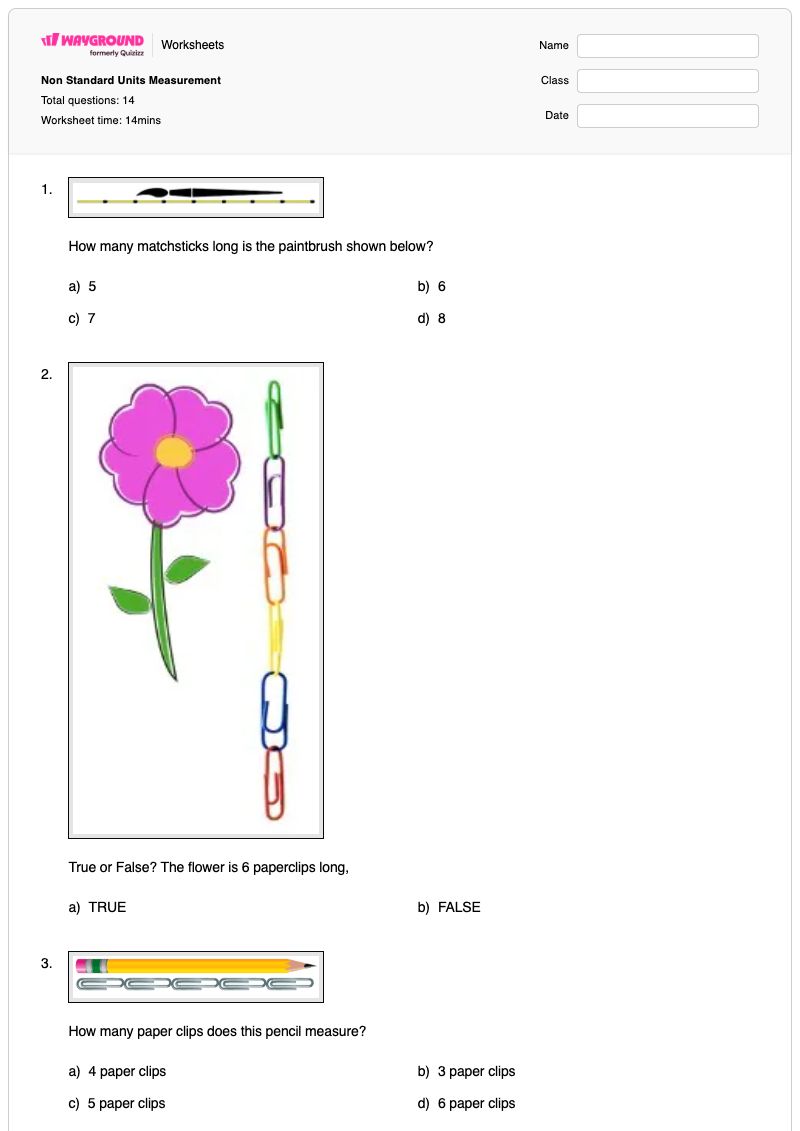
2.
True or False?
The flower is 6 paperclips long,
a)
TRUE
b)
FALSE
3.
How many paper clips does this pencil measure?
a)
4 paper clips
b)
3 paper clips
c)
5 paper clips
d)
6 paper clips
4.
About how many cubes high is the flower?
a)
3 cubes high
b)
5 cubes high
c)
10 cubes high
d)
18 cubes high
5.
Stephanie measures the ribbon with paper clips. Did Stephanie measure correctly?
a)
Yes, Stephanie measured correctly. The ribbon is three paper clips long.
b)
No, Stephanie did not measure correctly. She should have used more paper clips. Stephanie measures the ribbon with paper clips. Stephanie did not measure correctly. The paper clips need to be end to end.
c)
No, Stephanie did not measure correctly. She should have used more paper clips.
d)
No, Stephanie did not measure correctly. The ribbon is 10 paper clips long
6.
How many cubes does the boat measure?
a)
4 cubes
b)
5 cubes
c)
3 cubes
d)
6 cubes
7.
How many Peeps does this spoon measure?
a)
5 Peeps
b)
3 Peeps
c)
4 Peeps
d)
6 Peeps
8.
How many jelly beans does this foot measure?
a)
10 jelly beans
b)
12 jelly beans
c)
9 jelly beans
d)
11 jelly beans
9.
Which is true
a)
They are the same length
b)
The orange is longer
c)
The orange is shorter
10.
(a)
11.
a)
8 cubes
b)
32 cubes
c)
14 cubes
12.
The snake is __ blocks long.
a)
10
b)
3
c)
8
13.
To measure this you would use
a)
cubes
b)
cubes and string
c)
neither
14.
a)
cubes
b)
number chart
c)
cubes and string
Answer Key
Non Standard Units Measurement
Total questions: 14
1.
a)
5
2.
b)
FALSE
3.
c)
5 paper clips
4.
b)
5 cubes high
5.
d)
No, Stephanie did not measure correctly. The ribbon is 10 paper clips long
6.
d)
6 cubes
7.
b)
3 Peeps
8.
b)
12 jelly beans
9.
c)
The orange is shorter
10.
11
11.
b)
32 cubes
12.
c)
8
13.
b)
cubes and string
14.
b)
number chart
140 %
Browse by subjects
Browse by grades
Browse by format
FAQs
What does this nonstandard measurement worksheet help Grade 1 students learn?
This worksheet helps Grade 1 students measure and compare length and height with nonstandard units such as matchsticks, paper clips, cubes, Peeps, jelly beans, and blocks. Its 13 multiple-choice questions and 1 fill-in-the-blank item ask students to count units, judge whether a measurement is correct, compare objects, and select an appropriate measuring tool, including cubes and string.
How can I use this worksheet to teach measuring with nonstandard units?
Begin by modeling how to place identical units end to end with no gaps or overlaps, then work through one of the worksheet’s paper-clip or cube measurement examples together. Ask students to explain how they know an object is a certain number of units long or high before completing the remaining counting and comparison items independently. Use the question about whether a ribbon was measured correctly to prompt discussion about accurate placement and counting.
What mistakes should I watch for when students complete this nonstandard measurement worksheet?
Watch for students counting spaces incorrectly, leaving gaps or overlaps between paper clips or other units, or confusing an object’s length with its height. Students may also choose a familiar unit without considering the pictured object, misread comparison choices such as longer versus shorter, or overlook that one item asks which tools are needed rather than how many units measure it.
How do I assign and grade this nonstandard measurement worksheet?
The worksheet is available as a printable PDF and as a digital quiz on Wayground, and it includes a complete answer key for all 14 items. You can review digital responses in Wayground or grade printable submissions by scanning student work with the Wayground for Teachers app. The printable format also gives schools an option for reducing screen time.
How can I differentiate this worksheet for my students?
Use the worksheet’s Advanced Settings to adjust font spacing or choose a larger font size so the measurement prompts and answer choices are easier to follow. You can also enable a dyslexia-friendly font or translate the worksheet into another language, while keeping the matchstick, paper-clip, cube, and other nonstandard-unit questions intact.
Where can I find more worksheets like this on Wayground?
Wayground offers a broad collection of free printable worksheets and practice problems across subjects, with downloadable PDFs and answer keys to support essential skills and concepts. Browse more resources at https://wayground.com/en-us/worksheets.

 Worksheets


