

Wayground
Food Chains and Food Webs Review - Printable Science Worksheets grade 5 - Wayground

Food Chains and Food Webs Review

20 questions

5th - 5th Grade

Science

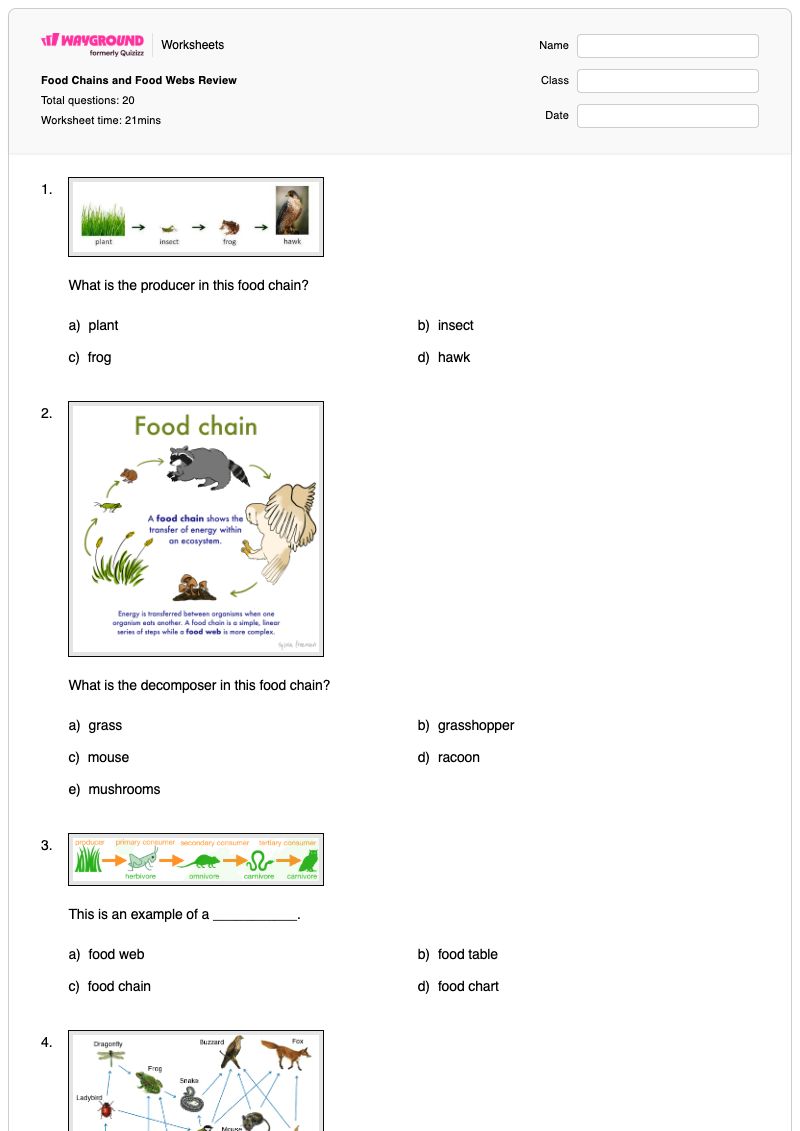
Food Chains and Food Webs Review is a Grade 5 science worksheet that helps students analyze how energy moves through ecosystems. Across 20 questions—including 18 multiple-choice items and 2 multiple-select items—students identify producers, consumers, decomposers, herbivores, carnivores, and omnivores; distinguish food chains from food webs; interpret arrows as energy flow; and trace which organisms provide energy to others. Students also connect producers to the Sun and explain how organisms can have multiple feeding relationships in a food web. Use this review worksheet to check students’ understanding before an assessment, reinforce vocabulary after instruction, or identify misconceptions about ecosystem relationships. The multiple-select questions require students to recognize all correct organisms in a feeding relationship, while the multiple-choice questions assess definitions and interpretation of food-chain and food-web representations. This is a free printable worksheet with a complete answer key for convenient classroom practice and review.

Worksheet settings

Font size

S
M
L
XL
Worksheets

Food Chains and Food Webs Review

Total questions: 20

Name
Class
Date
1.

What is the producer in this food chain?

a)

plant

b)

insect

c)

frog

d)

hawk

2.

What is the decomposer in this food chain?

a)

grass

b)

grasshopper

c)

mouse

d)

racoon

e)

mushrooms

3.

This is an example of a ___________.

a)

food web

b)

food table

c)

food chain

d)

food chart

4.

This is an example of a _______________.

a)

food web

b)

food table

c)

food chart

d)

food chain

5.

What do the arrows in a food chain and food web show?

a)

what each organism eats

b)

the flow of energy

c)

what organism dies before another organism

d)

what organism is a consumer and what organism is a decomposer

6.

Choose all that apply. The eagle gets energy directly from the _______.

a)

python

b)

butterfly

c)

corn

d)

frog

e)

rat

7.

All energy on Earth ultimately comes from what source?

a)

oxygen

b)

sun

c)

water

d)

consumers

8.

Choose all of the herbivores in the food web.

a)

lion

b)

goat

c)

rabbit

d)

snake

e)

mouse

9.

Polar Bears eat mostly seals and harp (a type of fish). Polar Bears are _____________.

a)

herbivores

b)

carnivores

c)

omnivores

d)

decomposers

10.

Turtles eat earthworms, grubs, bugs, grasses, fruits and berries. Turtles are ______________.

a)

carnivores

b)

herbivores

c)

omnivores

d)

decomposers

11.

Why might an organism have more than one arrow coming FROM it in a food web?

a)

More than one organism may eat them.

b)

This organism gets its energy from multiple sources.

c)

They may eat more than one other organism.

12.

An organism that needs to eat other organisms to obtain energy is known as a _______________.

a)

carnivore

b)

herbivore

c)

decomposer

d)

consumer

13.

Organisms that break down the remains of dead plants and animals are known as ____________________.

a)

producer

b)

consumer

c)

decomposer

d)

herbivore

14.

An organism that transforms energy from the sun and uses carbon dioxide and water to make food is called a(n) _________________________________.

a)

producer

b)

consumer

c)

decomposer

d)

herbivore

15.

What does a food chain represent?

a)

How plants create their own food.

b)

A single path of energy transfer within an ecosystem.

c)

All of the things that a particular animal eats.

d)

How all living organisms within an ecosystem are connected.

16.

Which type of consumer eats plants only?

a)

carnivore

b)

omnivore

c)

herbivore

d)

insectivore

17.

Which organism is a decomposer?

a)

elephant

b)

shrew

c)

cow

d)

mushroom

18.

What do you call an animal that hunts and eats other animals?

a)

predator

b)

prey

c)

herbivore

d)

producer

19.

An animal that is hunted and eaten for food is a _____________.

a)

predator

b)

prey

c)

herbivore

d)

producer

20.

Which of these describes how animals get energy they need to live and survive?

a)

They eat plants or other animals.

b)

They use sunlight.

c)

They drink water and juice.

d)

They drink water.

Answer Key

Food Chains and Food Webs Review

Total questions: 20

1.
a)

plant

2.
e)

mushrooms

3.
c)

food chain

4.
a)

food web

5.
b)

the flow of energy

6.
a)

python

, d)

frog

, e)

rat

7.
b)

sun

8.
b)

goat

, e)

mouse

, c)

rabbit

9.
b)

carnivores

10.
c)

omnivores

11.
a)

More than one organism may eat them.

12.
d)

consumer

13.
c)

decomposer

14.
a)

producer

15.
b)

A single path of energy transfer within an ecosystem.

16.
c)

herbivore

17.
d)

mushroom

18.
a)

predator

19.
b)

prey

20.
a)

They eat plants or other animals.

FAQs

What does the Food Chains and Food Webs Review worksheet cover?

This Grade 5 science worksheet uses 18 multiple-choice and 2 multiple-select questions to assess how students analyze energy flow and feeding relationships in food chains and food webs. Students identify producers, consumers, decomposers, herbivores, carnivores, and omnivores; distinguish a single energy-transfer path from a connected food web; and interpret arrows as the flow of energy. The select-all-that-apply items further require students to identify every organism that provides energy to a particular animal or every herbivore in a food web.

How can I use this worksheet to teach food chains and food webs?

Introduce the worksheet by reviewing that energy ultimately comes from the Sun, producers make food, and consumers obtain energy by eating other organisms. Model one food-chain representation and have students explain what each arrow means before they work independently. Then use the food-web items to discuss why one organism can have several feeding relationships and why more than one arrow may come from it.

What mistakes should I watch for when students complete this food-chain and food-web worksheet?

Watch for students who read arrows as showing what an organism eats or the order in which organisms die instead of the flow of energy. Students may also confuse a food chain’s single energy-transfer path with a food web’s connected relationships, or classify an organism by one food rather than its full diet, such as calling turtles herbivores despite their plant and animal foods. In the multiple-select questions, check that students choose every correct organism rather than stopping after one option.

How do I assign and grade this Food Chains and Food Webs Review worksheet?

The worksheet is available as a printable PDF and as a digital quiz on Wayground, and it includes a complete answer key for all 20 questions. Assign the digital quiz for online responses, or print the food-chain and food-web review for paper practice. Printable submissions can be graded by scanning student work with the Wayground for Teachers app.

How can I differentiate this food chains and food webs worksheet for my students?

Use the worksheet’s Advanced Settings to adjust font spacing and font size so the multiple-choice and multiple-select items are easier to read. You can also enable a dyslexia-friendly font or translate the worksheet into another language, which may help students process terms such as producer, decomposer, consumer, and energy flow.

Where can I find more worksheets like this on Wayground?

Wayground offers a broad collection of free printable worksheets and practice problems across subjects, with downloadable PDFs and answer keys to help students master essential skills and concepts. Browse more resources at https://wayground.com/en-us/worksheets.