
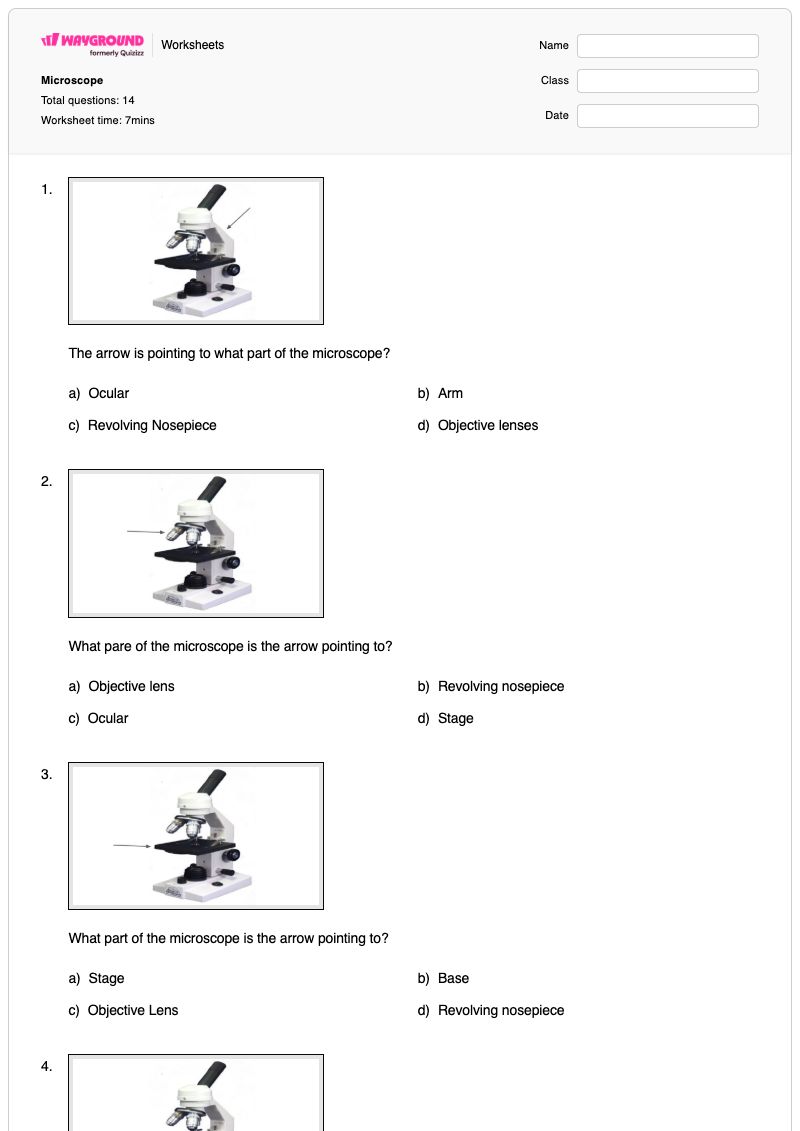

The Grade 7 Science Microscope worksheet uses 14 multiple-choice questions to check students’ ability to identify microscope parts from labeled diagrams and descriptions, including the arm, objective lenses, stage, illuminator, revolving nosepiece, ocular, and fine adjustment knob. Students also distinguish the functions of microscope components and connect each focusing knob to the appropriate objective lens.
The worksheet extends microscope terminology to foundational cell science by asking students to identify the scanning objective as the starting lens, recognize Robert Hooke’s observation of cork, and select a statement from Cell Theory. This free printable worksheet is suitable for review, independent practice, or a quick formative assessment, and it includes a complete answer key for efficient checking.
Worksheet settings
Font size
S
M
L
XL
Worksheets
Microscope
Total questions: 14
Name
Class
Date
1.
The arrow is pointing to what part of the microscope?
a)
Ocular
b)
Arm
c)
Revolving Nosepiece
d)
Objective lenses
2.
What pare of the microscope is the arrow pointing to?
a)
Objective lens
b)
Revolving nosepiece
c)
Ocular
d)
Stage
3.
What part of the microscope is the arrow pointing to?
a)
Stage
b)
Base
c)
Objective Lens
d)
Revolving nosepiece
4.
What part of the microscope is the arrow pointing to ?
a)
Illuminator
b)
Stage
c)
Base
d)
Ocular
5.
What part of the microscope is the arrow pointing to?
a)
Revolving nosepiece
b)
Objective lens
c)
Ocular
d)
Arm
6.
Which objective lens do you always start with?
a)
Scanning
b)
Yellow
c)
Blue
d)
40X
7.
Which knob do you use when focusing the yellow or 10X objective lens?
a)
Coarse adjustment knob
b)
Fine adjustment knob
8.
Which knob do you use with the scanning objective lens?
a)
Coarse adjustment knob
b)
Fine adjustment knob
9.
The part of the microscope that you look into is called what?
a)
Ocular
b)
Illuminator
c)
Objective lens
d)
Light
10.
a)
Coarse adjustment knob
b)
Fine adjustment knob
c)
Light switch
11.
What part of the microscope is the arrow pointing to?
a)
Fine adjustment knob
b)
Coarse adjustment knob
c)
Base
d)
Illuminator switch
12.
Which part of the microscope do you use to move the objective lenses around?
a)
Revolving nosepiece
b)
Ocular
c)
Objective lens
d)
Base
13.
Which scientist looked at cork under the microscope and called what he saw "Cells"
a)
Robert Hooke
b)
Anton Von Leeuwenhoek
c)
Theodore Schwann
d)
Matthias Schleiden
14.
Which is one of the parts of the Cell Theory
a)
All cells come from preexisting cells.
b)
Maggots appear on meat
Answer Key
Microscope
Total questions: 14
1.
b)
Arm
2.
a)
Objective lens
3.
a)
Stage
4.
a)
Illuminator
5.
a)
Revolving nosepiece
6.
a)
Scanning
7.
b)
Fine adjustment knob
8.
a)
Coarse adjustment knob
9.
a)
Ocular
10.
a)
Coarse adjustment knob
11.
a)
Fine adjustment knob
12.
a)
Revolving nosepiece
13.
a)
Robert Hooke
14.
a)
All cells come from preexisting cells.
140 %
Browse by subjects
Browse by grades
Browse by format
FAQs
What does this Microscope worksheet help Grade 7 students learn?
This Grade 7 Science worksheet uses 14 multiple-choice questions to assess microscope-part identification, including the arm, stage, illuminator, ocular, objective lenses, revolving nosepiece, and fine adjustment knob. It also checks whether students know to begin with the scanning objective, use the coarse adjustment knob with that lens, use the fine adjustment knob with the yellow or 10X objective lens, and recall Robert Hooke and a key statement from Cell Theory.
How can I use this worksheet to teach microscope parts and focusing?
Introduce the worksheet with a labeled microscope diagram, then have students explain what each identified part does before completing the multiple-choice questions. Use the focusing items to model the sequence: begin with the scanning objective and use the coarse adjustment knob, then use the fine adjustment knob with the yellow or 10X objective lens. Review the Hooke and Cell Theory questions afterward to connect microscope use with the study of cells.
What mistakes should I watch for when students complete this microscope worksheet?
Watch for students who confuse the ocular, which they look through, with the objective lenses, or confuse the revolving nosepiece, which moves the objective lenses, with an objective lens itself. Students may also select the fine adjustment knob for the scanning objective or the coarse adjustment knob for the yellow or 10X objective lens. In the final items, check that they distinguish Robert Hooke from other scientists and recognize that all cells come from preexisting cells as a statement of Cell Theory.
How do I assign and grade this Microscope worksheet?
You can assign this Microscope worksheet as a printable PDF or as a digital quiz on Wayground. It includes a complete answer key, and printable submissions can be graded by scanning student work with the Wayground for Teachers app. The printable format also gives schools an option for reducing screen time during microscope vocabulary review.
How can I differentiate this microscope worksheet for my students?
Use the worksheet’s Advanced Settings to adjust font spacing or increase the font size so the microscope-part questions and answer choices are easier to read. You can also enable a dyslexia-friendly font or translate the worksheet into another language when that better supports access to the microscope vocabulary and cell science questions.
Where can I find more worksheets like this on Wayground?
Wayground offers a comprehensive collection of free printable worksheets and practice problems across all subjects, with downloadable PDFs and answer keys to support essential skills and concepts. Browse more resources at https://wayground.com/en-us/worksheets.