

Wayground
Identify parts of an expression  - Printable Math Worksheets 6th Grade - Wayground

Identify parts of an expression

Wayground Content

Created by Wayground Content

15 questions

6th Grade

Math

Updated Oct 2026

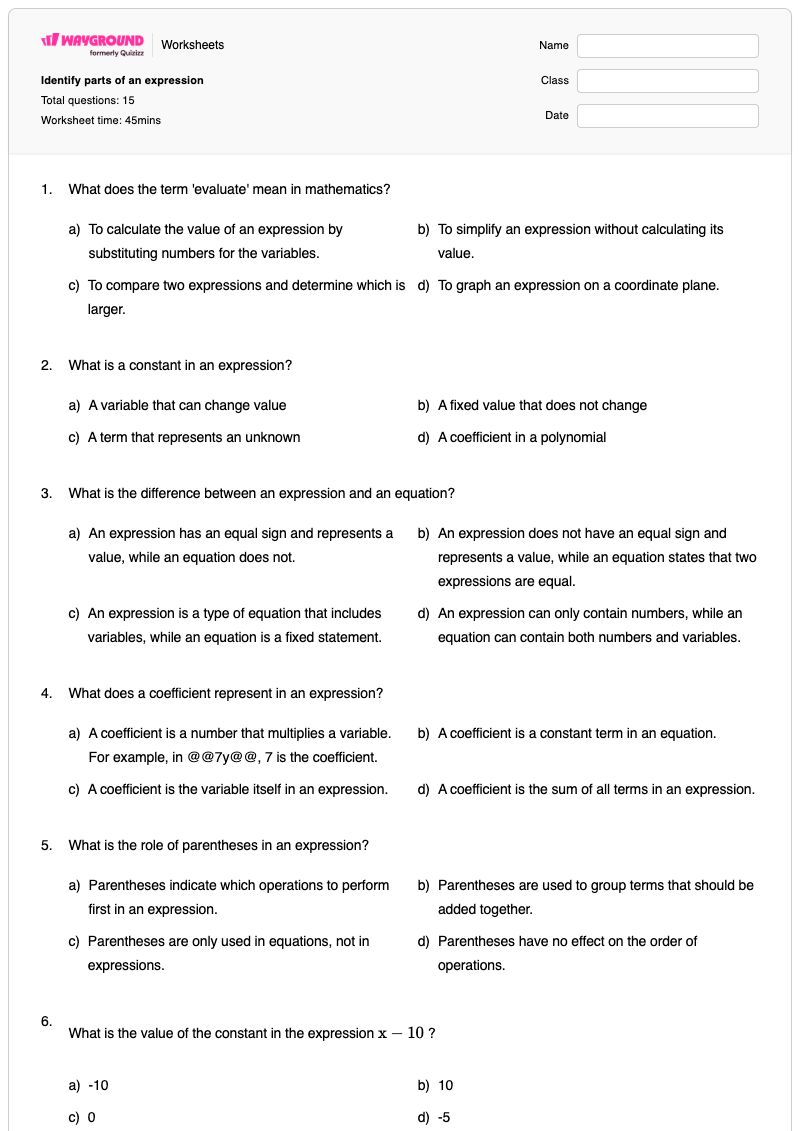
Identify Parts of an Expression is a Grade 6 mathematics worksheet that builds foundational algebra vocabulary and recognition skills. Through 15 multiple-choice questions, students define and distinguish expressions, equations, variables, constants, coefficients, terms, and like terms. They also identify the role of parentheses, count terms, recognize the parts of expressions such as 3x + 4y - 2, and determine coefficients and constants from displayed expressions. The worksheet moves from understanding terminology to applying it when combining like terms and simplifying an expression such as 4x - 3y + 2x + 5. It is useful for introducing parts of an expression, checking prerequisite knowledge, or reviewing before students begin more complex algebraic work. This free printable worksheet includes a complete answer key for efficient teacher review and feedback.

Worksheet settings

Font size

S
M
L
XL
WaygroundWorksheets

Identify parts of an expression

Total questions: 15

Name
Class
Date
1.

What does the term 'evaluate' mean in mathematics?

a)

To calculate the value of an expression by substituting numbers for the variables.

b)

To simplify an expression without calculating its value.

c)

To compare two expressions and determine which is larger.

d)

To graph an expression on a coordinate plane.

2.

What is a constant in an expression?

a)

A variable that can change value

b)

A fixed value that does not change

c)

A term that represents an unknown

d)

A coefficient in a polynomial

3.

What is the difference between an expression and an equation?

a)

An expression has an equal sign and represents a value, while an equation does not.

b)

An expression does not have an equal sign and represents a value, while an equation states that two expressions are equal.

c)

An expression is a type of equation that includes variables, while an equation is a fixed statement.

d)

An expression can only contain numbers, while an equation can contain both numbers and variables.

4.

What does a coefficient represent in an expression?

a)

A coefficient is a number that multiplies a variable. For example, in @@7y@@, 7 is the coefficient.

b)

A coefficient is a constant term in an equation.

c)

A coefficient is the variable itself in an expression.

d)

A coefficient is the sum of all terms in an expression.

5.

What is the role of parentheses in an expression?

a)

Parentheses indicate which operations to perform first in an expression.

b)

Parentheses are used to group terms that should be added together.

c)

Parentheses are only used in equations, not in expressions.

d)

Parentheses have no effect on the order of operations.

6.

What is the value of the constant in the expression x−10x - 10 ?

a)

-10

b)

10

c)

0

d)

-5

7.

What is a variable in mathematics?

a)

A constant value that does not change.

b)

A letter or symbol that represents an unknown number. For example, in the expression @@x + 3@@, x is a variable.

c)

A type of equation that has no solution.

d)

A fixed number used in calculations.

8.

How do you identify the number of terms in an expression?

a)

Count the number of separate parts in the expression. For example, in @@7x + 5^3 - 1@@, there are 3 terms.

b)

Add all the coefficients in the expression.

c)

Multiply the coefficients by the number of variables.

d)

Identify the highest power of the variable in the expression.

9.

What is the term 'expression' in mathematics?

a)

A mathematical statement that is always true.

b)

A combination of numbers, variables, and operators that represents a value.

c)

A rule that defines how to solve an equation.

d)

A type of function that maps inputs to outputs.

10.

What does the expression @@3x + 4y - 2@@ represent?

a)

It represents a quadratic equation.

b)

It represents an algebraic expression with three terms: 3x, 4y, and -2.

c)

It represents a linear equation with two variables.

d)

It represents a polynomial of degree three.

11.

In the expression 5a+25a + 2 , what is the coefficient of 'a'?

a)

2

b)

5

c)

10

d)

1

12.

What does the term 'like terms' mean?

a)

Terms that have different variables

b)

Terms that have the same variable raised to the same power

c)

Terms that are always positive

d)

Terms that can be added together regardless of their variables

13.

How do you combine like terms in an expression?

a)

You multiply the coefficients of like terms.

b)

You add or subtract the coefficients of like terms. For example, @@3x + 5x = 8x@@.

c)

You ignore the coefficients and only add the variables.

d)

You divide the coefficients of like terms.

14.

What is the difference between a term and a coefficient?

a)

A term is a single part of an expression, while a coefficient is the number in front of a variable in a term.

b)

A term can only be a number, while a coefficient can be a variable or a combination of both.

c)

A term is always a variable, while a coefficient is always a number.

d)

A term is a combination of multiple expressions, while a coefficient is a standalone number.

15.

What is the expression @@4x - 3y + 2x + 5@@ simplified?

a)

@@5x - 3y + 5@@

b)

@@6x - 3y + 4@@

c)

@@6x - 3y + 5@@

d)

@@4x - 3y + 7@@

WaygroundAnswer Key

Identify parts of an expression

Total questions: 15

1.
a)

To calculate the value of an expression by substituting numbers for the variables.

2.
b)

A fixed value that does not change

3.
b)

An expression does not have an equal sign and represents a value, while an equation states that two expressions are equal.

4.
a)

A coefficient is a number that multiplies a variable. For example, in @@7y@@, 7 is the coefficient.

5.
a)

Parentheses indicate which operations to perform first in an expression.

6.
a)

-10

7.
b)

A letter or symbol that represents an unknown number. For example, in the expression @@x + 3@@, x is a variable.

8.
a)

Count the number of separate parts in the expression. For example, in @@7x + 5^3 - 1@@, there are 3 terms.

9.
b)

A combination of numbers, variables, and operators that represents a value.

10.
b)

It represents an algebraic expression with three terms: 3x, 4y, and -2.

11.
b)

5

12.
b)

Terms that have the same variable raised to the same power

13.
b)

You add or subtract the coefficients of like terms. For example, @@3x + 5x = 8x@@.

14.
a)

A term is a single part of an expression, while a coefficient is the number in front of a variable in a term.

15.
c)

@@6x - 3y + 5@@

FAQs

What does the Identify Parts of an Expression worksheet cover?

This Grade 6 worksheet uses 15 multiple-choice questions to assess how students identify and define parts of an algebraic expression, including variables, constants, coefficients, terms, and like terms. Students also distinguish expressions from equations, interpret parentheses, count terms, identify coefficients and constants, and simplify an expression by combining like terms.

How can I use this worksheet to teach the parts of an algebraic expression?

Introduce the vocabulary by having students annotate sample expressions, labeling variables, constants, coefficients, and terms before completing the multiple-choice questions. Use the questions about 3x + 4y - 2 and like terms to prompt students to explain how they recognize separate terms, then model why 4x and 2x can be combined while -3y remains separate.

What mistakes should I watch for when students complete this worksheet?

Students may confuse a term with its coefficient, treat a variable as a fixed value, or mistake an expression for an equation because they overlook the equal sign distinction. When simplifying, watch for students combining unlike terms or changing the sign of a term; the final item requires combining 4x and 2x while keeping -3y and 5 unchanged.

How do I assign and grade this worksheet?

The Identify Parts of an Expression worksheet is available as a printable PDF and as a digital quiz on Wayground. It includes a complete answer key, and printable submissions can be graded by scanning student work with the Wayground for Teachers app. The printable format also gives schools an option for reducing screen time during algebra review.

How can I differentiate this worksheet for my students?

Use the worksheet’s Advanced Settings to adjust font spacing or increase the font size so the algebraic expressions and answer choices are easier to read. You can also select a dyslexia-friendly font or translate the worksheet into another language, depending on students’ reading needs.

Where can I find more free worksheets like this on Wayground?

Wayground offers a comprehensive collection of free printable worksheets and practice problems across all subjects, with downloadable PDFs and answer keys to support essential skills and concepts. Browse more resources at https://wayground.com/en-us/worksheets.