

Wayground
Components of Fitness - Printable Physical Education Worksheets grade 12 - Wayground

Components of Fitness

Janine Rich

Created by Janine Rich

12 questions

9th - 12th Grade

Physical Education

Components of Fitness is a Grade 9–12 Physical Education worksheet that builds understanding of five fitness components—muscular strength, muscular endurance, cardiovascular endurance, flexibility, and body composition—alongside the FITT Principle. Students connect components to example exercises, identify fitness concepts in workout situations, distinguish terms such as frequency and intensity, and recognize how FITT can support effective workout planning. The 12-item worksheet combines multiple-choice and true-or-false questions, matching tasks, fill-in-the-blank prompts, and multiple-select questions. Students apply vocabulary to examples such as back squats, stretching, sprinting, and weekly exercise planning rather than simply recalling definitions. This free printable worksheet includes a complete answer key, making it useful for introducing or reviewing fitness concepts, checking understanding, or assessing students’ ability to interpret basic training choices.

Worksheet settings

Font size

S
M
L
XL
WaygroundWorksheets

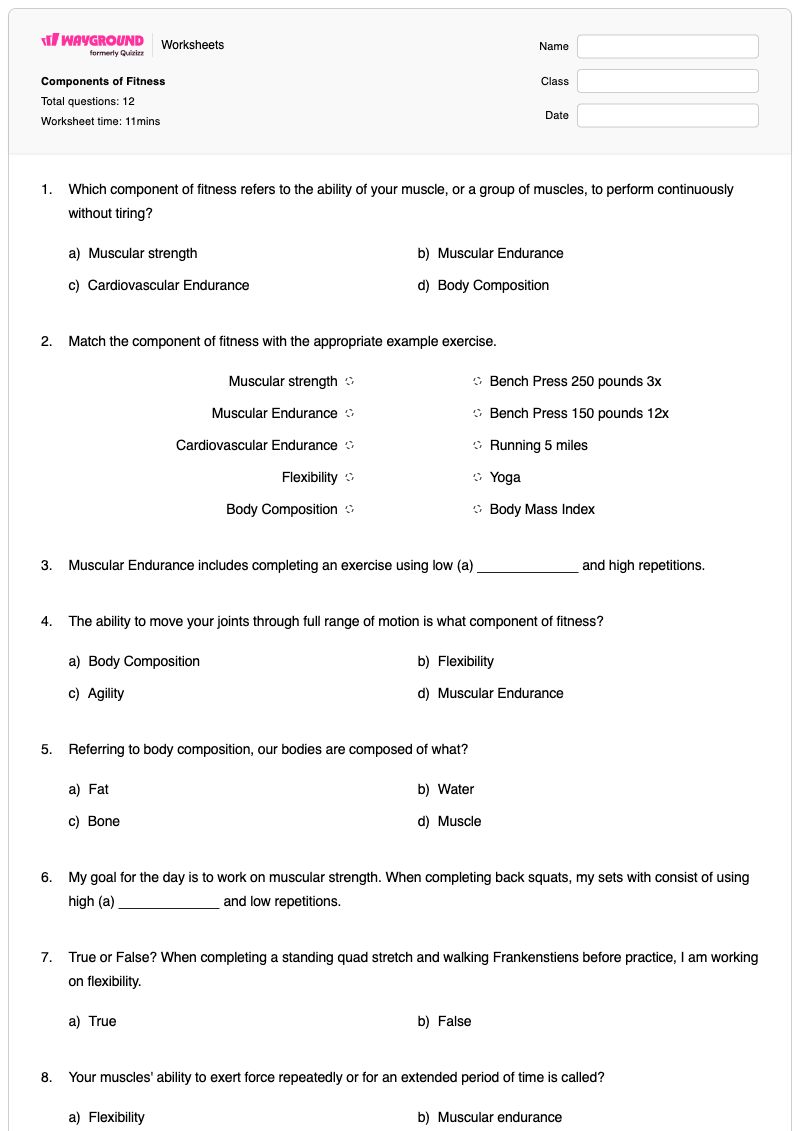
Components of Fitness

Total questions: 12

Name
Class
Date
1.

Which component of fitness refers to the ability of your muscle, or a group of muscles, to perform continuously without tiring?

a)

Muscular strength

b)

Muscular Endurance

c)

Cardiovascular Endurance

d)

Body Composition

2.

Match the component of fitness with the appropriate example exercise.

Muscular strength

Bench Press 250 pounds 3x

Muscular Endurance

Bench Press 150 pounds 12x

Cardiovascular Endurance

Running 5 miles

Flexibility

Yoga

Body Composition

Body Mass Index

3.

Muscular Endurance includes completing an exercise using low (a)   and high repetitions.

4.

The ability to move your joints through full range of motion is what component of fitness?

a)

Body Composition

b)

Flexibility

c)

Agility

d)

Muscular Endurance

5.

Referring to body composition, our bodies are composed of what?

a)

Fat

b)

Water

c)

Bone

d)

Muscle

6.

My goal for the day is to work on muscular strength. When completing back squats, my sets with consist of using high (a)   and low repetitions.

7.

True or False? When completing a standing quad stretch and walking Frankenstiens before practice, I am working on flexibility.

a)

True

b)

False

8.

Your muscles' ability to exert force repeatedly or for an extended period of time is called?

a)

Flexibility

b)

Muscular endurance

c)

Body composition

d)

Cardiovascular endurance

9.

The amount of times per week you complete an exercise would be considered (a)   in the FITT Principle.

10.

When completing a sprinting workout, if I am performing at 60-80% of my MHR (max heart rate), this would be considered (a)   in the FITT Principle.

11.

Match the term with the description pertaining to the FITT Principle.

Frequency

How often you complete an exercise.

Intensity

How challenging the exercise is.

Type

The kind of exercise

Time

How long you complete the exercise.

12.

Why might someone use the FITT Principle when brainstorming their future workouts.

a)

Helps keep them motivated

b)

Helps create an effective workout routine

c)

It's not really useful.

d)

Helps the person keep a routine.

WaygroundAnswer Key

Components of Fitness

Total questions: 12

1.
b)

Muscular Endurance

2.

Muscular strength

 - 

Bench Press 250 pounds 3x

, 

Muscular Endurance

 - 

Bench Press 150 pounds 12x

, 

Cardiovascular Endurance

 - 

Running 5 miles

, 

Flexibility

 - 

Yoga

, 

Body Composition

 - 

Body Mass Index

3.
weight
4.
b)

Flexibility

5.
a)

Fat

, b)

Water

, c)

Bone

, d)

Muscle

6.
weight
7.
a)

True

8.
b)

Muscular endurance

9.
frequency
10.
intensity
11.

Frequency

 - 

How often you complete an exercise.

, 

Intensity

 - 

How challenging the exercise is.

, 

Type

 - 

The kind of exercise

, 

Time

 - 

How long you complete the exercise.

12.
a)

Helps keep them motivated

, b)

Helps create an effective workout routine

, d)

Helps the person keep a routine.

FAQs

What does the Components of Fitness worksheet cover?

This Grade 9–12 Physical Education worksheet covers muscular strength, muscular endurance, cardiovascular endurance, flexibility, body composition, and the FITT Principle. Its 12 items use matching, fill-in-the-blank, multiple-choice or true-or-false, and multiple-select formats to have students connect fitness components with exercises and identify FITT terms such as frequency and intensity in workout scenarios.

How can I use this worksheet to teach fitness components and the FITT Principle?

Introduce the five fitness components with familiar examples such as back squats, stretching, and sprinting, then use the worksheet’s matching items to connect each component with an appropriate exercise. After reviewing the fill-in-the-blank FITT examples, have students explain how frequency, intensity, time, and type can shape a future workout routine. Use the multiple-select items as discussion prompts about why planning with FITT can support consistency and effective training.

What mistakes should I watch for when students complete this worksheet?

Students may confuse muscular strength with muscular endurance, or muscular endurance with cardiovascular endurance, especially when interpreting exercise examples. Watch for students mixing up FITT terms—particularly frequency, which refers to how often an exercise is completed, and intensity, which refers to effort level such as a percentage of maximum heart rate. In the multiple-select questions, check that students select every supported response rather than choosing only one option.

How do I assign and grade this Components of Fitness worksheet?

You can assign Components of Fitness as a printable PDF or as a digital quiz on Wayground. The worksheet includes a complete answer key for checking the matching, fill-in-the-blank, selected-response, and multiple-select items. For printable submissions, scan student work with the Wayground for Teachers app to grade it efficiently.

How can I differentiate this fitness components worksheet for my students?

Use the worksheet’s Advanced Settings to adjust font spacing or increase the font size for students who need more visual space while reading the fitness terms and workout scenarios. You can also apply a dyslexia-friendly font or translate the worksheet into another language, helping students access the matching, fill-in-the-blank, and FITT Principle questions.

Where can I find more worksheets like this on Wayground?

Wayground offers a comprehensive collection of free printable worksheets and practice problems across subjects, with downloadable PDFs and answer keys to support mastery of essential skills and concepts. Browse more resources at https://wayground.com/en-us/worksheets.