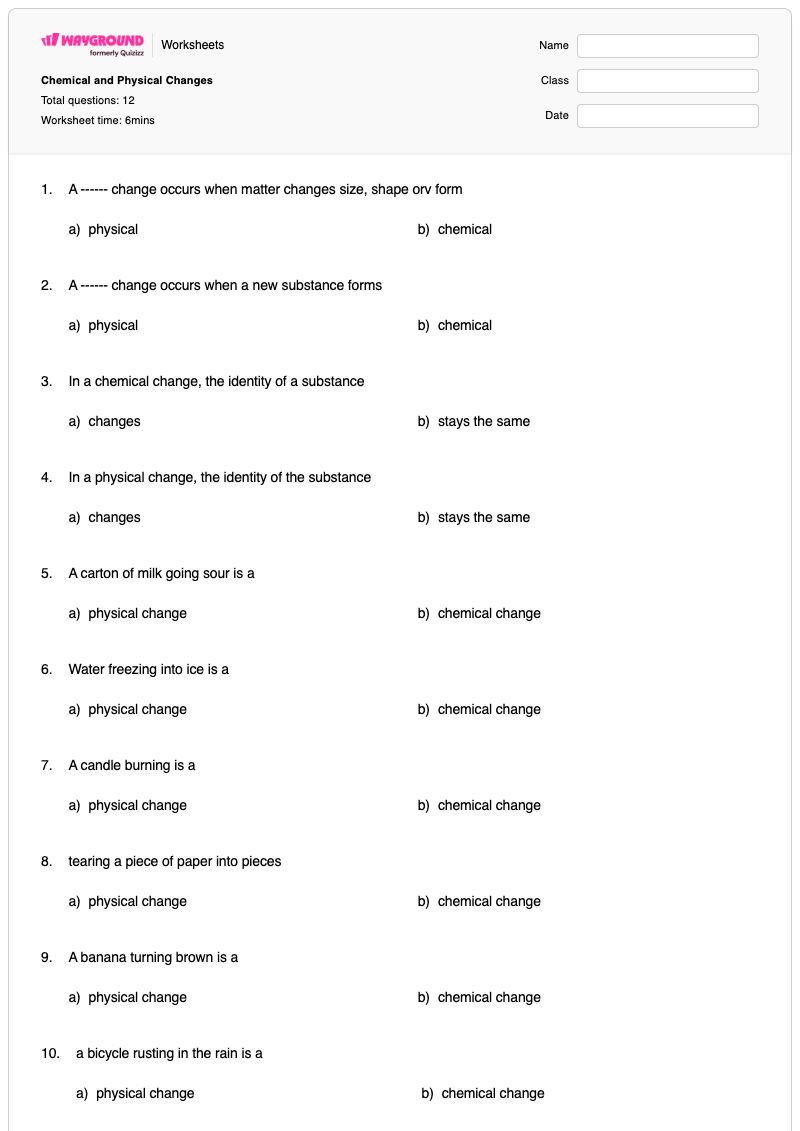
This Grade 3 science worksheet gives students focused practice distinguishing physical changes from chemical changes. Across 12 multiple-choice questions, students identify physical changes as changes in size, shape, or form, and chemical changes as changes that produce a new substance and alter the substance’s identity.
The questions apply these ideas to familiar examples, including milk turning sour, water freezing, a candle burning, paper tearing, a banana browning, a bicycle rusting, ice cream melting, and water boiling into steam. Students must use the defining difference between the two types of change rather than classify an example only by what it looks like. This free printable worksheet is suitable for Grade 3 science review, independent practice, or a quick formative assessment, and it includes a complete answer key for efficient checking.
Worksheet settings
Font size
S
M
L
XL
Worksheets
Chemical and Physical Changes
Total questions: 12
Name
Class
Date
1.
A ------ change occurs when matter changes size, shape orv form
a)
physical
b)
chemical
2.
A ------ change occurs when a new substance forms
a)
physical
b)
chemical
3.
In a chemical change, the identity of a substance
a)
changes
b)
stays the same
4.
In a physical change, the identity of the substance
a)
changes
b)
stays the same
5.
A carton of milk going sour is a
a)
physical change
b)
chemical change
6.
Water freezing into ice is a
a)
physical change
b)
chemical change
7.
A candle burning is a
a)
physical change
b)
chemical change
8.
tearing a piece of paper into pieces
a)
physical change
b)
chemical change
9.
A banana turning brown is a
a)
physical change
b)
chemical change
10.
a bicycle rusting in the rain is a
a)
physical change
b)
chemical change
11.
An ice cream cone melting is a
a)
physical change
b)
chemical change
12.
Water boiling into steam is a
a)
physical change
b)
chemical change
Answer Key
Chemical and Physical Changes
Total questions: 12
1.
a)
physical
2.
b)
chemical
3.
a)
changes
4.
b)
stays the same
5.
b)
chemical change
6.
a)
physical change
7.
b)
chemical change
8.
a)
physical change
9.
b)
chemical change
10.
b)
chemical change
11.
a)
physical change
12.
a)
physical change
140 %
Browse by subjects
Browse by grades
Browse by format
FAQs
What does the Chemical and Physical Changes worksheet cover?
This Grade 3 science worksheet uses 12 multiple-choice questions to help students distinguish physical changes from chemical changes. Students apply the key idea that physical changes affect size, shape, or form without changing a substance’s identity, while chemical changes form a new substance and change its identity. Examples such as freezing water, tearing paper, souring milk, rusting a bicycle, and burning a candle require students to classify each change.
How can I use this worksheet to teach physical and chemical changes?
First, introduce the decision rule: ask whether the substance’s identity stays the same or whether a new substance forms. Model the reasoning with one physical example, such as water freezing, and one chemical example, such as milk going sour, then have students complete the multiple-choice items and explain the evidence behind their choices. Use the examples involving melting, boiling, browning, and rusting to prompt a follow-up discussion about why an observable change is not always a chemical change.
What mistakes should I watch for when students complete this worksheet?
Students may select chemical change whenever they notice a visible change, incorrectly classifying freezing, melting, boiling, or tearing paper. They may also focus on the original material’s appearance instead of asking whether its identity changed, which can lead to errors with a browning banana, sour milk, a burning candle, or a rusting bicycle. Remind students to look for the formation of a new substance, not simply a change in state, size, shape, or form.
How do I assign and grade this Chemical and Physical Changes worksheet?
Wayground provides this worksheet as a printable PDF and as a digital quiz, so you can assign the 12 multiple-choice questions in the format that fits your lesson. It includes a complete answer key, and printable submissions can be graded by scanning student work with the Wayground for Teachers app. The printable option also supports classrooms that are reducing screen time.
How can I differentiate this physical and chemical changes worksheet for my students?
Use the worksheet’s Advanced Settings to adjust font spacing and font size so the multiple-choice questions and answer options are easier to read. You can also select a dyslexia-friendly font or translate the worksheet into another language while keeping the examples—such as freezing water, souring milk, and rusting a bicycle—focused on the same classification skill.
Where can I find more worksheets like this on Wayground?
Wayground offers a comprehensive collection of free printable worksheets and practice problems across all subjects, with downloadable PDFs and answer keys to support essential skills and concepts. Browse more resources at https://wayground.com/en-us/worksheets.


 Worksheets