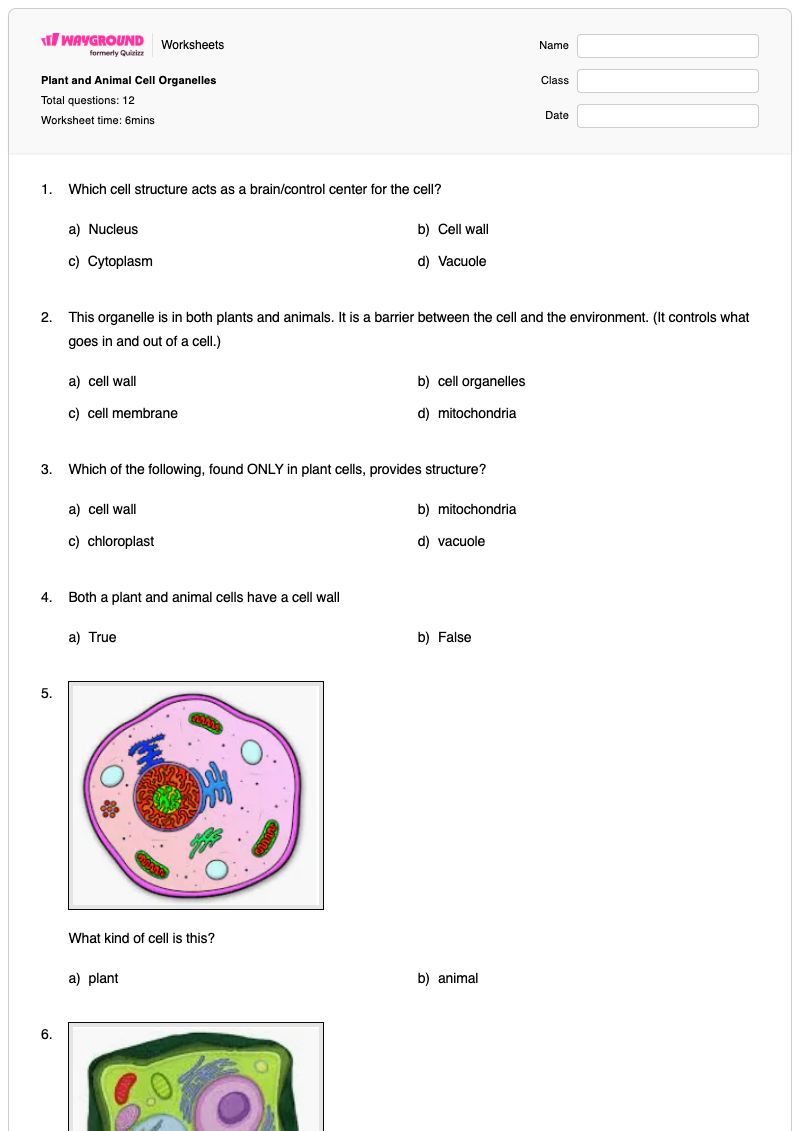
This Grade 5 science worksheet helps students identify major plant and animal cell organelles and connect each structure to its function. Across 12 multiple-choice questions, students identify the nucleus as the cell’s control center, distinguish the cell membrane from the plant cell wall, recognize cytoplasm, and explain the roles of chloroplasts and vacuoles. They also identify plant and animal cells and compare structures found in one cell type but not the other.
The questions reinforce key differences between plant and animal cells through organelle identification, function-based choices, diagram labeling, and a true-or-false comparison. Students use details such as the cell wall’s role in protection, support, and shape and chloroplasts’ role in making food to select accurate answers. This free printable worksheet is designed for Grade 5 science instruction, independent practice, review, or formative assessment, and it includes a complete answer key.
Worksheet settings
Font size
S
M
L
XL
Worksheets
Plant and Animal Cell Organelles
Total questions: 12
Name
Class
Date
1.
Which cell structure acts as a brain/control center for the cell?
a)
Nucleus
b)
Cell wall
c)
Cytoplasm
d)
Vacuole
2.
This organelle is in both plants and animals. It is a barrier between the cell and the environment. (It controls what goes in and out of a cell.)
a)
cell wall
b)
cell organelles
c)
cell membrane
d)
mitochondria
3.
Which of the following, found ONLY in plant cells, provides structure?
a)
cell wall
b)
mitochondria
c)
chloroplast
d)
vacuole
4.
Both a plant and animal cells have a cell wall
a)
True
b)
False
5.
What kind of cell is this?
a)
plant
b)
animal
6.
What kind of cell is this?
a)
plant
b)
animal
7.
Name two parts that are in the plant cell but that are NOT in an animal cell.
a)
cell wall and cell membrane
b)
cell wall and chloroplasts
c)
cell membrane and chloroplasts
d)
cell wall and cytoplasm
8.
What is number 2?
a)
cell membrane
b)
vacuole
c)
cytoplasm
d)
nucleus
9.
This is the jelly-like material that holds all the organelles.
a)
cytoplasm
b)
cell membrane
c)
chloroplast
d)
cell wall
10.
The cell wall provides this for the plant
a)
keeps all organelles within the cell
b)
stores food and water
c)
makes energy from food
d)
protection and support
11.
Chloroplast in cells do this.
a)
make food for the cells
b)
make energy for the cell
c)
keep all the organelles within the cell
d)
protect the cell and give it support
12.
Which part of the cell is a STIFF STRUCTURE that gives the plant cell its BOXY SHAPE?
a)
Chloroplast
b)
Cell Membrane
c)
Cell Wall
d)
Ribosome
Answer Key
Plant and Animal Cell Organelles
Total questions: 12
1.
a)
Nucleus
2.
c)
cell membrane
3.
a)
cell wall
4.
b)
False
5.
b)
animal
6.
a)
plant
7.
b)
cell wall and chloroplasts
8.
c)
cytoplasm
9.
a)
cytoplasm
10.
d)
protection and support
11.
a)
make food for the cells
12.
c)
Cell Wall
140 %
Browse by subjects
Browse by grades
Browse by format
FAQs
What does the Plant and Animal Cell Organelles worksheet cover?
This Grade 5 worksheet uses 12 multiple-choice questions to assess students’ ability to identify cell organelles, match structures with functions, and distinguish plant cells from animal cells. Students practice recognizing the nucleus, cell membrane, cytoplasm, cell wall, and chloroplasts, including the plant cell wall’s role in support and the chloroplast’s role in making food.
How can I use this worksheet to teach plant and animal cell organelles?
Introduce the worksheet by reviewing each organelle’s name, location or appearance when shown, and function, then have students explain why a cell wall and chloroplasts distinguish plant cells from animal cells. Use the multiple-choice items as guided practice first, asking students to justify choices such as cytoplasm versus cell membrane before assigning the worksheet independently.
What mistakes should I watch for on this cell organelles worksheet?
Watch for students confusing the cell wall with the cell membrane: the worksheet treats the membrane as the barrier controlling movement in and out, while the wall provides plant-cell protection, support, and a boxy shape. Students may also mistake cytoplasm for an organelle or overlook that chloroplasts and cell walls, rather than the cell membrane, are the two listed structures found in plant cells but not animal cells.
How do I assign and grade this Plant and Animal Cell Organelles worksheet?
You can assign it as a printable PDF or as a digital quiz on Wayground, and the worksheet includes a complete answer key for checking the 12 multiple-choice responses. For printable submissions, scan student work with the Wayground for Teachers app to streamline grading.
How can I differentiate this cell organelles worksheet for my students?
In the worksheet’s Advanced Settings, adjust font spacing or increase the font size to make the organelle definitions, answer choices, and diagram-identification items easier to read. You can also apply a dyslexia-friendly font or translate the worksheet into another language when that better supports access to the plant- and animal-cell content.
Where can I find more worksheets like this on Wayground?
Wayground offers a comprehensive collection of free printable worksheets and practice problems across subjects, with downloadable PDFs and answer keys to help students master essential skills and concepts. Browse more resources at https://wayground.com/en-us/worksheets.


 Worksheets

