
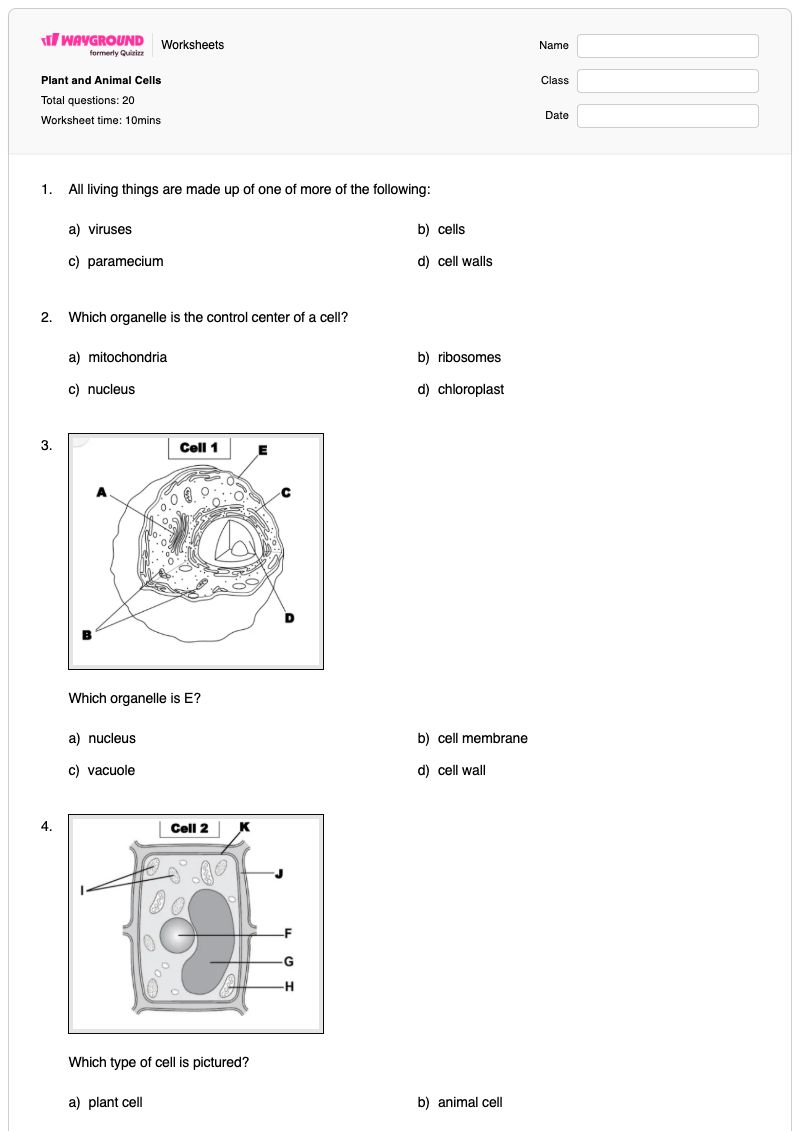

This Grade 7 science worksheet uses 20 multiple-choice questions to build foundational understanding of plant and animal cells. Students identify cells as the basic unit of living things, recognize organelles from labeled cell diagrams, match organelles to functions, explain processes such as photosynthesis, and compare plant, animal, and protist cells. The questions address the nucleus, cell membrane, cell wall, vacuoles, chloroplasts, and mitochondria, requiring students to connect each structure with its role.
This free printable worksheet with an answer key is suitable for science instruction, guided review, independent practice, or formative assessment. Teachers can use the labeled-diagram items to check visual identification and the function-based questions to see whether students understand why organelles matter, not simply whether they can recall names. The all-multiple-choice format supports efficient review and straightforward checking after a lesson on cell structure and function.
Worksheet settings
Font size
S
M
L
XL
Worksheets
Plant and Animal Cells
Total questions: 20
Name
Class
Date
1.
All living things are made up of one of more of the following:
a)
viruses
b)
cells
c)
paramecium
d)
cell walls
2.
Which organelle is the control center of a cell?
a)
mitochondria
b)
ribosomes
c)
nucleus
d)
chloroplast
3.
Which organelle is E?
a)
nucleus
b)
cell membrane
c)
vacuole
d)
cell wall
4.
Which type of cell is pictured?
a)
plant cell
b)
animal cell
5.
Which organelles store food and other materials needed by the cell?
a)
mitochondria
b)
chloroplasts
c)
ribosomes
d)
vacuoles
6.
What organelle is J?
a)
cell wall
b)
vacuole
c)
chloroplasts
d)
nucleus
7.
This organelle gives plants their green color and enables them to produce their own food.
a)
photosynthesis
b)
chloroplasts
c)
cell wall
d)
cytoplasm
8.
For what purpose does the cell membrane allow certain types of matter to pass into the cell?
a)
To allow the cell to gain new traits.
b)
To provide the cell with heat and light.
c)
To provide the cell with the materials it needs.
d)
To allow the cell to reproduce by fusing with another cell.
9.
What organelle is D?
a)
nucleus
b)
mitochondria
c)
vacuole
d)
chloroplasts
10.
Which of the following best describes the function of the mitochondria?
a)
They store energy from food molecules.
b)
They convert energy from food molecules into energy the cell can use.
c)
They store energy from sunlight.
d)
They produce nucleic acids that release energy.
11.
How does a protist cell differ from a plant or animal cell?
a)
Protists are unicellular.
b)
Plants and animal cells are unicellular.
c)
Plant and animal cells are the same as protists.
d)
Protists are multicellular.
12.
Which part of the cell controls what enters and leaves the cell?
a)
cell wall
b)
cell membrane
c)
chloroplasts
d)
mitochondria
13.
What organelle is B?
a)
nucleus
b)
cell membrane
c)
vacuole
d)
mitochondria
14.
Plant cells are able to convert the sun's light into food during the following process:
a)
photosynthesis
b)
respiration
c)
fermintation
d)
glycolysis
15.
What is the function of the cell wall?
a)
To protect and support the cell.
b)
To perform differently in each cell.
c)
To prevent water from passing through.
d)
To prevent oxygen from entering the cell.
16.
Animal cells do not have the following structures:
a)
food vacuoles and mitochondria
b)
nucleus and food vacuoles
c)
cell wall and chloroplasts
d)
mitochondria and nucleus
17.
Which organelle is present in both plant and animal cells but is usually much larger in plant cells?
a)
chloroplasts
b)
cell wall
c)
vacuoles
d)
mitochondria
18.
Which type of cell is pictured?
a)
Plant Cell
b)
Animal Cell
19.
What do you call the jelly-like substance that flows throughout the cell?
a)
mitochondria
b)
vacuoles
c)
plasma
d)
cytoplasm
20.
Tiny structures found inside cells are called:
a)
protists
b)
protozoans
c)
organs
d)
organelles
Answer Key
Plant and Animal Cells
Total questions: 20
1.
b)
cells
2.
c)
nucleus
3.
b)
cell membrane
4.
a)
plant cell
5.
d)
vacuoles
6.
a)
cell wall
7.
b)
chloroplasts
8.
c)
To provide the cell with the materials it needs.
9.
a)
nucleus
10.
b)
They convert energy from food molecules into energy the cell can use.
11.
a)
Protists are unicellular.
12.
b)
cell membrane
13.
d)
mitochondria
14.
a)
photosynthesis
15.
a)
To protect and support the cell.
16.
c)
cell wall and chloroplasts
17.
c)
vacuoles
18.
b)
Animal Cell
19.
d)
cytoplasm
20.
d)
organelles
140 %
Browse by subjects
Browse by grades
Browse by format
FAQs
What does the Plant and Animal Cells worksheet cover?
This Grade 7 science worksheet contains 20 multiple-choice questions on identifying cell organelles and matching them to their functions. Students interpret labeled cell diagrams, distinguish plant and animal cells, and connect structures such as the nucleus, cell membrane, cell wall, vacuoles, chloroplasts, and mitochondria to roles including control, support, transport, storage, photosynthesis, and usable energy production.
How can I use this worksheet to teach plant and animal cell structure?
Introduce the worksheet by reviewing a labeled plant or animal cell diagram and asking students to predict each organelle’s function before they begin. Have students complete the diagram-identification and organelle-function questions, then discuss why a cell membrane and cell wall have different roles and how chloroplasts relate to photosynthesis. Use the comparison items about plant, animal, and protist cells as a closing check for classification and vocabulary.
What mistakes should I watch for when students complete this cell worksheet?
Watch for students confusing the cell membrane with the cell wall, especially when answering questions about what controls movement into and out of the cell versus what provides protection and support. Students may also select photosynthesis instead of chloroplasts when asked to name the organelle, or describe mitochondria as storing energy rather than converting energy from food molecules into usable cellular energy. For the labeled-diagram items, check that students are identifying the lettered structures rather than choosing an organelle based only on a memorized function.
How do I assign and grade this Plant and Animal Cells worksheet?
The worksheet is available as a printable PDF and as a digital quiz on Wayground, so you can assign the 20 multiple-choice questions in the format that fits your lesson. It includes a complete answer key for checking students’ selections about organelle labels, functions, and cell types. For printable submissions, scan student work with the Wayground for Teachers app to help grade responses efficiently.
How can I differentiate this cell organelles worksheet for my students?
In the worksheet’s Advanced Settings, adjust font spacing or font size to make the 20 multiple-choice items and labeled cell-diagram questions easier to read. You can also enable a dyslexia-friendly font for students who benefit from that typeface or translate the worksheet into another language while students work with the organelle names and functions.
Where can I find more worksheets like this on Wayground?
Wayground offers a broad collection of free printable worksheets and practice problems across subjects, with downloadable PDFs and answer keys to support essential skills and concepts. Browse more resources at https://wayground.com/en-us/worksheets.