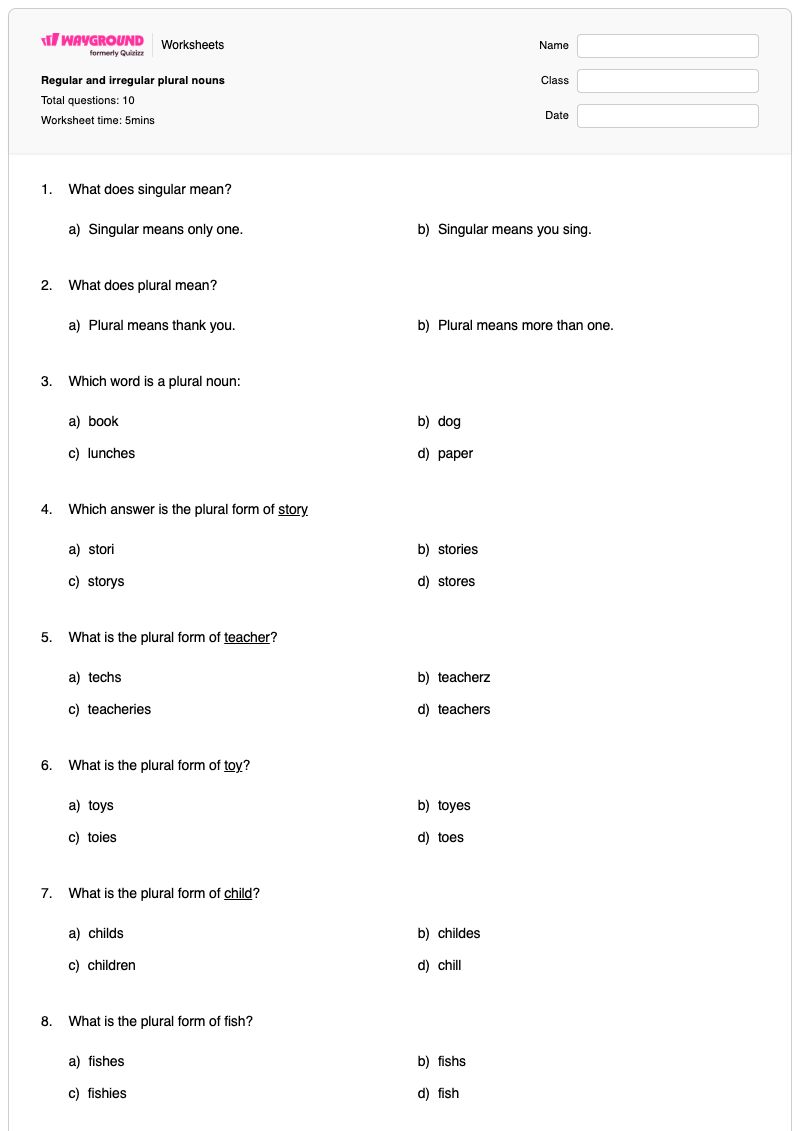
This free printable English worksheet helps students in Grades 2–4 distinguish singular nouns from plural nouns and identify how plural forms are created. Across 10 multiple-choice questions, students recognize that singular means one and plural means more than one, select plural nouns, and choose the correct forms of words such as story, teacher, and toy.
The worksheet also introduces irregular plural nouns through examples such as child becoming children and fish remaining fish, then asks students to distinguish regular and irregular forms using children and libraries. Its focused questions provide a quick practice or review activity for checking students’ understanding of noun number and plural formation. A complete answer key is included for efficient checking and feedback.
Worksheet settings
Font size
S
M
L
XL
Worksheets
Regular and irregular plural nouns
Total questions: 10
Name
Class
Date
1.
What does singular mean?
a)
Singular means only one.
b)
Singular means you sing.
2.
What does plural mean?
a)
Plural means thank you.
b)
Plural means more than one.
3.
Which word is a plural noun:
a)
book
b)
dog
c)
lunches
d)
paper
4.
Which answer is the plural form of story
a)
stori
b)
stories
c)
storys
d)
stores
5.
What is the plural form of teacher?
a)
techs
b)
teacherz
c)
teacheries
d)
teachers
6.
What is the plural form of toy?
a)
toys
b)
toyes
c)
toies
d)
toes
7.
What is the plural form of child?
a)
childs
b)
childes
c)
children
d)
chill
8.
What is the plural form of fish?
a)
fishes
b)
fishs
c)
fishies
d)
fish
9.
Is children a regular plural noun or an irregular plural noun?
a)
regular plural noun
b)
irregular plural noun
10.
Is libraries a regular plural noun or an irregular plural noun?
a)
regular plural noun
b)
irregular plural noun
Answer Key
Regular and irregular plural nouns
Total questions: 10
1.
a)
Singular means only one.
2.
b)
Plural means more than one.
3.
c)
lunches
4.
b)
stories
5.
d)
teachers
6.
a)
toys
7.
c)
children
8.
d)
fish
9.
b)
irregular plural noun
10.
a)
regular plural noun
140 %
Browse by subjects
Browse by grades
Browse by format
FAQs
What does this worksheet help students learn about regular and irregular plural nouns?
This Grade 2–4 English worksheet uses 10 multiple-choice questions to help students distinguish singular nouns from plural nouns and select correct plural forms. Students practise regular forms such as stories, teachers, and toys, recognize irregular forms such as children and fish, and classify children and libraries as irregular or regular plural nouns.
How can I use this worksheet to teach regular and irregular plural nouns?
Begin by reviewing the meanings of singular and plural, then model how the plural forms in the worksheet change, such as story to stories and toy to toys. Use the questions about child, fish, children, and libraries to prompt students to explain why some plural forms cannot be created by simply adding a common ending. Finish with the multiple-choice items independently or discuss each option as a class.
What mistakes should I watch for when students complete this plural nouns worksheet?
Watch for students confusing the meanings of singular and plural or choosing a word that is not plural, such as book or dog, in the noun-identification item. Students may also select invented spellings such as storys, toyes, or childs instead of the forms tested on the worksheet. In the classification questions, check that they distinguish the irregular form children from the regular form libraries.
How do I assign and grade this regular and irregular plural nouns worksheet?
The worksheet is available as a printable PDF and as a digital quiz on Wayground, so you can use the 10 multiple-choice questions for independent practice, review, or assessment. It includes a complete answer key, and printable submissions can be graded by scanning student work with the Wayground for Teachers app. The printable version can also support schools that are reducing screen time.
How can I differentiate this plural nouns worksheet for my students?
Use the worksheet’s Advanced Settings to adjust font spacing or increase the font size so the 10 multiple-choice items and their answer choices are easier to read. You can also enable a dyslexia-friendly font or translate the worksheet into another language while students practise forms such as stories, children, fish, and libraries.
Where can I find more free worksheets like this from Wayground?
Wayground offers a comprehensive collection of free printable worksheets and practice problems across all subjects, with downloadable PDFs and answer keys to support essential skills and concepts. Browse more resources at https://wayground.com/en-us/worksheets.

 Worksheets