

Wayground
Quiz Polarity and IMF - Printable Science Worksheets - Wayground

Quiz Polarity and IMF

14 questions

KG - Kindergarten

Science

This free printable science worksheet, Quiz Polarity and IMF, gives students practice connecting electronegativity to bond polarity and intermolecular forces. The 14-item set includes 11 multiple-choice questions, two classification activities, and one hotspot question covering polar and nonpolar covalent bonds, ionic bonds, dipoles, Lewis-structure charge symbols, and how covalent bonds form. Students use an electronegativity chart to identify the more electronegative atom and calculate the hydrogen–fluorine difference, order bonds by molecular charge, and classify descriptions of bond types. They also identify intermolecular forces, recognize hydrogen bonding in water, and interpret visual models of forces between water molecules and other molecules. Listed for Kindergarten science, the worksheet includes a complete answer key for checking understanding or reviewing misconceptions.

Worksheet settings

Font size

S
M
L
XL
Worksheets

Quiz Polarity and IMF

Total questions: 14

Name
Class
Date
1.
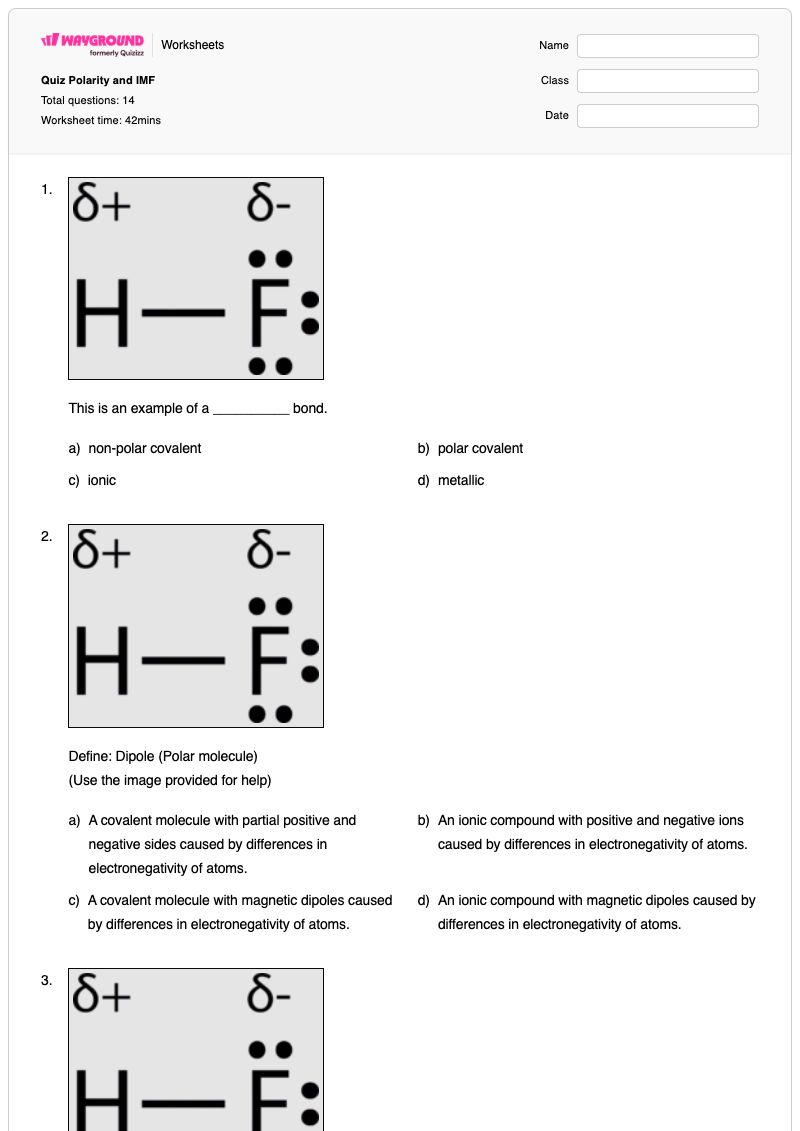
This is an example of a __________ bond.
a)
non-polar covalent
b)
polar covalent
c)
ionic
d)
metallic
2.

Define: Dipole (Polar molecule)

(Use the image provided for help)

a)

A covalent molecule with partial positive and negative sides caused by differences in electronegativity of atoms.

b)

An ionic compound with positive and negative ions caused by differences in electronegativity of atoms.

c)

A covalent molecule with magnetic dipoles caused by differences in electronegativity of atoms.

d)

An ionic compound with magnetic dipoles caused by differences in electronegativity of atoms.

3.

Identify the more electronegative atom using the image provided.

a)

Hydrogen (H)

b)

Fluorine (F)

c)

Both have the same electronegativity

4.

Using your electronegativity chart, calculate the difference in electronegativity between the hydrogen and fluorine bond.

a)

1.9

b)

4.0

c)

-1.9

d)

2.1

5.

Order the types of bonds based on the charge of their molecules. (lowest amount of charge to greatest)

a)

Polar Covalent --> Ionic --> Nonpolar Covalent

b)

Ionic --> Nonpolar Covalent --> Polar Covalent

c)

Ionic --> Polar Covalent --> Nonpolar Covalent

d)

Nonpolar Covalent --> Polar Covalent --> Ionic

6.

In this Lewis structure, the symbol (δ-) above Fluorine means...

a)

Fluorine has formed an anion

b)
electrons are less attracted to F than H
c)
electrons are more attracted to F than H
d)
Fluorine has formed a cation
7.

Explain how covalent bonds form.

a)

Complete transfer of valence electrons between atoms to form ions.

b)
Opposite slight charges attract each other between compounds.
c)
Scientists are still not sure how they form.
d)

Sharing of valence electrons between nonmetal atoms.

8.

Organize these options into the right categories

Categorize the following
Polar Molecule
Nonpolar Molecule
9.

Organize these options into the correct categories

Categorize the following

When electrons are shared unevenly

When one atom takes or gives electrons to another atom

When electrons are shared evenly

Bond formed between a metal and nonmetal atom

Bond between diatomic elements (Br2, Cl2, N2, O2 )

Bond formed between two DIFFERENT nonmetals

Formed by ions held together by electrostatic attraction

Ionic Bond
Polar Covalent Bond
Non-polar Covalent Bond
10.

Click on the more electronegative atom on this water molecule.

11.

Intermolecular forces are the forces...

a)

within molecules that bond atoms together.

b)

between molecules causing them to attract.

12.

Which best explains the very high melting and boiling point of water?

a)

Strong dipole-dipole force between water molecules.

b)

Strong hydrogen bonding force between water molecules.

c)

Weak electron dispersion forces which present in water molecules.

d)

Asymmetrical shape of the polar bonds in water molecules.

13.

Identify the image that correctly show intermolecular forces within ICE (water) molecules.

a)

b)

c)

d)

14.

Identify the image showing the strongest intermolecular forces between molecules.

Each circle represents a molecule.

a)

b)

c)

Answer Key

Quiz Polarity and IMF

Total questions: 14

1.
b) polar covalent
2.
a)

A covalent molecule with partial positive and negative sides caused by differences in electronegativity of atoms.

3.
b)

Fluorine (F)

4.
a)

1.9

5.
d)

Nonpolar Covalent --> Polar Covalent --> Ionic

6.
c) electrons are more attracted to F than H
7.
d)

Sharing of valence electrons between nonmetal atoms.

8.
Polar Molecule
Nonpolar Molecule
9.
Ionic Bond

When one atom takes or gives electrons to another atom

Bond formed between a metal and nonmetal atom

Formed by ions held together by electrostatic attraction

Polar Covalent Bond

When electrons are shared unevenly

Bond formed between two DIFFERENT nonmetals

Non-polar Covalent Bond

When electrons are shared evenly

Bond between diatomic elements (Br2, Cl2, N2, O2 )

10.
11.
b)

between molecules causing them to attract.

12.
b)

Strong hydrogen bonding force between water molecules.

13.
b)

14.
a)

FAQs

What does the Quiz Polarity and IMF worksheet cover?

This worksheet uses multiple-choice, classification, and hotspot questions to help students connect electronegativity with polar covalent bonds, nonpolar covalent bonds, and ionic bonds. Students identify more electronegative atoms, calculate the hydrogen–fluorine electronegativity difference, interpret δ− in a Lewis structure, and classify bond descriptions. The final questions shift to intermolecular forces, including hydrogen bonding and visual comparisons of forces in water and between molecules.

How can I use this worksheet to teach bond polarity and intermolecular forces?

Introduce the worksheet by modeling how to read an electronegativity chart and subtract the hydrogen and fluorine values to find a difference of 1.9. Then have students explain why uneven electron sharing creates a polar bond and use the classification items to compare nonpolar covalent, polar covalent, and ionic bonding. Finish by contrasting forces within a molecule with intermolecular forces between molecules, using the water and ice diagrams as discussion prompts.

What mistakes should I watch for when students complete this polarity and IMF worksheet?

Students may confuse a polar covalent bond with an ionic bond, treat δ− as proof that fluorine has become an anion, or reverse which atom attracts electrons more strongly. In the electronegativity calculation, check that they use the positive difference rather than a negative option. For the classification and visual items, watch for students mixing forces within molecules with forces between molecules or selecting ordinary dipole forces instead of hydrogen bonding to explain water’s high melting and boiling points.

How do I assign and grade the Quiz Polarity and IMF worksheet?

Wayground provides this worksheet as a printable PDF and as a digital quiz, with a complete answer key for the multiple-choice, classification, and hotspot items. You can review the electronegativity, bond-type, and intermolecular-force responses directly in the digital version, or grade printable submissions by scanning student work with the Wayground for Teachers app. The printable format can also support schools that are reducing screen time.

How can I differentiate this worksheet for my students?

Use the worksheet’s Advanced Settings to adjust font spacing and font size so the bond classifications, electronegativity choices, and molecule diagrams are easier to follow. You can also apply a dyslexia-friendly font or translate the worksheet into another language through the same settings. These options can make the scientific vocabulary, symbols, and visual-response items more accessible without changing the questions.

Where can I find more worksheets like this on Wayground?

Wayground offers a broad collection of free printable worksheets and practice problems across subjects, with downloadable PDFs and answer keys to support essential skills and concepts. Browse more resources at https://wayground.com/en-us/worksheets.