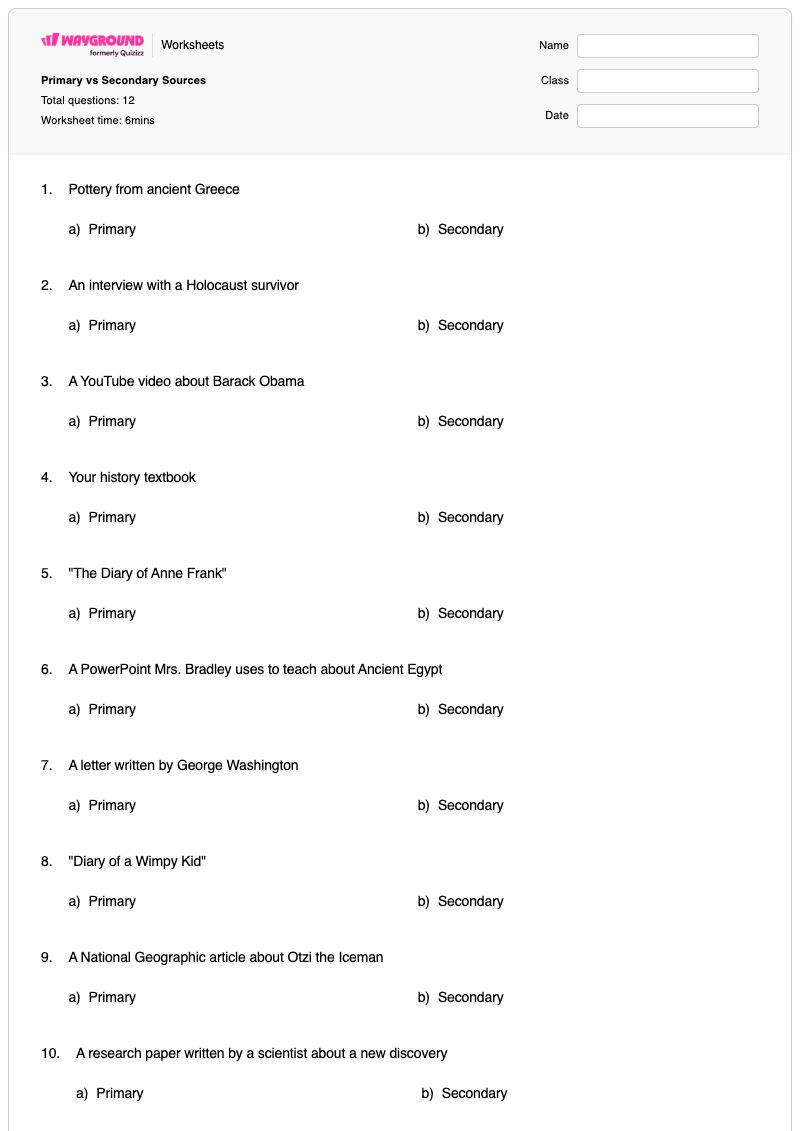
Primary vs Secondary Sources is a Grade 6 social studies worksheet that helps students classify real-world examples as primary or secondary sources. Across 12 multiple-choice questions, students evaluate items such as ancient Greek pottery, an interview with a Holocaust survivor, Anne Frank’s diary, a history textbook, a letter written by George Washington, a research paper, a portrait, and biographies or articles about historical figures and events.
The varied examples help students focus on the nature and origin of a source rather than its format alone. Students must distinguish firsthand or original materials from later interpretations, summaries, and teaching resources, including less obvious examples such as a diary-based novel and a scientist’s research paper. This free printable worksheet is designed for Grade 6 social studies instruction, independent practice, review, or a quick formative assessment. A complete answer key is included for efficient checking and feedback.
Worksheet settings
Font size
S
M
L
XL
Worksheets
Primary vs Secondary Sources
Total questions: 12
Name
Class
Date
1.
Pottery from ancient Greece
a)
Primary
b)
Secondary
2.
An interview with a Holocaust survivor
a)
Primary
b)
Secondary
3.
A YouTube video about Barack Obama
a)
Primary
b)
Secondary
4.
Your history textbook
a)
Primary
b)
Secondary
5.
"The Diary of Anne Frank"
a)
Primary
b)
Secondary
6.
A PowerPoint Mrs. Bradley uses to teach about Ancient Egypt
a)
Primary
b)
Secondary
7.
A letter written by George Washington
a)
Primary
b)
Secondary
8.
"Diary of a Wimpy Kid"
a)
Primary
b)
Secondary
9.
A National Geographic article about Otzi the Iceman
a)
Primary
b)
Secondary
10.
A research paper written by a scientist about a new discovery
a)
Primary
b)
Secondary
11.
A painted portrait of Thomas Jefferson
a)
Primary
b)
Secondary
12.
A biography about Donald Trump
a)
Primary
b)
Secondary
Answer Key
Primary vs Secondary Sources
Total questions: 12
1.
a)
Primary
2.
a)
Primary
3.
b)
Secondary
4.
b)
Secondary
5.
a)
Primary
6.
b)
Secondary
7.
a)
Primary
8.
a)
Primary
9.
b)
Secondary
10.
a)
Primary
11.
a)
Primary
12.
b)
Secondary
140 %
Browse by subjects
Browse by grades
Browse by format
FAQs
What does the Primary vs Secondary Sources worksheet cover?
This Grade 6 social studies worksheet uses 12 multiple-choice questions to ask students whether examples such as pottery, interviews, diaries, letters, textbooks, articles, portraits, and biographies are primary or secondary sources. Classifying these varied examples helps students identify a source’s role and origin instead of relying only on its format or subject.
How can I use this worksheet to teach primary and secondary sources?
Introduce the distinction by having students examine who created each source and whether it presents original material or a later account. Then use the worksheet’s examples—such as George Washington’s letter, Anne Frank’s diary, a history textbook, and a National Geographic article—to prompt students to explain the clue that supports each choice before completing the multiple-choice questions independently.
What mistakes should I watch for when students complete this worksheet?
Students may classify every book or written item as secondary, even though the worksheet identifies both “The Diary of Anne Frank” and “Diary of a Wimpy Kid” as primary sources. They may also confuse a source’s subject with its type, such as labeling a biography about Donald Trump or an article about Otzi the Iceman as primary simply because it discusses a real person or discovery.
How do I assign and grade this Primary vs Secondary Sources worksheet?
Wayground provides this worksheet as a printable PDF and as a digital quiz, and it includes a complete answer key for all 12 multiple-choice questions. For printable submissions, you can scan student work with the Wayground for Teachers app to streamline grading and review.
How can I differentiate this primary and secondary sources worksheet for my students?
Use the worksheet’s Advanced Settings to adjust font spacing and font size so the 12 source-classification questions are easier to read. You can also enable a dyslexia-friendly font or translate the worksheet into another language when those options support access to the examples and answer choices.
Where can I find more worksheets like this on Wayground?
Wayground offers a broad collection of free printable worksheets and practice problems across subjects, with downloadable PDFs and answer keys to support essential skills and concepts. Browse more resources at https://wayground.com/en-us/worksheets.

 Worksheets