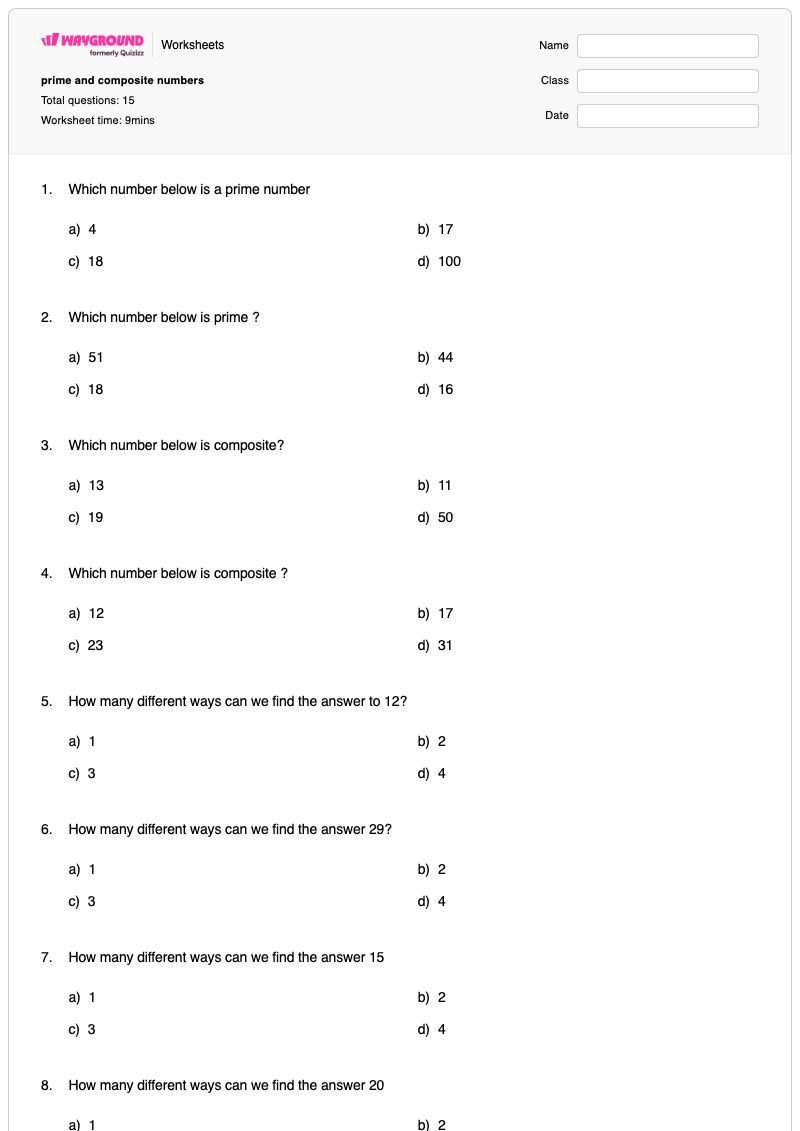
This Grade 4 mathematics worksheet gives students focused practice identifying and classifying prime and composite numbers through factor pairs. It includes 13 multiple-choice questions and 2 fill-in-the-blank items that ask students to recognize numbers with one factor pair, identify numbers with multiple factor pairs, define prime and composite numbers, and select the first factor pair for 8. The worksheet also includes four multiple-choice application problems involving subtraction with money, finding change, multiplying after taking half of a number, and combining a half-price cost with an additional fee. These items provide practice applying calculation skills in practical contexts after working with number classification.
Use this resource for independent practice, small-group review, homework, or a quick Grade 4 mathematics check. Students can explain how factor pairs support prime and composite classification while showing whether they can transfer subtraction, multiplication, division-by-half, and decimal-money skills to word problems. This is a free printable worksheet with a complete answer key for efficient checking.
Worksheet settings
Font size
S
M
L
XL
Worksheets
prime and composite numbers
Total questions: 15
Name
Class
Date
1.
Which number below is a prime number
a)
4
b)
17
c)
18
d)
100
2.
Which number below is prime ?
a)
51
b)
44
c)
18
d)
16
3.
Which number below is composite?
a)
13
b)
11
c)
19
d)
50
4.
Which number below is composite ?
a)
12
b)
17
c)
23
d)
31
5.
How many different ways can we find the answer to 12?
a)
1
b)
2
c)
3
d)
4
6.
How many different ways can we find the answer 29?
a)
1
b)
2
c)
3
d)
4
7.
How many different ways can we find the answer 15
a)
1
b)
2
c)
3
d)
4
8.
How many different ways can we find the answer 20
a)
1
b)
2
c)
3
d)
4
9.
A (a) number is a number with more than one way to find it's answer
10.
A (a) number is an answer you can only get when you multiply by one.
11.
What is the 1st factor pair of 8
a)
(1,9)
b)
(2,4)
c)
(1,8)
d)
0
12.
Jessica needed money to help pay for concert tickets. She only has $28 dollars saved and the tickets cost $133. How much more does she need to save?
a)
$22
b)
$105
c)
$288
d)
$57
13.
Sandy went to the store with a $100 dollar bill. Her mom gave her a list with 15 items on it and the total cost for it all is $76.32. How much change did she return to her mother>
a)
$23.11
b)
$23.68
c)
$32.76
d)
$3.90
14.
What is 3 times, half of 640?
a)
960
b)
899
c)
233
d)
822
15.
Karen took his pet to get groomed on Sunday for $15.00. They were having a special for pets with spots, half price. Spark had spots, but he wanted his nails clipped also, which was an extra 13.00. How much did he spend in all?
a)
21.00
b)
20.00
c)
20.50
d)
20.90
Answer Key
prime and composite numbers
Total questions: 15
1.
b)
17
2.
a)
51
3.
d)
50
4.
a)
12
5.
c)
3
6.
a)
1
7.
b)
2
8.
c)
3
9.
Composite , composite, COMPOSITE
10.
Prime, PRIME, prime
11.
c)
(1,8)
12.
b)
$105
13.
b)
$23.68
14.
a)
960
15.
c)
20.50
140 %
Browse by subjects
Browse by grades
Browse by format
FAQs
What does this prime and composite numbers worksheet cover?
This Grade 4 worksheet uses 13 multiple-choice questions and 2 fill-in-the-blank items to practice classifying numbers as prime or composite through their factor pairs. Students determine how many factor-pair combinations numbers such as 12, 15, 20, and 29 have, identify the first factor pair of 8, and complete definitions for prime and composite numbers. Four additional multiple-choice problems apply subtraction, money, halves, and multiplication in everyday contexts.
How can I use this worksheet to teach prime and composite numbers?
First model how to list factor pairs systematically, such as 1 × 12, 2 × 6, and 3 × 4 for 12, then have students explain why the number of pairs matters. Use the questions about 12, 15, 20, and 29 to compare numbers with multiple factor pairs against a number with only one factor pair. Before the final four word problems, ask students to underline the operation or sequence of operations needed, such as finding half before multiplying by 3.
What mistakes should I watch for when students complete this worksheet?
Students may count individual factors instead of factor pairs, overlook a pair, or treat 1 as a complete factor pair without identifying its partner. They may also confuse the first factor pair of 8 with 2 × 4, although the worksheet asks for the pair beginning with 1. In the application items, check for errors such as subtracting $28 from $133 in the wrong order, finding the wrong amount of change from $100, or applying the half-price discount and added nail-clipping fee in the wrong sequence.
How do I assign and grade this prime and composite numbers worksheet?
On Wayground, assign it as a digital quiz or download the printable PDF for students to complete on paper. The worksheet includes a complete answer key for checking the factor-pair classifications, definitions, and application problems. Printable submissions can also be graded by scanning student work with the Wayground for Teachers app.
How can I differentiate this worksheet for my students?
Use the worksheet’s Advanced Settings to adjust font spacing or choose a larger font size so the multiple-choice options, factor-pair expressions, and money word problems are easier to read. You can also enable a dyslexia-friendly font for the prime and composite definitions and translate the worksheet into another language when students need language support. These changes apply to the worksheet file itself while preserving its question format.
Where can I find more free worksheets like this on Wayground?
Wayground offers a comprehensive collection of free printable worksheets and practice problems across subjects, with downloadable PDFs and answer keys to help students master essential skills and concepts. Browse more resources at https://wayground.com/en-us/worksheets.


 Worksheets