This free printable Producers, Consumers, & Decomposers worksheet helps students in Grades 3–5 classify organisms by how they obtain energy and function in an ecosystem. Across 10 multiple-choice questions, students identify trees as producers, organisms such as deer and leopards by their diets, dung beetles as decomposers, and animals such as bears, chimpanzees, coyotes, and sharks as herbivores, omnivores, or carnivores based on the foods they eat.
The worksheet gives students focused practice connecting definitions to familiar animal and ecosystem examples. Students must distinguish organisms that make their own food, obtain energy by eating other organisms, and break down waste, while also using diet evidence to select herbivore, carnivore, or omnivore. It is suitable for science instruction, review, independent practice, or a quick formative assessment, and includes a complete answer key for efficient checking.
Worksheet settings
Font size
S
M
L
XL
Worksheets
Producers, Consumers, & Decomposers
Total questions: 10
Name
Class
Date
1.
A tree is a __________ because it makes its own food using a process called photosynthesis.
a)
producer
b)
consumer
c)
decomposer
2.
Deer are classified as ____________ because they eat only plants.
a)
omnivore
b)
herbivore
c)
carnivore
3.
A dung beetle is classified as a __________because it is an organism that breaks down waste in its ecosystem.
a)
consumer
b)
decomposer
c)
producer
4.
A ___________ obtains its energy through another organism.
a)
consumer
b)
producer
c)
decomposer
5.
A leopard is a ______________ because it obtains its energy by eating other animals.
a)
herbivore
b)
onmivore
c)
carnivore
6.
A bear is classified as a _______________ because it eats different types of berries and fish.
a)
herbivore
b)
omnivore
c)
carnivore
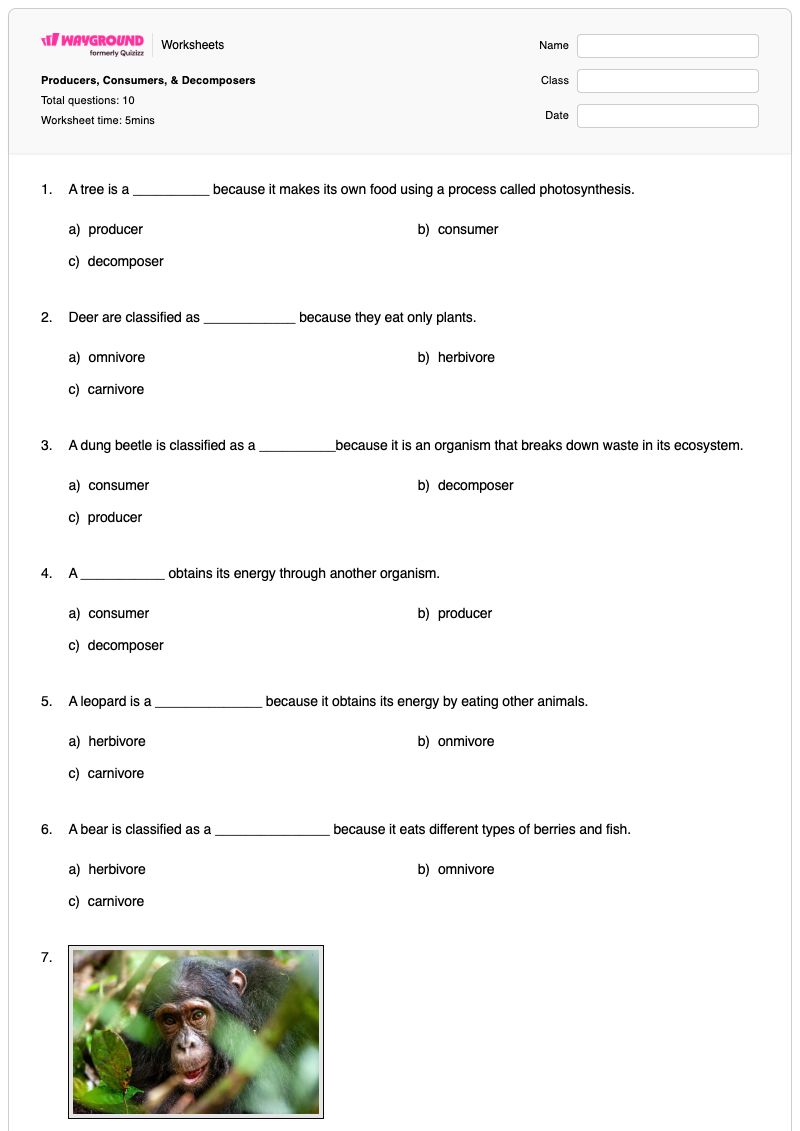
7.
A Chimpanzee is a ____________ because it eats small monkeys, small antelope, nuts, and seeds.
a)
carnivore
b)
herbivore
c)
omnivore
8.
A goat is a ____________ because it eats grains, grass, hay, and tree bark
a)
carnivore
b)
herbivore
c)
omnivore
9.
A coyote is a ____________ because it eats rabbits, dear, snakes, and grass
a)
carnivore
b)
herbivore
c)
omnivore
10.
A shark is a ____________ because it eats seals, squid, fish, and sea turtles.
a)
omnivore
b)
carnivore
c)
herbivore
Answer Key
Producers, Consumers, & Decomposers
Total questions: 10
1.
a)
producer
2.
b)
herbivore
3.
b)
decomposer
4.
a)
consumer
5.
c)
carnivore
6.
b)
omnivore
7.
c)
omnivore
8.
b)
herbivore
9.
c)
omnivore
10.
b)
carnivore
140 %
Browse by subjects
Browse by grades
Browse by format
FAQs
What does the Producers, Consumers, & Decomposers worksheet cover?
This Grade 3–5 science worksheet uses 10 multiple-choice questions to help students classify organisms by their roles and energy sources. Students identify producers such as trees, decomposers such as dung beetles, and consumers, then use animal diets to distinguish herbivores, carnivores, and omnivores. The questions build classification skills by requiring students to connect each definition or food example to the correct term.
How can I use this worksheet to teach producers, consumers, and decomposers?
Introduce the three ecosystem roles with a simple comparison: producers make their own food, consumers obtain energy through other organisms, and decomposers break down waste. Then use the worksheet’s sentence stems to have students underline the evidence—for example, “makes its own food,” “eats only plants,” or “breaks down waste”—before choosing an answer. Afterward, discuss how the food examples for the bear, chimpanzee, coyote, and shark support the herbivore, omnivore, or carnivore classifications.
What mistakes should I watch for when students complete this worksheet?
Students may confuse a consumer with a decomposer because both obtain energy from material outside themselves; reinforce that the worksheet defines consumers through eating other organisms and decomposers through breaking down waste. They may also classify an animal from one food alone instead of considering the full list: animals that eat both plant and animal foods, such as bears, chimpanzees, and coyotes in these questions, are omnivores. Watch for students selecting producer for an animal or overlooking that a tree makes its own food through photosynthesis.
How do I assign and grade this worksheet?
You can assign this worksheet as a printable PDF or as a digital quiz on Wayground. It includes a complete answer key, and printable submissions can be graded by scanning student work with the Wayground for Teachers app. The printable format also gives schools an option for reducing screen time while students practise organism classification.
How can I differentiate this worksheet for my students?
Use the worksheet’s Advanced Settings to adjust font spacing or increase the font size so the 10 multiple-choice sentence stems and answer choices are easier to read. You can also apply a dyslexia-friendly font or translate the worksheet into another language. These options preserve the worksheet’s focus on classifying producers, consumers, decomposers, and animal diets while changing the presentation of the items.
Where can I find more worksheets like this on Wayground?
Wayground offers a comprehensive collection of free printable worksheets and practice problems across all subjects, with downloadable PDFs and answer keys to support essential skills and concepts. Browse more resources at https://wayground.com/en-us/worksheets.

 Worksheets


