The 5th Grade Profit and Loss Word Problems Challenge helps students calculate profit or gain from everyday buying and selling situations. Across 10 multiple-choice questions, students use purchase cost, selling price, quantity, and total revenue to determine the profit made when all items are sold. Contexts include toys, a bicycle, apples, cupcakes, books, dolls, and other familiar products, giving learners repeated practice applying subtraction and multiplication in word problems.
Designed for Grade 5 mathematics and math-focused English practice, this worksheet supports lessons on interpreting financial information and selecting a correct calculation from several options. It is useful for guided practice, independent review, homework, or a quick formative assessment of students’ ability to distinguish cost from selling price and calculate total profit. This free printable worksheet includes a complete answer key for efficient checking.
Worksheet settings
Font size
S
M
L
XL
Worksheets
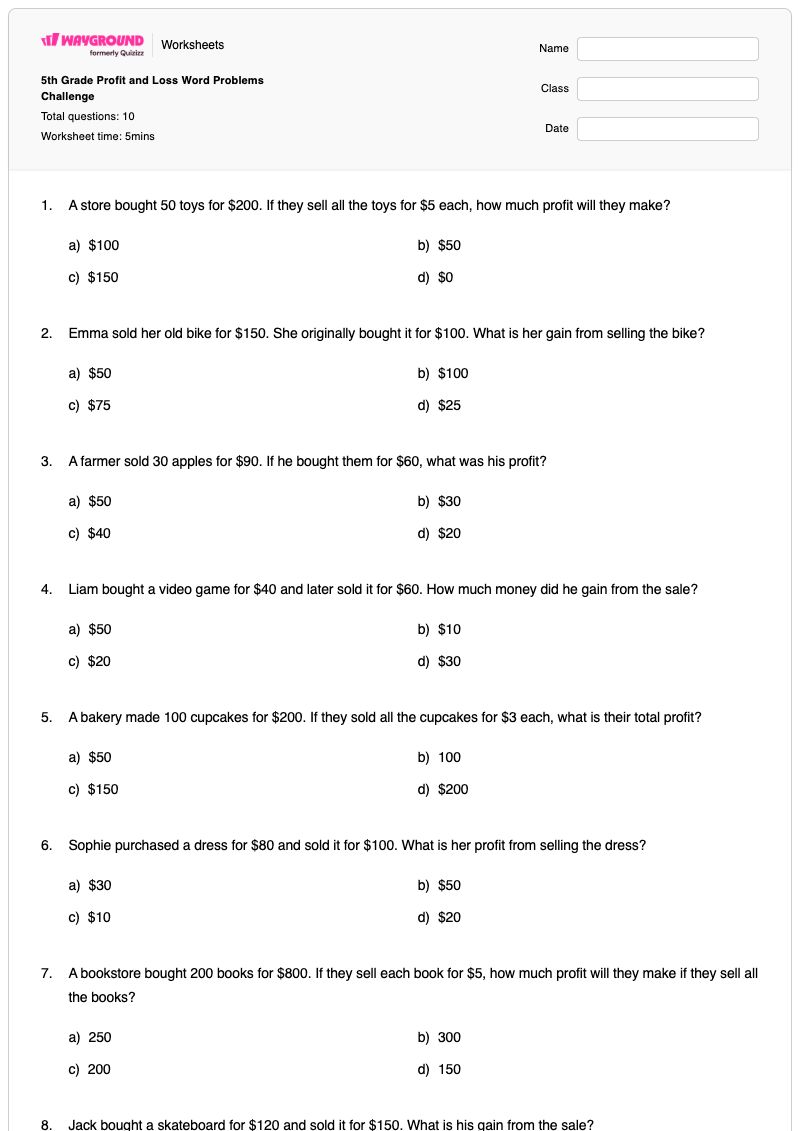
5th Grade Profit and Loss Word Problems Challenge
Total questions: 10
Name
Class
Date
1.
A store bought 50 toys for $200. If they sell all the toys for $5 each, how much profit will they make?
a)
$100
b)
$50
c)
$150
d)
$0
2.
Emma sold her old bike for $150. She originally bought it for $100. What is her gain from selling the bike?
a)
$50
b)
$100
c)
$75
d)
$25
3.
A farmer sold 30 apples for $90. If he bought them for $60, what was his profit?
a)
$50
b)
$30
c)
$40
d)
$20
4.
Liam bought a video game for $40 and later sold it for $60. How much money did he gain from the sale?
a)
$50
b)
$10
c)
$20
d)
$30
5.
A bakery made 100 cupcakes for $200. If they sold all the cupcakes for $3 each, what is their total profit?
a)
$50
b)
100
c)
$150
d)
$200
6.
Sophie purchased a dress for $80 and sold it for $100. What is her profit from selling the dress?
a)
$30
b)
$50
c)
$10
d)
$20
7.
A bookstore bought 200 books for $800. If they sell each book for $5, how much profit will they make if they sell all the books?
a)
250
b)
300
c)
200
d)
150
8.
Jack bought a skateboard for $120 and sold it for $150. What is his gain from the sale?
a)
$20
b)
$30
c)
$50
d)
$10
9.
A toy company produced 500 dolls at a cost of $1,000. If they sell each doll for $3, what is their total profit if all dolls are sold?
a)
400
b)
500
c)
600
d)
300
10.
Mia bought a painting for $200 and later sold it for $250. How much profit did she make from the sale?
a)
$50
b)
$25
c)
$100
d)
$75
Answer Key
5th Grade Profit and Loss Word Problems Challenge
Total questions: 10
1.
b)
$50
2.
a)
$50
3.
b)
$30
4.
c)
$20
5.
b)
100
6.
d)
$20
7.
c)
200
8.
b)
$30
9.
b)
500
10.
a)
$50
140 %
Browse by subjects
Browse by grades
Browse by format
FAQs
What does the 5th Grade Profit and Loss Word Problems Challenge cover?
This worksheet covers calculating profit or gain in 10 multiple-choice word problems involving purchase cost, selling price, quantity, and total revenue. Students determine the profit for individual items, such as a bike or video game, and for larger groups of products, such as toys, books, cupcakes, and dolls. Completing these items builds fluency with subtracting total cost from total selling revenue and interpreting financial information in context.
How can I use this worksheet to teach profit and loss word problems?
Introduce the worksheet by modeling one item-level example, identifying the cost price and selling price before finding the difference. Then model a quantity-based example by calculating total revenue first, such as multiplying the number of books by the selling price, and subtracting the stated total cost. Have students explain why the multi-item questions require an extra multiplication step before completing the remaining multiple-choice problems independently.
What mistakes should I watch for when students complete these profit word problems?
Students may subtract the selling price from the cost price, choose the selling price itself as the profit, or confuse gain with the original purchase cost. In the questions involving 50 toys, 100 cupcakes, 200 books, or 500 dolls, watch for students who calculate the profit per item but fail to multiply across all items. Students may also overlook that the problem asks for total profit when every product is sold.
How do I assign and grade this profit and loss worksheet?
The worksheet is available as a printable PDF and as a digital quiz on Wayground, so you can use the 10 multiple-choice profit problems for independent practice, homework, or assessment. It includes a complete answer key, and printable submissions can be graded by scanning student work with the Wayground for Teachers app. The printable format can also support schools that are reducing screen time.
How can I differentiate this worksheet for my students?
For the 10 multiple-choice profit word problems, use Advanced Settings to adjust font spacing and font size so the cost, selling price, quantity, and answer choices are easier to follow. You can also enable a dyslexia-friendly font or translate the worksheet into another language when those changes help students interpret the financial vocabulary and multi-step calculations.
Where can I find more worksheets like this on Wayground?
Wayground offers a comprehensive collection of free printable worksheets and practice problems across subjects, with downloadable PDFs and answer keys to help students master essential skills and concepts. Browse more resources at https://wayground.com/en-us/worksheets.

 Worksheets