

Wayground
6th 4-2 Properties of Equality - Printable Math Worksheets 6th Grade - Wayground

6th 4-2 Properties of Equality

Ryan Wolf

Created by Ryan Wolf

15 questions

6th Grade

Math

Updated Oct 2026

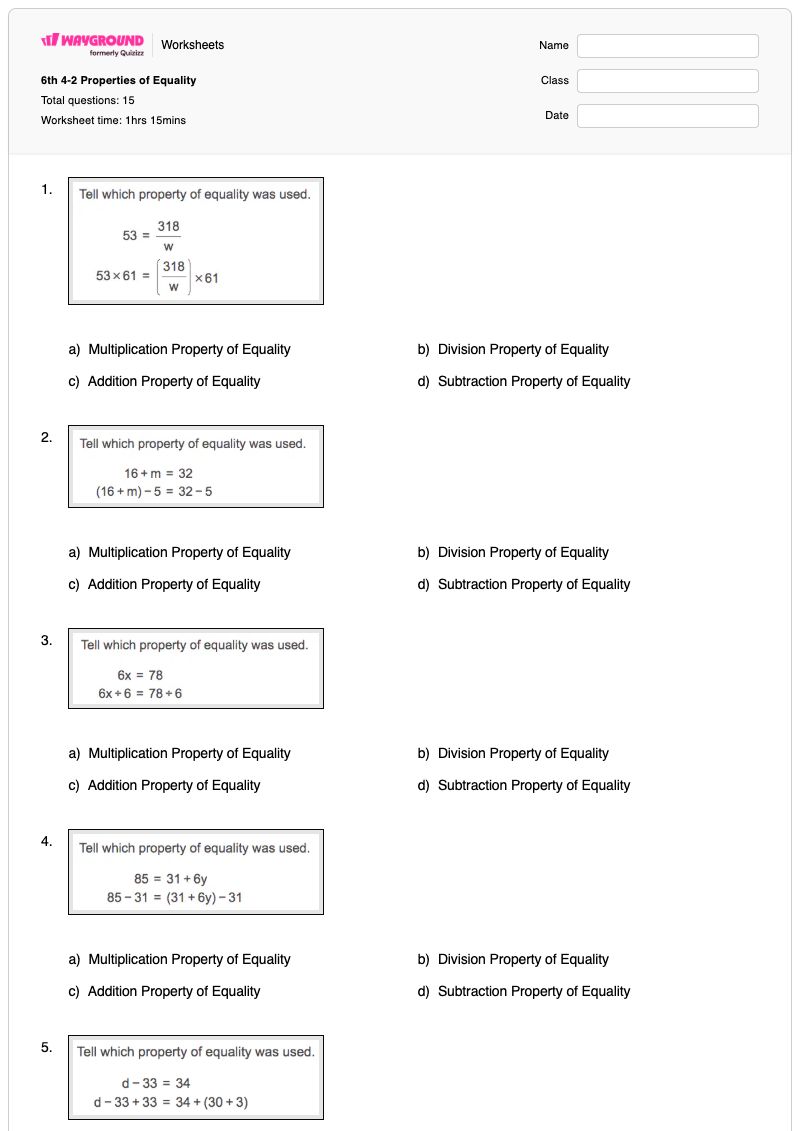
This Grade 6 mathematics worksheet gives students practice with properties of equality through 15 multiple-choice questions. Students decide whether equations remain true when the same operation—such as addition or division—is applied to both sides, and explain why an equation does or does not preserve equality. The questions also include identifying the base of a power, finding the greatest common factor, evaluating an expression by substitution, using the Distributive Property, and simplifying expressions by combining like terms. Use this worksheet to reinforce foundational algebra skills and check whether students can distinguish valid equation transformations from changes that produce unequal expressions. Its selected-response format is useful for independent practice, review, homework, or a quick formative assessment in a Grade 6 math class. This is a free printable worksheet with a complete answer key for efficient checking and feedback.

Worksheet settings

Font size

S
M
L
XL
WaygroundWorksheets

6th 4-2 Properties of Equality

Total questions: 15

Name
Class
Date
1.
Question Image

a)

Multiplication Property of Equality

b)

Division Property of Equality

c)

Addition Property of Equality

d)

Subtraction Property of Equality

2.
Question Image

a)

Multiplication Property of Equality

b)

Division Property of Equality

c)

Addition Property of Equality

d)

Subtraction Property of Equality

3.
Question Image

a)

Multiplication Property of Equality

b)

Division Property of Equality

c)

Addition Property of Equality

d)

Subtraction Property of Equality

4.
Question Image

a)

Multiplication Property of Equality

b)

Division Property of Equality

c)

Addition Property of Equality

d)

Subtraction Property of Equality

5.
Question Image

a)

Multiplication Property of Equality

b)

Division Property of Equality

c)

Addition Property of Equality

d)

Subtraction Property of Equality

6.
Question Image

a)

Multiplication Property of Equality

b)

Division Property of Equality

c)

Addition Property of Equality

d)

Subtraction Property of Equality

7.

If 9×4=36​, does 9×4+5=36+6​? Explain.

a)

No. A different number was added to each side of the equation.

b)

No. The second equation is not exactly the same as the first​ equation, so it cannot be true.

c)

Yes. The same number was added to each side of the equation.

d)

Yes. Both equations have 9×4 on the left side and 36 on the right side.

8.

If 4m=130​, does 4m÷4=130÷4​? Explain.

a)

No. Each side was divided by a different number.

b)

No. The second equation is not exactly the same as the first​ equation, so it cannot be true.

c)

Yes. Both equations have 4m on the left side and 130 on the right side.

d)

Yes. Each side was divided by the same number.

9.

If a÷4=11​, does a÷4+4=11+4​? Explain.

a)

No. A different number was added to each side of the equation.

b)

Yes. Both equations have a÷4 on the left side and 11 on the right side.

c)

Yes. The same number was added to each side of the equation.

d)

No. The second equation is not exactly the same as the first​ equation, so it cannot be true.

10.

Answer yes or​ no, and explain why or why not.

If 4s−2=​12, does ​(4s−​2)÷2=12÷​2?

a)

No. Each side is divided by a different number.

b)

No. The second equation is not exactly the same as the first​ equation, so it cannot be true.

c)

Yes. Both equations have 4s−2 on the left side and 12 on the right side.

d)

Yes. Each side is divided by the same number.

11.

What is the base: 24

a)

2

b)

4

c)

8

d)

16

12.

Find the GCF of 14 and 24.

a)

2

b)

3

c)

6

d)

336

13.


 Evaluate the exp⁡resion s2 + 2 for s = 14Evaluate\ the\ \exp resion\ s^2\ +\ 2\ for\ s\ =\ \frac{1}{4}  

a)

 21162\frac{1}{16}  

b)

 2182\frac{1}{8}  

c)

 4144\frac{1}{4}  

d)

2

14.

Use the Distributive Property to simplify the expression.

4(2n + 3) - 4

a)

8n + 8

b)

8n - 4

c)

7

d)

8n - 1

15.

Simplify the expression.

 12n +2x −3 + 5.2x −4n\frac{1}{2}n\ +2x\ -3\ +\ 5.2x\ -4n  

a)

 0.70.7  

b)

 212n +1.2x−32\frac{1}{2}n\ +1.2x-3  

c)

 −312n+7.2x−3-3\frac{1}{2}n+7.2x-3  

d)

 2.5nx−3+1.2xn2.5nx-3+1.2xn  

WaygroundAnswer Key

6th 4-2 Properties of Equality

Total questions: 15

1.
a)

Multiplication Property of Equality

2.
d)

Subtraction Property of Equality

3.
b)

Division Property of Equality

4.
d)

Subtraction Property of Equality

5.
c)

Addition Property of Equality

6.
d)

Subtraction Property of Equality

7.
a)

No. A different number was added to each side of the equation.

8.
d)

Yes. Each side was divided by the same number.

9.
c)

Yes. The same number was added to each side of the equation.

10.
d)

Yes. Each side is divided by the same number.

11.
a)

2

12.
a)

2

13.
a)

 21162\frac{1}{16}  

14.
a)

8n + 8

15.
c)

 −312n+7.2x−3-3\frac{1}{2}n+7.2x-3  

FAQs

What does the 6th 4-2 Properties of Equality worksheet cover?

This Grade 6 worksheet uses 15 multiple-choice questions to assess whether students can preserve equality by applying the same operation to both sides of an equation, including addition and division. It also reinforces related expression skills by asking students to identify a base, find a GCF, evaluate a power-based expression by substitution, apply the Distributive Property, and combine like terms.

How can I use this worksheet to teach properties of equality?

First model one equation transformation, such as dividing both sides of 4m = 130 by 4, and have students state the operation performed on each side. Then use the worksheet’s yes-or-no equation items for partner discussion: students should identify whether the same operation was applied to both sides and justify their multiple-choice selection before moving to the expression-simplification questions.

What mistakes should I watch for on this properties of equality worksheet?

Students may accept an equation when different numbers were added to the two sides, or reject a valid equation simply because its appearance changed. In the expression items, watch for confusing the base and exponent, failing to substitute the given value before evaluating, distributing incorrectly in 4(2n + 3) - 4, or combining unlike terms instead of combining the n-terms and x-terms separately.

How do I assign and grade this worksheet?

The worksheet is available as a printable PDF and as a digital quiz on Wayground, so you can use the 15 multiple-choice questions for paper practice or online assessment. It includes a complete answer key, and printable submissions can be graded by scanning student work with the Wayground for Teachers app.

How can I differentiate this worksheet for my students?

For the equation transformations and algebraic-expression choices on this worksheet, use Advanced Settings to adjust font spacing or select a larger font size so symbols, fractions, and answer options are easier to read. You can also apply a dyslexia-friendly font or translate the worksheet into another language when those versions support access to the mathematical directions and expressions.

Where can I find more worksheets like this on Wayground?

Wayground offers a broad collection of free printable worksheets and practice problems across all subjects, with downloadable PDFs and answer keys to support mastery of essential skills and concepts. Browse more resources at https://wayground.com/en-us/worksheets.