
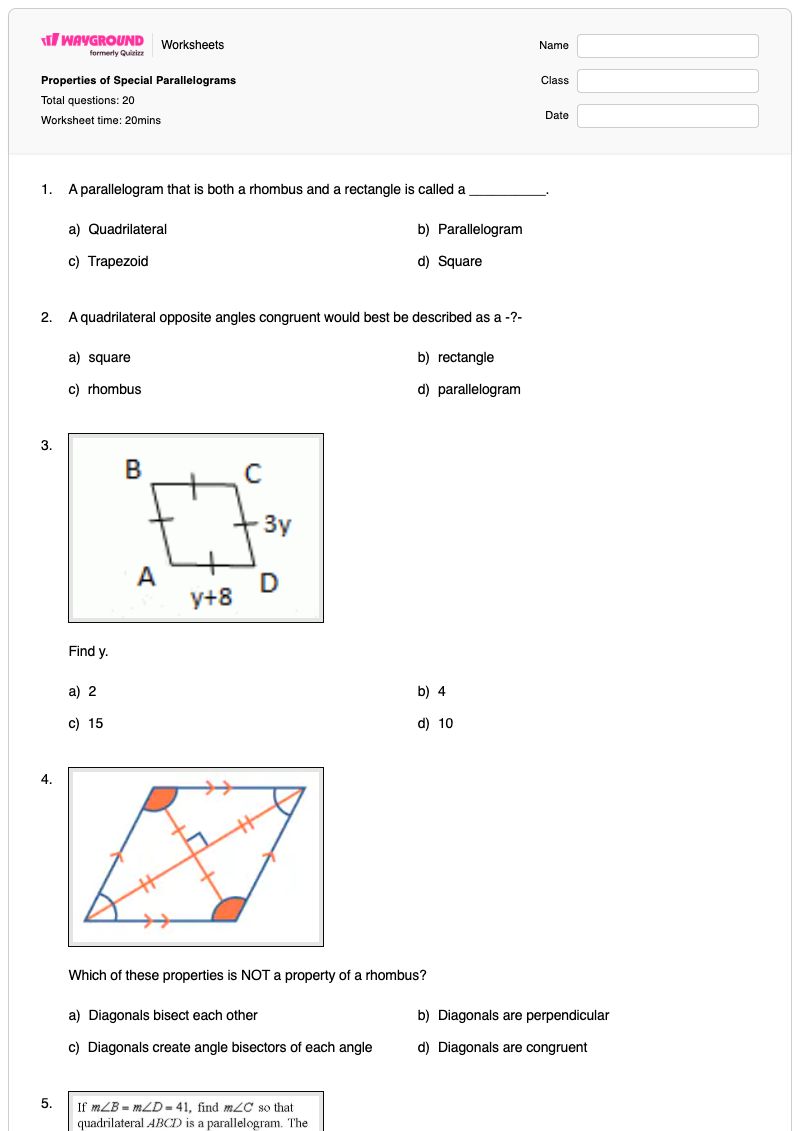

Properties of Special Parallelograms is a Grade 10 mathematics worksheet with 20 multiple-choice questions focused on identifying and distinguishing parallelograms, rhombi, rectangles, and squares. Students classify quadrilaterals from defining properties, recognize relationships among sides, angles, and diagonals, and determine missing angle or variable measures from diagrams.
The questions strengthen precise geometric reasoning by asking students to distinguish properties that special parallelograms share from those that set them apart—for example, identifying a rhombus from its congruent sides and recognizing when a parallelogram is also a square. This free printable worksheet includes a complete answer key for efficient review, independent practice, homework, or a quick Grade 10 geometry check.
Worksheet settings
Font size
S
M
L
XL
Worksheets
Properties of Special Parallelograms
Total questions: 20
Name
Class
Date
1.
A parallelogram that is both a rhombus and a rectangle is called a __________.
a)
Quadrilateral
b)
Parallelogram
c)
Trapezoid
d)
Square
2.
A quadrilateral opposite angles congruent would best be described as a -?-
a)
square
b)
rectangle
c)
rhombus
d)
parallelogram
3.
Find y.
a)
2
b)
4
c)
15
d)
10
4.
Which of these properties is NOT a property of a rhombus?
a)
Diagonals bisect each other
b)
Diagonals are perpendicular
c)
Diagonals create angle bisectors of each angle
d)
Diagonals are congruent
5.
a)
139
b)
41
c)
180
d)
10
6.
a)
A
b)
B
c)
C
d)
D
7.
Find the measure of angle 4
a)
50
b)
25
c)
90
d)
65
8.
The diagonals of a rhombus
a)
never intersect
b)
bisect the opposite angles
c)
are congruent
d)
bisect the sides
9.
Find the measure of angle 4
a)
44
b)
68
c)
90
d)
136
10.
Which quadrilateral has all the properties listed: - All sides are congruent - Opposite sides are parallel - Opposite angles are congruent -Sides are not perpendicular
a)
Square
b)
Rectangle
c)
Trapezoid
d)
Rhombus
11.
Do diagonals of a rectangle bisect each other?
a)
Yes
b)
No
12.
A rhombus is ______________.
a)
A parallelogram with four congruent sides.
b)
A parallelogram with four right angles.
c)
A parallelogram with four congruent sides and four right angles.
d)
A parallelogram with congruent diagonals.
13.
Find the measure of ∠BAE
a)
90°
b)
23°
c)
67°
d)
5°
14.
Which choice is NOT true for a RHOMBUS?
a)
Diagonals bisect each other
b)
Diagonals are perpendicular
c)
Diagonals are congruent
d)
Diagonals bisect opposite angles
15.
Find the measure of angle 1
a)
54
b)
108
c)
72
d)
36
16.
In a rhombus, all four sides are congruent.
a)
True
b)
False
17.
Q1. What is the capital of France?
a)
A) 90
b)
B) 23
c)
C) 22
d)
D) 180
18.
What is the value of x?
a)
132
b)
66
c)
114
d)
48
19.
Which statement is true?
a)
A rhombus is never a square.
b)
A rhombus is always a square.
c)
A rhombus is never a rectangle.
d)
A rhombus is always a parallelogram.
20.
The figure is a parallelogram. Solve for x.
a)
7
b)
2
c)
0
d)
4
Answer Key
Properties of Special Parallelograms
Total questions: 20
1.
d)
Square
2.
d)
parallelogram
3.
b)
4
4.
d)
Diagonals are congruent
5.
a)
139
6.
c)
C
7.
b)
25
8.
b)
bisect the opposite angles
9.
c)
90
10.
d)
Rhombus
11.
a)
Yes
12.
a)
A parallelogram with four congruent sides.
13.
c)
67°
14.
c)
Diagonals are congruent
15.
c)
72
16.
a)
True
17.
c)
C) 22
18.
b)
66
19.
d)
A rhombus is always a parallelogram.
20.
a)
7
140 %
Browse by subjects
Browse by grades
Browse by format
FAQs
What does the Properties of Special Parallelograms worksheet cover?
This Grade 10 worksheet uses 20 multiple-choice questions to assess classification of parallelograms, rhombi, rectangles, and squares. Students identify defining side, angle, and diagonal properties, determine which statements are not true for a rhombus, and solve for missing angle or variable measures shown in diagrams.
How can I use this worksheet to teach the properties of special parallelograms?
Use the classification questions to begin by having students compare the defining properties of a parallelogram, rectangle, rhombus, and square. Then have students justify the multiple-choice answers about diagonals before solving the missing-angle and variable-measure items, asking them to name the property or relationship used for each choice.
What mistakes should I watch for when students complete this special parallelograms worksheet?
Students may confuse properties shared by all parallelograms with properties unique to rectangles or rhombi, especially when deciding whether diagonals are perpendicular, congruent, or angle-bisecting. They may also select an angle measure without matching the diagram’s labels to the correct supplementary, congruent, or bisected-angle relationship, so ask them to show the property behind each calculation.
How do I assign and grade this special parallelograms worksheet?
The worksheet is available as a printable PDF and as a digital quiz on Wayground, and it includes a complete answer key for the 20 multiple-choice questions. You can grade printable submissions by scanning student work with the Wayground for Teachers app. The printable format also supports schools that are reducing screen time.
How can I differentiate this special parallelograms worksheet for my students?
In the worksheet’s Advanced Settings, adjust font spacing or choose a larger font size to make the property statements, answer choices, and angle diagrams easier to read. You can also enable a dyslexia-friendly font or translate the worksheet into another language when those options better support access to the geometry questions.
Where can I find more worksheets like this on Wayground?
Wayground offers a broad collection of free printable worksheets and practice problems across subjects, with downloadable PDFs and answer keys to support mastery of essential skills and concepts. Browse more resources at https://wayground.com/en-us/worksheets.