
Wayground
DNA and Punnett squares - Printable Science Worksheets grade 7 - Wayground

DNA and Punnett squares

19 questions

7th - 7th Grade

Science

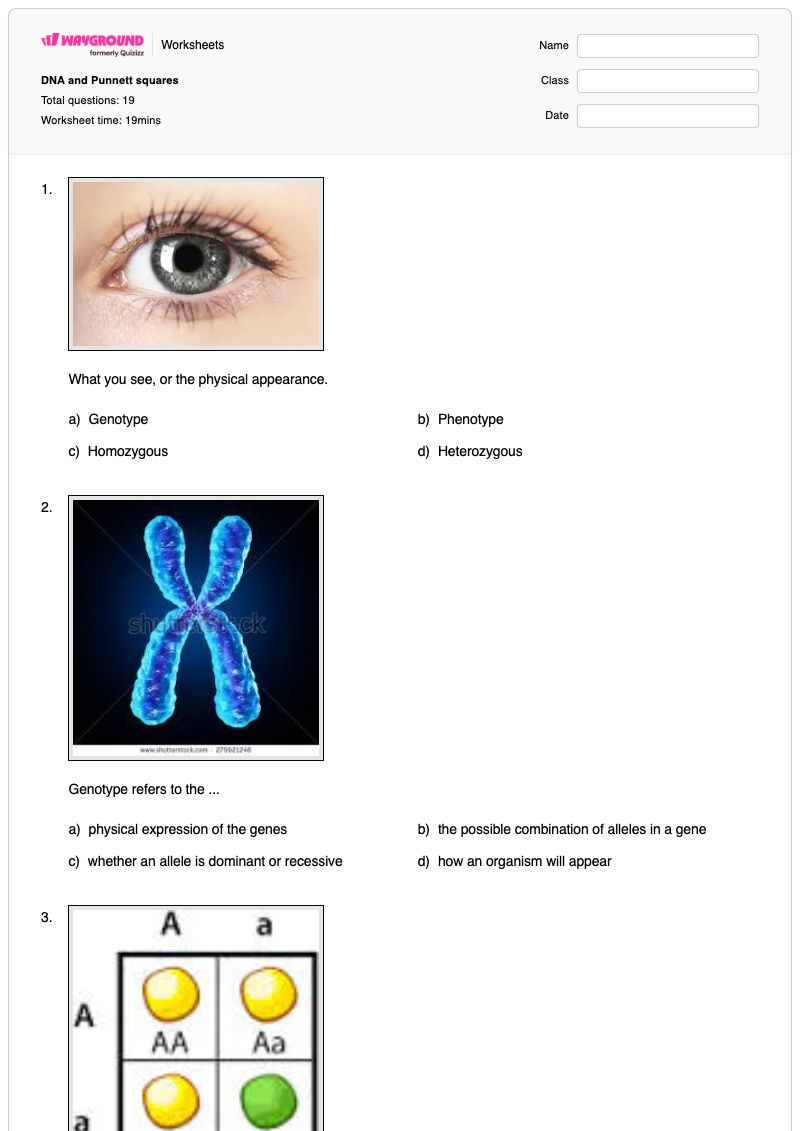
DNA and Punnett squares is a Grade 7 science worksheet that builds foundational genetics knowledge through 19 questions: 18 multiple-choice items and 1 multiple-select item. Students identify genotype, phenotype, homozygous, and heterozygous combinations; distinguish inherited characteristics; and connect dominant and recessive alleles to observable traits. The worksheet also introduces Gregor Mendel, chromosomes, pedigree charts, and the purpose of Punnett squares. Students apply these ideas to inheritance scenarios, including predicting offspring genotypes and phenotypes, calculating the probability of heterozygous offspring, interpreting a pedigree, and identifying a likely genotype from an observable trait. These varied questions help students move from vocabulary recognition to using genetic information in basic inheritance problems. This free printable worksheet with an answer key is designed for Grade 7 science instruction, independent practice, review, or formative assessment.

Worksheet settings

Font size

S
M
L
XL
Worksheets

DNA and Punnett squares

Total questions: 19

Name
Class
Date
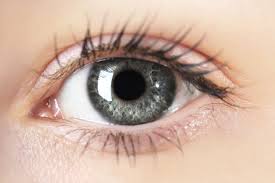
1.
What you see, or the physical appearance.
a)
Genotype
b)
Phenotype
c)
Homozygous
d)
Heterozygous
2.
Genotype refers to the ...
a)
physical expression of the genes
b)
the possible combination of alleles in a gene
c)
whether an allele is dominant or recessive
d)
how an organism will appear
3.
What is the dominant trait?
a)
yellow pea seeds
b)
green pea seeds
c)
there is no dominant seed
d)
Jolly green giant
4.
What are the possible combinations of a pea plant with the alleles PP and a male pea plant with the alleles pp.
P= purple
p= white
a)
all Pp
b)
all PP
c)
Pp,PP,Pp,PP
d)
all pp
5.
When the allele combination is a dominate and a recessive trait together which trait will be seen?
a)
Dominate
b)
Recessive
c)
none
d)
both
6.
What is a phenotype?
a)
The expression of a trait; physical appearance.
b)
refers to the genetic makeup of an individual
c)
An organism that has the same genes for a trait (ex. TT or tt)
d)
the passing of traits from parent to offspring
7.
Black fur is dominant (B) over white fur (b).  Find the probability of heterozygous offspring using the following genotype of these parents.
Bb + bb
a)
0%
b)
25%
c)
50%
d)
100%
8.
Gregor Mendel is often called ....
a)
The father of heredity.
b)
The father of genetics.
c)
The king of peas
d)
The father of punnett squares.
9.
It is NOT possible for two purebred black rabbits (both BB) to produce white offspring.
a)
True
b)
False
10.
Bob the abominable snowman lives in the snowy Andes mountains. He has white fur, which blends in nicely. He is therefore dismayed when his mate keeps having red-furred babies. What is Bob's likely genotype?
a)
Homozygous Dominant
b)
Heterozygous
c)
Homozygous Recessive
11.
Which characteristic is inherited?
a)
hair color
b)
sleeping late
c)
enjoying hiking
d)
loving to read
12.

How many chromosomes are present in a human cell nucleus?

a)

23 chromosomes or 46 pairs

b)

46 pairs or 92 chromosomes

c)

46 chromosomes or 23 pairs

d)

32 chromosomes or 16 pairs

13.

A pedigree chart is used to _______.

a)

predict percentage of offspring with a trait

b)

predict genotypic probabilities

c)

track inherited traits through generations

d)

identify the genotype of parents

14.

A Punnett square is used to _______.

a)

predict the genotypic and phenotypic probabilities of possible offspring

b)

determine if a trait runs in a family

c)

track inherited traits through many generations

d)

identify organisms that are carriers of a specific trait

15.

Sickle cell anemia is known to run in a family. A pedigree chart for this family is shown below.

What best describes offspring 4?

a)

A female carrier of the disease

b)

A female having the disease

c)

A male carrier of the disease

d)

A male having the disease

16.

Which of the following genotypes are Purebred? Select 2 answers.

a)

aA

b)

Aa

c)

AA

d)

aa

17.

If A = green pods and a = yellow pods, what are the GENOTYPIC RATIOS of the offspring in the Punnett square?

a)

100% green pods

b)

100% yellow pods

c)

100% heterozygous

d)

100% homozygous dominant

18.

Why is DNA important?

a)

it is very small and very complicated

b)

because we eat it every day for energy

c)

it serves as the blueprint (directions) for traits of all living things

19.
Which organelle is DNA usually found in?
a)
cell membrane
b)
vacuole
c)
ribosome
d)
nucleus
Answer Key

DNA and Punnett squares

Total questions: 19

1.
b) Phenotype
2.
b) the possible combination of alleles in a gene
3.
a) yellow pea seeds
4.
a) all Pp
5.
a) Dominate
6.
a) The expression of a trait; physical appearance.
7.
c) 50%
8.
b) The father of genetics.
9.
a) True
10.
c) Homozygous Recessive
11.
a) hair color
12.
c)

46 chromosomes or 23 pairs

13.
c)

track inherited traits through generations

14.
a)

predict the genotypic and phenotypic probabilities of possible offspring

15.
d)

A male having the disease

16.
c)

AA

, d)

aa

17.
c)

100% heterozygous

18.
c)

it serves as the blueprint (directions) for traits of all living things

19.
d) nucleus

FAQs

What does the DNA and Punnett squares worksheet cover?

This Grade 7 science worksheet uses 18 multiple-choice questions and 1 multiple-select question to assess genetics vocabulary and inheritance reasoning. Students distinguish genotype from phenotype, identify homozygous and heterozygous combinations, determine dominant-trait outcomes, use Punnett squares to predict offspring probabilities, and interpret a pedigree chart.

How can I use this worksheet to teach DNA and Punnett squares?

Introduce genotype, phenotype, dominant, recessive, homozygous, and heterozygous with a simple trait example before students begin the questions. Then model how parental alleles fill a Punnett square, ask students to explain the difference between genotype and phenotype, and use the worksheet’s inheritance scenarios and pedigree item for guided discussion before independent completion.

What mistakes should I watch for when students complete this genetics worksheet?

Watch for students confusing genotype—the allele combination—with phenotype—the physical expression of a trait. Students may also confuse homozygous and heterozygous pairs, report a dominant allele as automatically meaning a homozygous genotype, or mix up genotypic and phenotypic probabilities when solving the Punnett square items. In the pedigree question, check that they use the chart’s symbols and labels rather than guessing from the family story alone.

How do I assign and grade the DNA and Punnett squares worksheet?

You can assign this worksheet as a printable PDF or as a digital quiz on Wayground, and it includes a complete answer key for checking the 18 multiple-choice and 1 multiple-select responses. Printable submissions can also be graded by scanning student work with the Wayground for Teachers app.

How can I differentiate this DNA and Punnett squares worksheet for my students?

In the worksheet’s Advanced Settings, adjust font spacing or font size to make the genetics definitions, allele combinations, and Punnett square questions easier to read. You can also apply a dyslexia-friendly font or translate the worksheet into another language when that supports access to the vocabulary and inheritance scenarios.

Where can I find more worksheets like this on Wayground?

Wayground offers a comprehensive collection of free printable worksheets and practice problems across subjects, with downloadable PDFs and answer keys to help students master essential skills and concepts. Browse more resources at https://wayground.com/en-us/worksheets.