

Wayground
Punnett Square Practice - Printable Science Worksheets grade 7 - Wayground

Punnett Square Practice

20 questions

7th - 7th Grade

Science

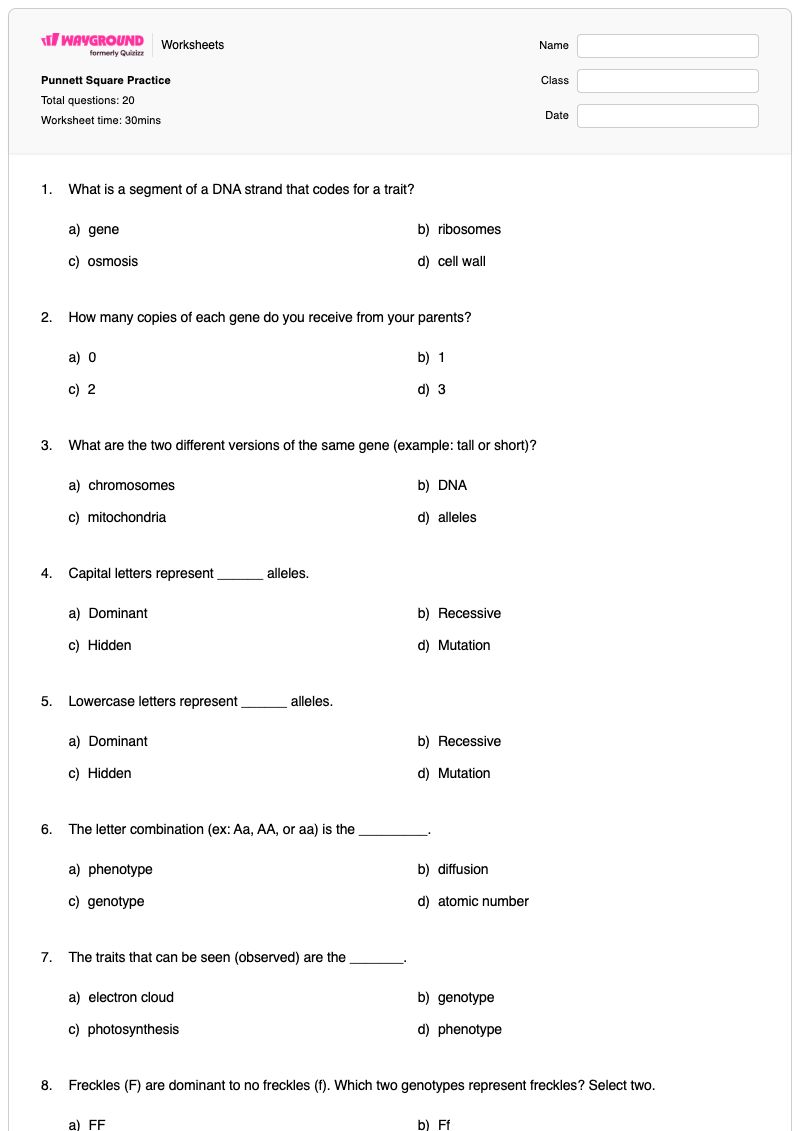
Punnett Square Practice is a Grade 7 science worksheet that builds foundational genetics vocabulary and applies it to simple inheritance problems. Students identify genes, alleles, dominant and recessive alleles, genotypes, and phenotypes, then use those ideas to determine which genotypes produce traits such as freckles, dimples, and different hairlines. The free printable worksheet includes 20 questions—18 multiple-choice items and 2 multiple-select items. Later questions ask students to complete a missing Punnett square entry and calculate the probability of an inherited phenotype, helping them connect allele notation to observable traits and percentages. An answer key is included, making this worksheet useful for guided practice, independent review, or a quick Grade 7 science assessment.

Worksheet settings

Font size

S
M
L
XL
Worksheets

Punnett Square Practice

Total questions: 20

Name
Class
Date
1.

What is a segment of a DNA strand that codes for a trait?

a)

gene

b)

ribosomes

c)

osmosis

d)

cell wall

2.

How many copies of each gene do you receive from your parents?

a)

0

b)

1

c)

2

d)

3

3.

What are the two different versions of the same gene (example: tall or short)?

a)

chromosomes

b)

DNA

c)

mitochondria

d)

alleles

4.

Capital letters represent ______ alleles.

a)

Dominant

b)

Recessive

c)

Hidden

d)

Mutation

5.

Lowercase letters represent ______ alleles.

a)

Dominant

b)

Recessive

c)

Hidden

d)

Mutation

6.

The letter combination (ex: Aa, AA, or aa) is the _________.

a)

phenotype

b)

diffusion

c)

genotype

d)

atomic number

7.

The traits that can be seen (observed) are the _______.

a)

electron cloud

b)

genotype

c)

photosynthesis

d)

phenotype

8.

Freckles (F) are dominant to no freckles (f). Which two genotypes represent freckles? Select two.

a)

FF

b)

Ff

c)

ff

9.

Freckles (F) are dominant to no freckles (f). Which genotype represents no freckles?

a)

FF

b)

Ff

c)

ff

10.

Dimples (D) are dominant to no dimples (d). Which two genotypes represent dimples? Select two.

a)

DD

b)

Dd

c)

dd

11.

Dimples (D) are dominant to no dimples (d). Which genotype represents no dimples?

a)

DD

b)

Dd

c)

dd

12.

Widow's peak hairline (A) is dominant to straight (a). If a person has the genotype Aa, what would their phenotype be?

a)

widow's peak hairline

b)

straight hairline

13.

Widow's peak hairline (A) is dominant to straight (a). If a person has the genotype aa, what would their phenotype be?

a)

widow's peak hairline

b)

straight hairline

14.
T - tall and t = short
In the punnett square below, what belongs in the missing square
a)
tt
b)
Tt
c)
Bb
d)
TT
15.
B = brown fur  b = white fur
In the punnett square, what is the probability for white fur? 
a)
0%
b)
25%
c)
50%
d)
75%
16.

Purple is dominant to white for flower color in pea plants. If a purple flowered pea plant (PP) is crossed with a white flowered plant (pp), what color will the offspring be?

a)

25% white, 75% purple

b)

50% white, 50% purple

c)

100% purple

d)

100% white

17.

Black fur is dominant to yellow fur in Labrador retrievers. If two heterozygous Labradors are crossed, what would the probable fur color of their offspring be?

a)

100% black

b)

100% yellow

c)

50% yellow, 50% black

d)

75% black, 25% yellow

18.

JoAnne owns a horse ranch with new foals (baby horses). There are three black foals and one chestnut foal. Black coat color (B) is dominant to chestnut coat color (b).

What MOST likely are the genotypes of the parents?

a)

BB x BB

b)

Bb x bb

c)

Bb x Bb

d)

BB x Bb

19.

Freckles are dominant (F) and no freckles are recessive (f). Two parents' genotypes are crossed and their offspring have a 3/4 chance of having freckles and 1/4 chance of not having freckles. Which Punnett square shows the cross and its offspring?

a)

b)

c)

d)

20.

Cystic fibrosis is a recessive genetic disorder. If only one gene is present, an individual is a carrier. What is the probability of two healthy cystic fibrosis carriers having a child that has the disease?

a)
25%
b)
75%
c)

100%

d)

0%

Answer Key

Punnett Square Practice

Total questions: 20

1.
a)

gene

2.
c)

2

3.
d)

alleles

4.
a)

Dominant

5.
b)

Recessive

6.
c)

genotype

7.
d)

phenotype

8.
a)

FF

, b)

Ff

9.
c)

ff

10.
a)

DD

, b)

Dd

11.
c)

dd

12.
a)

widow's peak hairline

13.
b)

straight hairline

14.
a) tt
15.
c) 50%
16.
c)

100% purple

17.
d)

75% black, 25% yellow

18.
c)

Bb x Bb

19.
b)

20.
a) 25%

FAQs

What does the Punnett Square Practice worksheet cover?

This Grade 7 science worksheet combines genetics vocabulary with introductory Punnett square reasoning. Students distinguish genes, alleles, genotypes, and phenotypes; identify dominant and recessive allele notation; determine which genotypes produce a trait; complete a missing Punnett square entry; and calculate an inheritance probability using multiple-choice and multiple-select questions.

How can I use this worksheet to teach genotypes, phenotypes, and Punnett squares?

Introduce the vocabulary first by having students explain how allele pairs form a genotype and how the genotype relates to an observable phenotype. Then use the freckles, dimples, and hairline items to model why a dominant trait can result from either a homozygous or heterozygous genotype before students complete the missing-square and probability questions independently. Ask students to justify each answer using the allele symbols shown in the worksheet.

What mistakes should I watch for when students complete this Punnett square worksheet?

Students may confuse a genotype, such as Aa, with the phenotype it produces, or reverse the meanings of uppercase dominant and lowercase recessive symbols. In the multiple-select items, they may choose only one genotype for a dominant trait and overlook that both homozygous and heterozygous combinations can show it. When completing the Punnett square and probability item, check that they combine alleles correctly and count the relevant outcomes rather than guessing from the trait name.

How do I assign and grade this Punnett Square Practice worksheet?

The worksheet is available as a printable PDF and as a digital quiz on Wayground, and it includes a complete answer key for the 18 multiple-choice and 2 multiple-select questions. For printable submissions, you can grade student work by scanning it with the Wayground for Teachers app. The PDF option also supports schools that want to reduce screen time while students practise genetics.

How can I differentiate this Punnett Square Practice worksheet for my students?

Use the worksheet’s Advanced Settings to adjust font spacing and font size so the allele combinations, answer choices, and Punnett square items are easier to read. You can also enable a dyslexia-friendly font or translate the worksheet into another language when that better supports access to the genetics vocabulary and questions.

Where can I find more free worksheets like this on Wayground?

Wayground offers a comprehensive collection of free printable worksheets and practice problems across all subjects, with downloadable PDFs and answer keys to help students master essential skills and concepts. Browse more resources at https://wayground.com/en-us/worksheets.