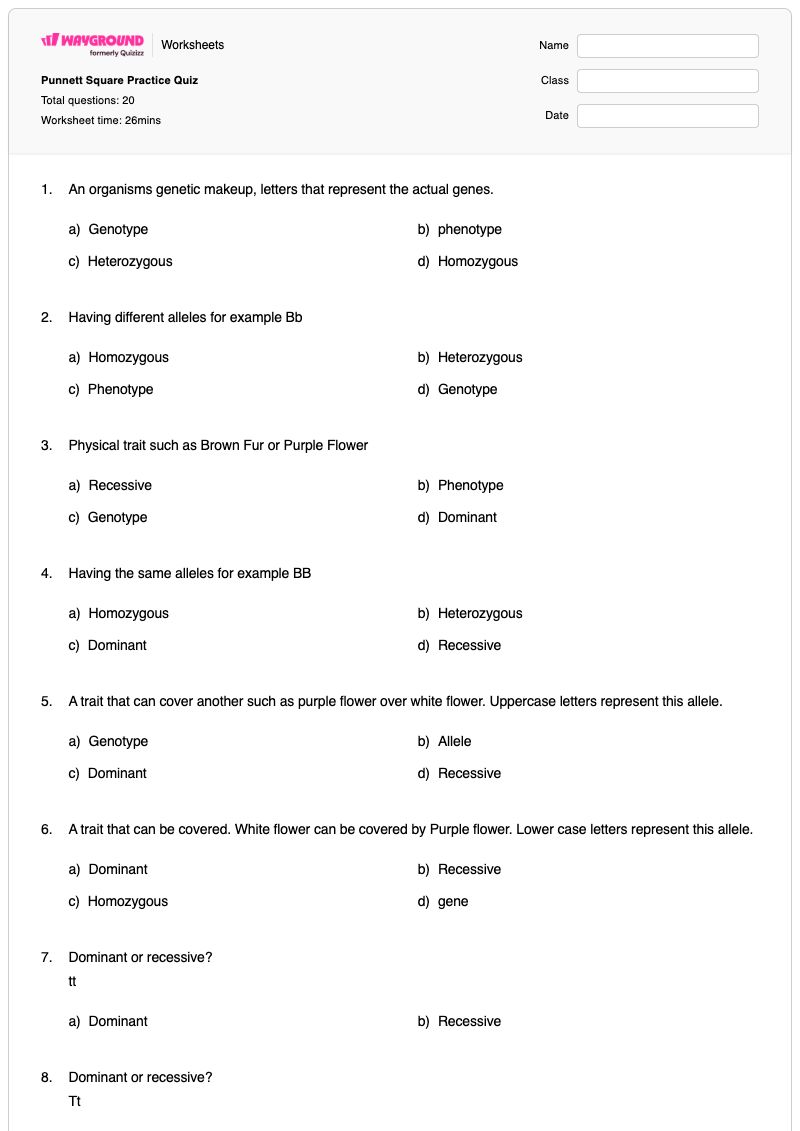
This Grade 8 science worksheet helps students build foundational Punnett square skills through 20 questions: 16 multiple-choice items, one multiple-select item, and three fill-in-the-blank items. Students identify genotype, phenotype, alleles, homozygous and heterozygous combinations, and dominant and recessive representations. They also interpret allele pairs such as BB, Bb, and bb and determine which genotype or allele pattern an item describes.
The worksheet then applies this vocabulary to inheritance probability, including calculating the expected percentage of offspring with a recessive trait and identifying missing or required genotypes in Punnett square setups. It is a free printable worksheet with a complete answer key for Grade 8 science instruction, independent practice, review, or formative assessment. The varied question formats give teachers multiple ways to check whether students can recognize genetic notation and use it to reason about possible offspring traits.
Worksheet settings
Font size
S
M
L
XL
Worksheets
Punnett Square Practice Quiz
Total questions: 20
Name
Class
Date
1.
An organisms genetic makeup, letters that represent the actual genes.
a)
Genotype
b)
phenotype
c)
Heterozygous
d)
Homozygous
2.
Having different alleles for example Bb
a)
Homozygous
b)
Heterozygous
c)
Phenotype
d)
Genotype
3.
Physical trait such as Brown Fur or Purple Flower
a)
Recessive
b)
Phenotype
c)
Genotype
d)
Dominant
4.
Having the same alleles for example BB
a)
Homozygous
b)
Heterozygous
c)
Dominant
d)
Recessive
5.
A trait that can cover another such as purple flower over white flower. Uppercase letters represent this allele.
a)
Genotype
b)
Allele
c)
Dominant
d)
Recessive
6.
A trait that can be covered. White flower can be covered by Purple flower. Lower case letters represent this allele.
a)
Dominant
b)
Recessive
c)
Homozygous
d)
gene
7.
Dominant or recessive? tt
a)
Dominant
b)
Recessive
8.
Dominant or recessive? Tt
a)
Dominant
b)
Recessive
9.
B = brown fur b = white fur In the punnett square, what is the percent chance for white fur?
a)
0%
b)
25%
c)
50%
d)
75%
10.
Brown eyes (B) tend to be dominant whereas blue eyes (b) tend to be recessive. Parents with heterozygous genes want to know: what is the likelihood of them having a child with blue eyes?
a)
0%
b)
25%
c)
75%
d)
100%
11.
Select TWO answers. Which are the missing parts?
a)
BB
b)
bb
c)
Bb
12.
Which of the following must be the father's genotype?
a)
RR
b)
Rr
c)
rr
13.
Identify the homozygous dominant genotype:
a)
FF
b)
Ff
c)
ff
14.
Dominant alleles are represented by a:
a)
Male gene
b)
lowercase letter
c)
recessive trait
d)
capital letter
15.
What are the alleles of highlighted box?
(a)
16.
What are the alleles of highlighted box?
(a)
17.
What are the alleles of highlighted box?
(a)
18.
Why do scientist use Punnett Squares?
a)
A tool scientist use to to see alleles
b)
A tool scientist use to see which alleles are dominant
c)
A tool scientist use to determine possible genotypes for offspring
19.
Which of the following is a homozygous recessive genotype?
a)
HH
b)
dd
c)
Aa
20.
Which of the following is a heterozygous genotype?
a)
Gg
b)
UU
c)
pp
Answer Key
Punnett Square Practice Quiz
Total questions: 20
1.
a)
Genotype
2.
b)
Heterozygous
3.
b)
Phenotype
4.
a)
Homozygous
5.
c)
Dominant
6.
b)
Recessive
7.
b) Recessive
8.
a) Dominant
9.
c) 50%
10.
b)
25%
11.
a)
BB
, b)
bb
12.
b)
Rr
13.
a) FF
14.
d) capital letter
15.
Ii
16.
Ff
17.
EE
18.
c)
A tool scientist use to determine possible genotypes for offspring
19.
b)
dd
20.
a)
Gg
140 %
Browse by subjects
Browse by grades
Browse by format
FAQs
What does the Punnett Square Practice Quiz help students learn?
This Grade 8 science worksheet reinforces how to distinguish genotype, phenotype, allele, homozygous, heterozygous, dominant, and recessive concepts. Its multiple-choice, multiple-select, and fill-in-the-blank questions then ask students to interpret allele pairs such as BB, Bb, and bb and use Punnett square information to calculate inheritance probabilities, including a 50% or 25% chance for a specified recessive trait.
How can I use this worksheet to teach Punnett squares and genetic notation?
Introduce the vocabulary first by modeling how uppercase and lowercase letters represent dominant and recessive alleles, then contrast genotype combinations such as BB, Bb, and bb with observable phenotypes. Have students complete the identification questions before solving the probability items, and ask them to explain how the parent genotypes lead to each percentage choice in the Punnett square questions.
What mistakes should I watch for when students complete this Punnett square worksheet?
Watch for students confusing a genotype, such as Bb, with a phenotype, such as brown fur, or labeling a heterozygous pair as homozygous because it contains a dominant allele. Students may also overlook that a capital letter indicates a dominant allele, misclassify tt or Tt, count the wrong Punnett square outcomes when finding a percentage, or select only one response on the multiple-select item asking for two missing genotypes.
How do I assign and grade this Punnett Square Practice Quiz?
The worksheet is available as a printable PDF and as a digital quiz on Wayground, so you can assign the format that fits your Grade 8 science lesson. It includes a complete answer key for the genotype, allele, and inheritance-probability questions. For printable submissions, you can scan student work with the Wayground for Teachers app to help grade responses efficiently.
How can I differentiate this Punnett square worksheet for my students?
In the worksheet’s Advanced Settings, adjust font spacing or choose a larger font size to make the allele notation, answer choices, and Punnett square items easier to read. You can also apply a dyslexia-friendly font or translate the worksheet into another language while preserving its multiple-choice, multiple-select, and fill-in-the-blank format.
Where can I find more worksheets like this on Wayground?
Wayground offers a broad collection of free printable worksheets and practice problems across subjects, with downloadable PDFs and answer keys to support mastery of essential skills and concepts. Browse more resources at https://wayground.com/en-us/worksheets.


 Worksheets


