

Wayground
7.3 Monohybrid Punnett Squares 2023 - Printable Science Worksheets grade 9 - Wayground

7.3 Monohybrid Punnett Squares 2023

20 questions

9th - 9th Grade

Science

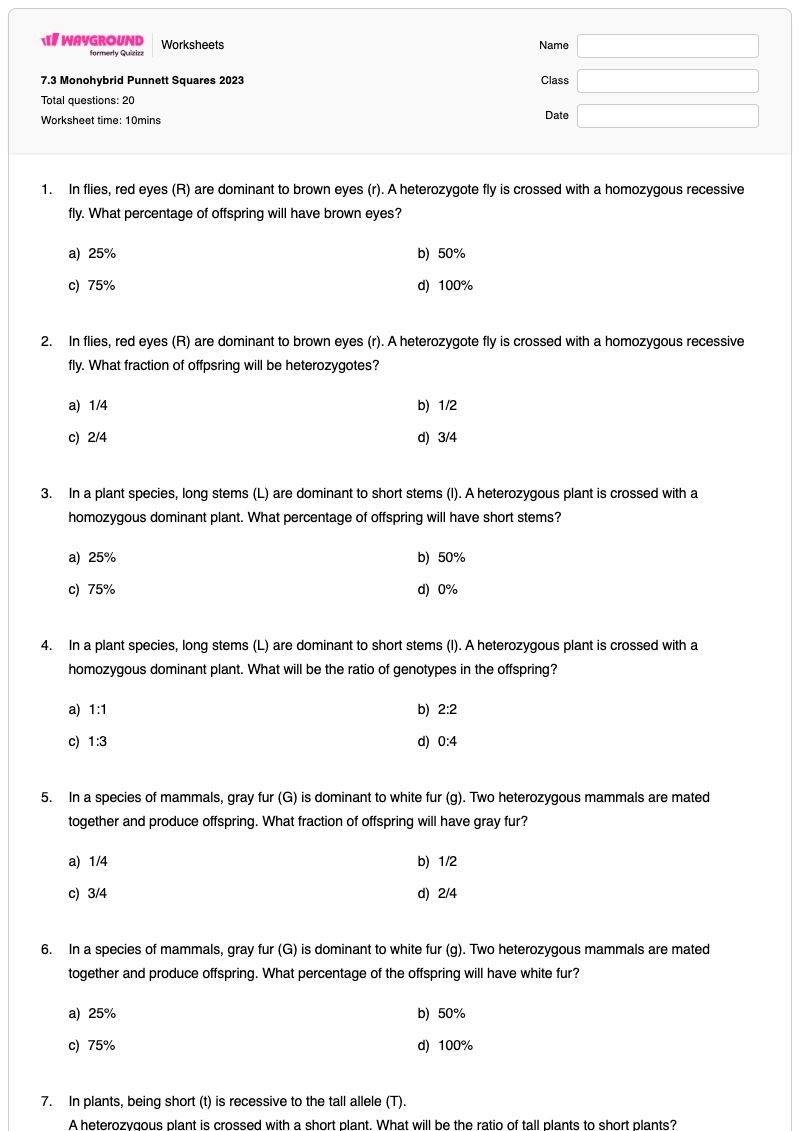
The 7.3 Monohybrid Punnett Squares 2023 worksheet helps Grade 9 science students analyze single-trait genetic crosses using dominant and recessive alleles. Through 20 multiple-choice questions, students determine expected genotypes and phenotypes, then express inheritance outcomes as fractions, percentages, and ratios for crosses such as heterozygous × homozygous recessive, heterozygous × homozygous dominant, and homozygous dominant × homozygous recessive. This practice reinforces the connection between allele combinations and observable traits, including eye color, stem height, fur color, wing size, earlobe attachment, and hair length. Students must distinguish homozygous from heterozygous offspring and identify when a recessive phenotype can appear. Designed for Grade 9 science instruction, review, or assessment, this free printable worksheet includes a complete answer key for efficient checking and feedback.

Worksheet settings

Font size

S
M
L
XL
Worksheets

7.3 Monohybrid Punnett Squares 2023

Total questions: 20

Name
Class
Date
1.

In flies, red eyes (R) are dominant to brown eyes (r). A heterozygote fly is crossed with a homozygous recessive fly. What percentage of offspring will have brown eyes?

a)

25%

b)

50%

c)

75%

d)

100%

2.

In flies, red eyes (R) are dominant to brown eyes (r). A heterozygote fly is crossed with a homozygous recessive fly. What fraction of offpsring will be heterozygotes?

a)

1/4

b)

1/2

c)

2/4

d)

3/4

3.

In a plant species, long stems (L) are dominant to short stems (l). A heterozygous plant is crossed with a homozygous dominant plant. What percentage of offspring will have short stems?

a)

25%

b)

50%

c)

75%

d)

0%

4.

In a plant species, long stems (L) are dominant to short stems (l). A heterozygous plant is crossed with a homozygous dominant plant. What will be the ratio of genotypes in the offspring?

a)

1:1

b)

2:2

c)

1:3

d)

0:4

5.

In a species of mammals, gray fur (G) is dominant to white fur (g). Two heterozygous mammals are mated together and produce offspring. What fraction of offspring will have gray fur?

a)

1/4

b)

1/2

c)

3/4

d)

2/4

6.

In a species of mammals, gray fur (G) is dominant to white fur (g). Two heterozygous mammals are mated together and produce offspring. What percentage of the offspring will have white fur?

a)

25%

b)

50%

c)

75%

d)

100%

7.

In plants, being short (t) is recessive to the tall allele (T).

A heterozygous plant is crossed with a short plant. What will be the ratio of tall plants to short plants?

a)

1:1

b)

2:2

c)

1:3

d)

3:1

8.

In plants, being short (t) is recessive to the tall allele (T).

A heterozygous plant is crossed with a short plant. What fraction of offspring will be homozygous recessive?

a)

1/4

b)

2/4

c)

1/2

d)

3/4

9.

In a certain animal, brown eyes are dominant and blue eyes are recessive. A heterozygote is mated with a blue eyed animal. What fraction of offspring will have blue eyes?

a)

1/4

b)

2/4

c)

1/2

d)

4/4

10.

In a certain animal, brown eyes are dominant and blue eyes are recessive. A heterozygote is mated with a blue eyed animal. What percentage of the offspring will be heterozygotes?

a)

25%

b)

50%

c)

75%

d)

100%

11.

In flies, small wings (w) are recessive to large wings (W). A

homozygous dominant fly is mated with a homozygous recessive fly. What percentage of offspring will have a Ww genotype?

a)

25%

b)

50%

c)

75%

d)

100%

12.

In flies, small wings (w) are recessive to large wings (W). A

homozygous dominant fly is mated with a homozygous recessive fly. What percentage of offspring will have small wings?

a)

25%

b)

50%

c)

75%

d)

0%

13.

Having attached earlobes (e) is recessive to unattached earlobes (E). A man with genotype (Ee) and a woman with attached earlobes have a child. What is the percent chance the child has attached earlobes?

a)

25%

b)

50%

c)

75%

d)

100%

14.

Having attached earlobes (e) is recessive to unattached earlobes (E). A man with genotype (Ee) and a woman with attached earlobes have a child. What fraction of this couple’s children are likely to be genotype Ee?

a)

1/4

b)

1/2

c)

3/4

d)

4/4

15.

In cats, long hair (H) is dominant to short hair (h). A cat with long hair (Hh) is mated with a cat that also has long hair (Hh). What fraction of offspring will have short hair?

a)

1/4

b)

1/2

c)

2/4

d)

3/4

16.

In cats, long hair (H) is dominant to short hair (h). A cat with long hair (Hh) is mated with a cat that also has long hair (Hh). What will be the ratio of long hair to short hair?

a)

1:1

b)

2:2

c)

3:1

d)

1:3

17.

In pigeons, normal feathers are dominant to frizzy feathers.

Two heterozygote pigeons mate with each other and produce offspring. What fraction of offspring will have normal feathers?

a)

1/4

b)

1/2

c)

3/4

d)

4/4

18.

In pigeons, normal feathers are dominant to frizzy feathers.

Two heterozygote pigeons mate with each other and produce offspring. What percentage of the offspring will have frizzy feathers?

a)

25%

b)

50%

c)

75%

d)

100%

19.

In pea plants, yellow peas (g) are recessive to green peas (G). Two plants with yellow peas are crossed together. What percentage of offspring will have yellow peas?

a)

25%

b)

50%

c)

75%

d)

100%

20.

In pea plants, yellow peas (g) are recessive to green peas (G). Two plants with yellow peas are crossed together. What percentage of offspring will be heterozygotes?

a)

25%

b)

50%

c)

75%

d)

0%

Answer Key

7.3 Monohybrid Punnett Squares 2023

Total questions: 20

1.
b)

50%

2.
b)

1/2

3.
d)

0%

4.
a)

1:1

5.
c)

3/4

6.
a)

25%

7.
a)

1:1

8.
c)

1/2

9.
c)

1/2

10.
b)

50%

11.
d)

100%

12.
d)

0%

13.
b)

50%

14.
b)

1/2

15.
a)

1/4

16.
c)

3:1

17.
c)

3/4

18.
a)

25%

19.
d)

100%

20.
d)

0%

FAQs

What does this monohybrid Punnett squares worksheet help Grade 9 students learn?

This worksheet gives students 20 multiple-choice opportunities to analyze single-trait crosses and calculate expected genotype and phenotype outcomes. They determine fractions, percentages, and ratios for crosses such as heterozygous × homozygous recessive and heterozygous × heterozygous, linking allele combinations to traits like eye color, fur color, stem height, and hair length.

How can I use this worksheet to teach monohybrid crosses?

Introduce the dominant and recessive allele notation, then model one cross by listing the possible gametes and connecting each offspring genotype to its phenotype. Have students solve the worksheet questions in pairs, requiring them to explain why an outcome such as 3/4 gray fur or 0% short stems follows from the parental genotypes. Finish by discussing how the same probability can be represented as a fraction, percentage, or ratio.

What mistakes should I watch for when students complete these Punnett square questions?

Watch for students confusing a genotype with a phenotype—for example, treating a dominant trait as proof that an offspring is homozygous. Students may also convert fractions, percentages, and ratios incorrectly, overlook that a recessive phenotype requires two recessive alleles, or assume every cross produces a 3:1 outcome. Check especially whether they identify all possible offspring genotypes before calculating the requested result.

How do I assign and grade this monohybrid crosses worksheet?

This worksheet is available as a printable PDF and as a digital quiz on Wayground, so you can assign the 20 multiple-choice questions in the format that fits your lesson. It includes a complete answer key, and printable submissions can be graded by scanning student work with the Wayground for Teachers app. The printable option can also support schools that are reducing screen time.

How can I differentiate this monohybrid Punnett squares worksheet for my students?

Use the worksheet’s Advanced Settings to adjust font spacing and font size so the multiple-choice genetics questions are easier to read and annotate. You can also apply a dyslexia-friendly font or translate the worksheet into another language when those options support access to the allele, genotype, and phenotype problems.

Where can I find more worksheets like this on Wayground?

Wayground offers a comprehensive collection of free printable worksheets and practice problems across all subjects, with downloadable PDFs and answer keys to help students master essential skills and concepts. Browse more resources at https://wayground.com/en-us/worksheets.