

Life Sci: Punnett Squares is a Grade 9–12 biology worksheet that builds foundational genetics skills through 20 varied items. Students identify genotypes, phenotypes, alleles, homozygous and heterozygous forms, dominant and recessive alleles, and purebred genotypes. They also interpret inheritance probabilities, determine missing genotypes, select correct genetic keys, complete a matching item, and choose more than one correct answer when identifying purebred forms.
The worksheet combines 16 multiple-choice questions with two drawing tasks that require students to complete Punnett squares for fruit-fly eye color and a cystic fibrosis inheritance scenario. These tasks move students from recognizing genetic vocabulary and notation to applying allele information in crosses and calculating likely offspring traits. It is designed for biology instruction, independent practice, review, or formative assessment in Grades 9–12. This free printable worksheet includes a complete answer key for efficient checking and feedback.
Worksheet settings
Font size
S
M
L
XL
Worksheets
Life Sci: Punnett Squares
Total questions: 20
Name
Class
Date
1.
Aa, DD, bB, yy are all examples of
a)
genotypes
b)
phenotypes
2.
AA and Aa always show up as
a)
dominant
b)
recessive
3.
Which of the following genotypes is homozygous dominant?
a)
A
b)
Aa
c)
AA
d)
aa
4.
Which of the following genotypes is heterozygous?
a)
Bb
b)
BB
c)
bb
d)
B
5.
In a heterozygous genotype, the ___________ allele takes over in the phenotype.
a)
recessive
b)
dominant
c)
lower case letter
d)
both
6.
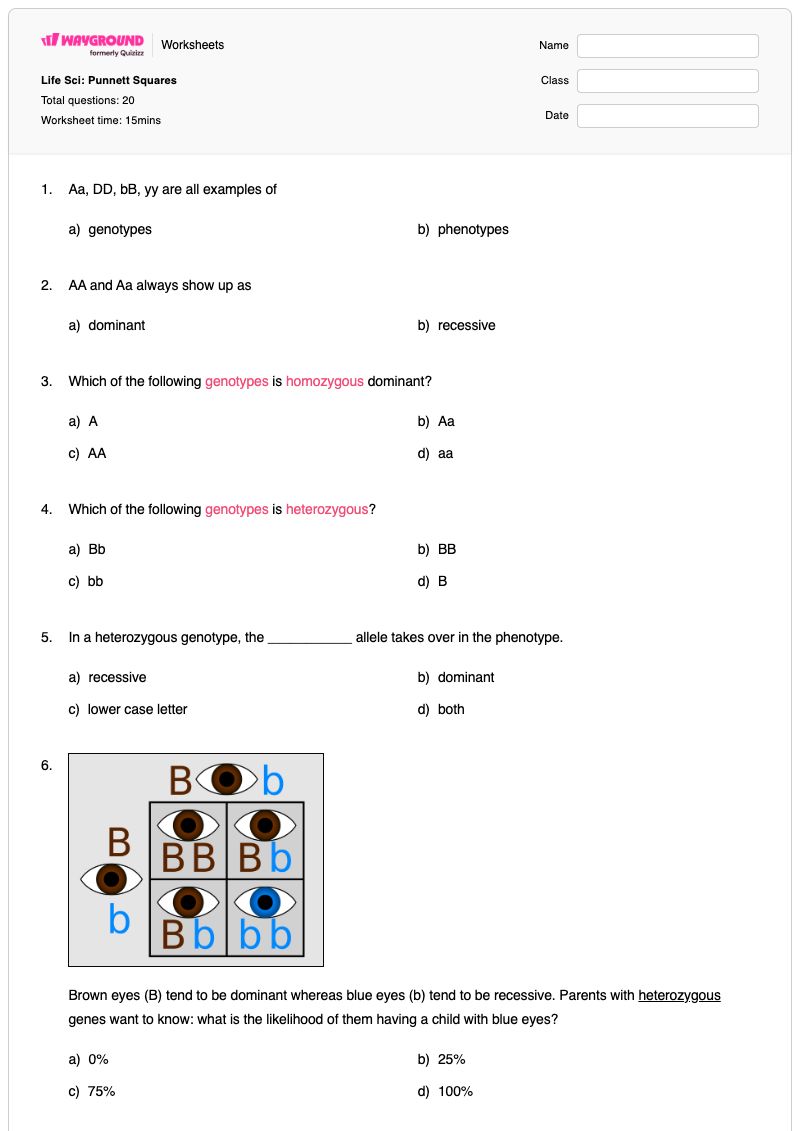
Brown eyes (B) tend to be dominant whereas blue eyes (b) tend to be recessive. Parents with heterozygous genes want to know: what is the likelihood of them having a child with blue eyes?
a)
0%
b)
25%
c)
75%
d)
100%
7.
Which of the following would complete this Punnett Square?
a)
aa
b)
AA
c)
Aa
8.
Which of the following must be the father's genotype?
a)
RR
b)
Rr
c)
rr
9.
G = green, g = yellow The genotype for a yellow plant is...
a)
GG
b)
Gg
c)
gg
d)
all of the choices result in yellow
10.
Complete the punnett square for the following scenario: In fruit flies, red eyes are dominant to white eyes. The female fly has white eyes and the male fly has homozygous dominant red eyes.
11.
Complete the punnett square for the following scenario: A woman who is a carrier (heterozygous) for Cystic Fibrosis marries a man who has Cystic Fibrosis, a recessive disease.
12.
In pea plants, the tall allele is dominant to the short allele. What key would demonstrate this?
a)
Tall = T Short = S
b)
Tall = T Short = t
c)
Tall = t Short = T
d)
Tall = TT Short = tt
13.
A heterozygous long-tusked elephant is crossed with a homozygous recessive short-tusked elephant. What is the probability of the offspring having short tusks?
a)
0%
b)
25%
c)
50%
d)
75%
14.
Which of the following genotypes is Purebred? Select 2 answers.
a)
aA
b)
Aa
c)
AA
d)
aa
15.
Different versions of a trait (tall or short, white or purple) are called
a)
alleles
b)
traits
c)
versions
d)
genes
16.
If something is heterozygous, it is also _____
a)
purebred
b)
hybrid
c)
dominant
d)
recessive
17.
If A = red fur and a = white fur, what color fur would Aa be?
a)
red
b)
white
c)
purple
d)
blue
18.
Match the following vocabulary words with their definitions
Genetics
The Scientific study of heredity
Heredity
The process in which characteristics are passed down from parents to offspring.
Trait
An organism's characteristics.
Genotype
The specific genetic make up or "code" for an individual.
Phenotype
The total physical appearance for an individual.
19.
What are the possible genotypes for this cross?
a)
TT = 25% Tt= 50% tt=25%
b)
all tall
c)
TT= 75% tt = 25%
d)
Tt = 100%
20.
What allele combination should go in the missing box?
a)
AA
b)
Aa
c)
aa
d)
none of these
Answer Key
Life Sci: Punnett Squares
Total questions: 20
1.
a) genotypes
2.
a) dominant
3.
c) AA
4.
a) Bb
5.
b) dominant
6.
b)
25%
7.
a)
aa
8.
b)
Rr
9.
c) gg
10.
n/a
11.
n/a
12.
b) Tall = T Short = t
13.
c) 50%
14.
c)
AA
, d)
aa
15.
a)
alleles
16.
b)
hybrid
17.
a)
red
18.
Genetics
-
The Scientific study of heredity
,
Heredity
-
The process in which characteristics are passed down from parents to offspring.
,
Trait
-
An organism's characteristics.
,
Genotype
-
The specific genetic make up or "code" for an individual.
,
Phenotype
-
The total physical appearance for an individual.
19.
a)
TT = 25% Tt= 50% tt=25%
20.
b) Aa
140 %
Browse by subjects
Browse by grades
Browse by format
FAQs
What does the Life Sci: Punnett Squares worksheet cover?
This Grade 9–12 biology worksheet practices identifying genotypes, phenotypes, alleles, homozygous and heterozygous genotypes, dominant and recessive alleles, and purebred forms. Its 20 items combine multiple choice, multiple select, matching, and drawing tasks, including completing Punnett squares and determining offspring probabilities for traits such as eye color and tusk length.
How can I use this Punnett squares worksheet to teach genotype and inheritance concepts?
Introduce the worksheet by modeling how allele symbols identify homozygous or heterozygous genotypes and how a dominant allele appears in a heterozygous phenotype. Then have students complete the vocabulary and notation items before drawing the fruit-fly and cystic-fibrosis Punnett squares, asking them to explain how each parent’s alleles determine the possible offspring genotypes.
What mistakes should I watch for when students complete this Punnett squares worksheet?
Watch for students confusing a genotype, such as Aa, with the phenotype it produces, or treating a capital letter as a complete genotype rather than one allele. Students may also reverse homozygous and heterozygous labels, use an incorrect genetic key, select only one answer for the purebred multiple-select item, or calculate probabilities without completing each Punnett-square combination.
How do I assign and grade this Punnett squares worksheet?
On Wayground, assign it as a printable PDF or as a digital quiz, and use the complete answer key to check the 16 multiple-choice items, drawing responses, multiple-select item, and matching item. Printable submissions can also be graded by scanning student work with the Wayground for Teachers app.
How can I differentiate this Punnett squares worksheet for my students?
Use the worksheet’s Advanced Settings to adjust font spacing or font size so the genotype choices and Punnett-square drawing areas are easier to read and use. You can also enable a dyslexia-friendly font or translate the worksheet into another language, supporting access to the genetic vocabulary and inheritance scenarios.
Where can I find more free worksheets like this on Wayground?
Wayground offers a comprehensive collection of free printable worksheets and practice problems across subjects, with downloadable PDFs and answer keys to help students master essential skills and concepts. Browse more resources at https://wayground.com/en-us/worksheets.