

Wayground
Practice Punnett Squares - Printable Biology Worksheets grade 9 - Wayground

Practice Punnett Squares

14 questions

9th - 9th Grade

Biology

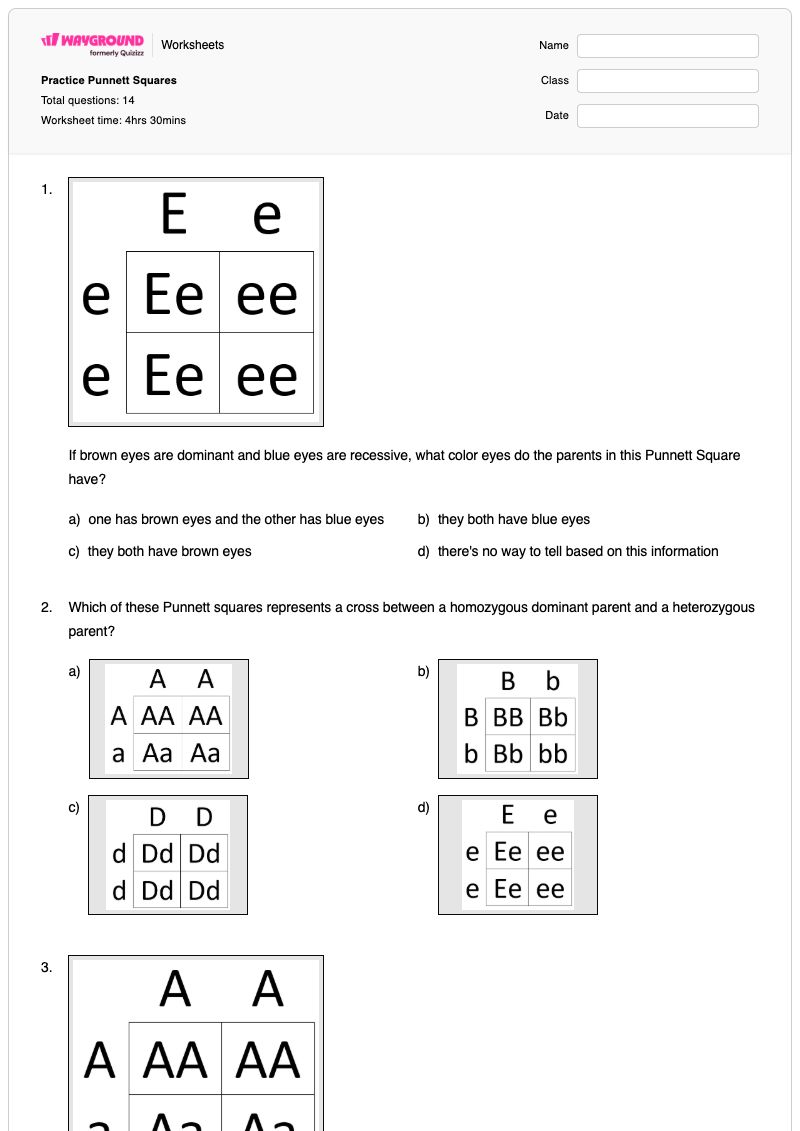
Practice Punnett Squares is a free printable Biology worksheet for Grade 9 students learning to interpret and complete basic Mendelian genetics problems. It contains 14 multiple-choice questions that ask students to identify homozygous and heterozygous parent genotypes, connect genotypes with dominant or recessive phenotypes, and read Punnett squares to determine possible offspring outcomes. Students calculate genotype and phenotype probabilities, including chances of 0%, 25%, 50%, 75%, or 100%, and work backward from offspring results to infer a parent’s genotype or identify the dominant phenotype. Examples use traits in pea plants, humans, dogs, rabbits, and other familiar contexts, giving students repeated practice applying the same inheritance process to different scenarios. The worksheet is useful for biology review, independent practice, or formative assessment after introducing Punnett squares. It is available as a free printable worksheet with a complete answer key.

Worksheet settings

Font size

S
M
L
XL
Worksheets

Practice Punnett Squares

Total questions: 14

Name
Class
Date
1.

If brown eyes are dominant and blue eyes are recessive, what color eyes do the parents in this Punnett Square have?

a)

one has brown eyes and the other has blue eyes

b)

they both have blue eyes

c)

they both have brown eyes

d)

there's no way to tell based on this information

2.

Which of these Punnett squares represents a cross between a homozygous dominant parent and a heterozygous parent?

a)
b)
c)
d)
3.

Based on this Punnett square, what is the chance that an offspring will have a homozygous genotype?

a)

0%

b)

25%

c)

50%

d)

75%

e)

100%

4.

If both parents have the genotype Aa, what is the chance their offspring will also have the genotype Aa?

a)

0%

b)

25%

c)

50%

d)

75%

e)

100%

5.

In pea plants, being tall is dominant and being short is recessive. Two tall plants mate. One has the genotype Tt and the other has the genotype TT. What is the chance that they will have a tall offspring?

a)

0%

b)

25%

c)

50%

d)

75%

e)

100%

6.

In humans, being able to curl your tongue is a dominant trait and NOT being able to curl you tongue is a recessive trait. If a mom with the genotype Rr has a child with a dad with the genotype Rr, what is the probability that their child will be able to curl its tongue?

a)

0%

b)

25%

c)

50%

d)

75%

e)

100%

7.

A dog with straight fur (Bb) is crossed with a dog with curly fur (bb). What is the probability the offspring will have straight fur?

a)

0%

b)

25%

c)

50%

d)

75%

e)

100%

8.

In rabbits, black fur is dominant and white fur is recessive. If two white rabbits mate, what is the chance that they will produce an offspring with black fur?

a)

0%

b)

25%

c)

50%

d)

75%

e)

100%

9.

Unattached earlobes are a dominant trait and attached earlobes are a recessive trait. If two heterozygous parents with unattached earlobes have a baby, what is the probability that their baby will have attached earlobes?

a)

0%

b)

25%

c)

50%

d)

75%

e)

100%

10.

Tall pea plants are dominant and short pea plants are recessive. A homozygous tall pea plant is crossed with a homozygous short plant. What is the chance that they will produce a tall plant?

a)

0%

b)

25%

c)

50%

d)

75%

e)

100%

11.

SpongeBob is known for his big round eyes, which is dominant. Having oval eyes is recessive. If he is heterozygous and marries a woman with oval eyes, predict the chance of them having a baby sponge with oval eyes.

a)

0%

b)

25%

c)

50%

d)

75%

e)

100%

12.

Having freckles is a dominant trait. Not having freckles is a recessive trait. A child is born and has NO freckles. The mother has freckles and the father does not have freckles. What is the genotype of the mother?

a)

FF

b)

Ff

c)

ff

13.

Cody crosses a plant producing wrinkled peas with a plant producing smooth peas. Weeks later, he discovers that all the offspring plants have smooth peas. Cody drew the Punnett square above to show the genotypes of the offspring plants. What were the genotypes of the parent plants?

a)

RR and rr

b)

Rr and Rr

c)

RR and Rr

d)

Rr and rr

14.

Cody crosses a plant producing wrinkled peas with a plant producing smooth peas. Weeks later, he discovers that all the offspring plants have smooth peas. Cody drew the Punnett square above to show the genotypes of the offspring plants. Which is the dominant phenotype in the pea plants used in Cody’s experiment?

a)

smooth

b)

wrinkled

c)

RR

d)

Rr

Answer Key

Practice Punnett Squares

Total questions: 14

1.
a)

one has brown eyes and the other has blue eyes

2.
a)
3.
c)

50%

4.
c)

50%

5.
e)

100%

6.
d)

75%

7.
c)

50%

8.
a)

0%

9.
b)

25%

10.
e)

100%

11.
c)

50%

12.
b)

Ff

13.
a)

RR and rr

14.
a)

smooth

FAQs

What does the Practice Punnett Squares worksheet cover?

This Grade 9 Biology worksheet uses 14 multiple-choice questions to build skill with interpreting Punnett squares. Students identify homozygous and heterozygous parents, determine dominant and recessive phenotypes, calculate genotype and phenotype probabilities, and infer a parent genotype from an observed offspring result.

How can I use this worksheet to teach students to interpret Punnett squares?

Introduce the allele notation and the difference between homozygous and heterozygous genotypes before students begin the 14 questions. Model one cross by placing each parent’s alleles into the square, then have students use the completed combinations to answer probability questions involving traits such as pea-plant height, fur color, and freckles. Ask students to explain whether each answer describes a genotype or a phenotype.

What mistakes should I watch for when students complete this Punnett square worksheet?

Students may confuse a homozygous genotype such as AA with a dominant phenotype, or treat a heterozygous genotype as recessive because it contains one recessive allele. They may also count the wrong type of outcome when selecting a percentage—for example, confusing the chance of an Aa offspring with the chance of any offspring showing the dominant trait. In the reverse problems, check that students use the offspring results to infer the parent genotype rather than guessing from the parents’ visible traits.

How do I assign and grade this Punnett square worksheet?

You can assign Practice Punnett Squares as a printable PDF or as a digital quiz on Wayground. The worksheet includes a complete answer key for checking the 14 multiple-choice responses, and printable submissions can be graded by scanning student work with the Wayground for Teachers app. The printable format also gives schools an option for reducing screen time.

How can I differentiate this Punnett square worksheet for my students?

In the worksheet’s Advanced Settings, adjust font spacing or choose a larger font size to make the allele combinations, answer choices, and probability values easier to read. You can also enable a dyslexia-friendly font or translate the worksheet into another language while keeping the 14 multiple-choice Punnett square questions in the same format.

Where can I find more worksheets like this on Wayground?

Wayground offers a comprehensive collection of free printable worksheets and practice problems across subjects, with downloadable PDFs and answer keys to support essential skills and concepts. Browse more resources at https://wayground.com/en-us/worksheets.