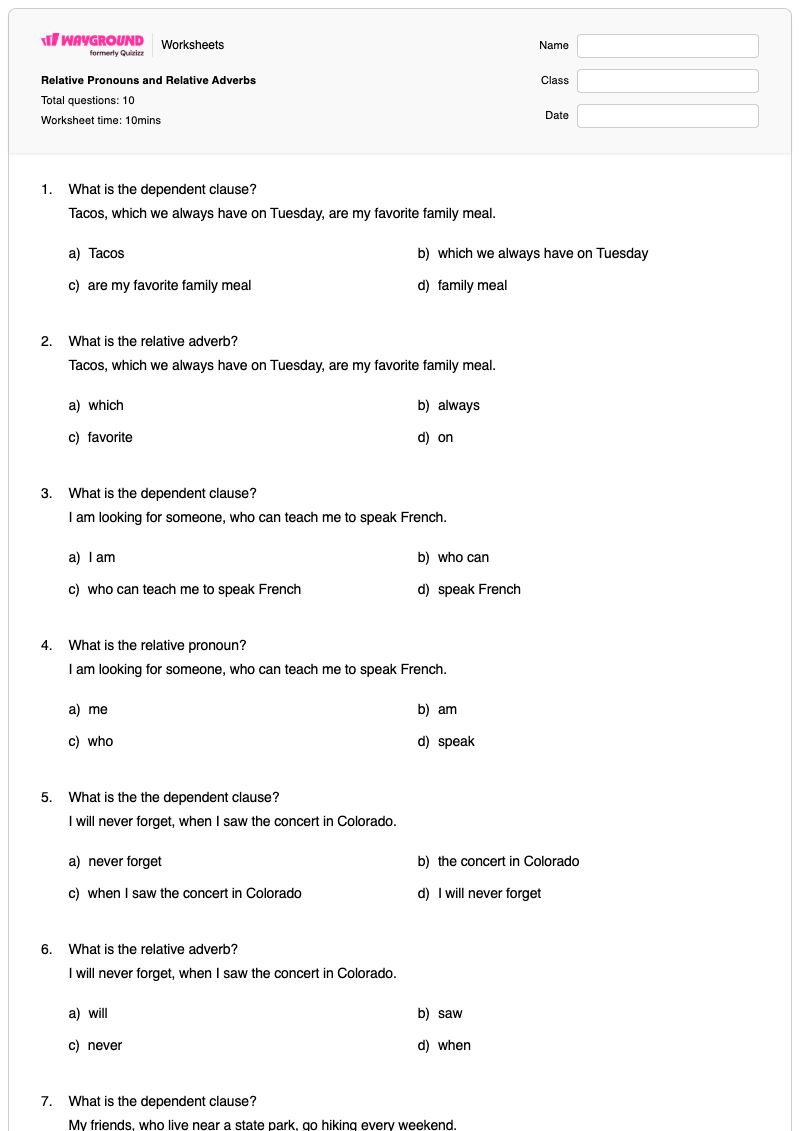
Relative Pronouns and Relative Adverbs is a Grade 4 English worksheet with 10 multiple-choice questions focused on identifying dependent clauses and the relative pronouns or relative adverbs used within them. Students analyze complete sentences featuring clauses introduced by words such as who, which, and when, then select the specific clause or signal word requested in each item.
This free printable worksheet helps students connect sentence structure to the words that introduce additional information about people, places, events, or things. It is useful for guided grammar instruction, independent practice, review, or a quick check of understanding after teaching dependent clauses and relative words. The worksheet includes a complete answer key so teachers can quickly review students’ choices and address confusion between a dependent clause, an independent clause, and an individual word. A digital quiz version is also available on Wayground.
Worksheet settings
Font size
S
M
L
XL
Worksheets
Relative Pronouns and Relative Adverbs
Total questions: 10
Name
Class
Date
1.
What is the dependent clause?
Tacos, which we always have on Tuesday, are my favorite family meal.
a)
Tacos
b)
which we always have on Tuesday
c)
are my favorite family meal
d)
family meal
2.
What is the relative adverb?
Tacos, which we always have on Tuesday, are my favorite family meal.
a)
which
b)
always
c)
favorite
d)
on
3.
What is the dependent clause?
I am looking for someone, who can teach me to speak French.
a)
I am
b)
who can
c)
who can teach me to speak French
d)
speak French
4.
What is the relative pronoun?
I am looking for someone, who can teach me to speak French.
a)
me
b)
am
c)
who
d)
speak
5.
What is the the dependent clause?
I will never forget, when I saw the concert in Colorado.
a)
never forget
b)
the concert in Colorado
c)
when I saw the concert in Colorado
d)
I will never forget
6.
What is the relative adverb?
I will never forget, when I saw the concert in Colorado.
a)
will
b)
saw
c)
never
d)
when
7.
What is the dependent clause?
My friends, who live near a state park, go hiking every weekend.
a)
go hiking every weekend
b)
who live near a state park
c)
My friends, who live near a state park, go hiking every weekend.
d)
My friends, who live near a state park,
8.
What is the relative pronoun?
My friends, who live near a state park, go hiking every weekend.
a)
every
b)
friends
c)
live
d)
who
9.
What is the dependent clause?
My favorite author wrote this book, which tells about a kingdom from long ago.
a)
about a kingdom
b)
My favorite author wrote this book
c)
wrote this book
d)
which tells about a kingdom from long ago
10.
What is the relative pronoun?
My favorite author wrote this book, which tells about a kingdom from long ago.
a)
which
b)
this
c)
favorite
d)
long
Answer Key
Relative Pronouns and Relative Adverbs
Total questions: 10
1.
b)
which we always have on Tuesday
2.
a)
which
3.
c)
who can teach me to speak French
4.
c)
who
5.
c)
when I saw the concert in Colorado
6.
d)
when
7.
b)
who live near a state park
8.
d)
who
9.
d)
which tells about a kingdom from long ago
10.
a)
which
140 %
Browse by subjects
Browse by grades
Browse by format
FAQs
What does the Relative Pronouns and Relative Adverbs worksheet cover?
This Grade 4 English worksheet uses 10 multiple-choice questions to have students identify dependent clauses and the relative pronouns or relative adverbs within complete sentences. By selecting answers such as “who,” “which,” or “when” and locating clauses such as “who can teach me to speak French,” students practise separating a dependent clause from the surrounding independent clause.
How can I use this worksheet to teach dependent clauses and relative words?
First, model one of the worksheet’s sentences by marking the dependent clause and circling the relative word that introduces it. Then have students read each sentence, bracket the clause requested in the question, and identify the target word before choosing an answer. Ask students to explain why a complete sentence portion is not the dependent clause when reviewing items such as the sentences about tacos, friends, and a favorite author.
What mistakes should I watch for when students complete this worksheet?
Students may choose a nearby noun or verb instead of the full dependent clause, such as selecting “tacos” or “speak French” rather than the entire clause. They may also select the whole sentence, confuse the independent clause with the dependent clause, or overlook the signal word when identifying who, which, or when. Review the sentence boundaries and have students read the selected words together to check whether they form the clause named in the question.
How do I assign and grade this worksheet?
You can assign Relative Pronouns and Relative Adverbs as a printable PDF or as a digital quiz on Wayground. The worksheet includes a complete answer key, and printable submissions can be graded by scanning student work with the Wayground for Teachers app. The printable format also supports instruction when your school is reducing screen time.
How can I differentiate this worksheet for my students?
Use the worksheet’s Advanced Settings to adjust font spacing or choose a larger font size, making the complete sentences and dependent-clause choices easier to track. You can also apply a dyslexia-friendly font or translate the worksheet into another language while students work through the multiple-choice items.
Where can I find more worksheets like this on Wayground?
Wayground offers a comprehensive collection of free printable worksheets and practice problems across all subjects, with downloadable PDFs and answer keys to help students master essential skills and concepts. Browse more resources at https://wayground.com/en-us/worksheets.

 Worksheets