

Wayground
Revolutionary War  - Printable Social Studies Worksheets grade 8 - Wayground

Revolutionary War

20 questions

8th - 8th Grade

Social Studies

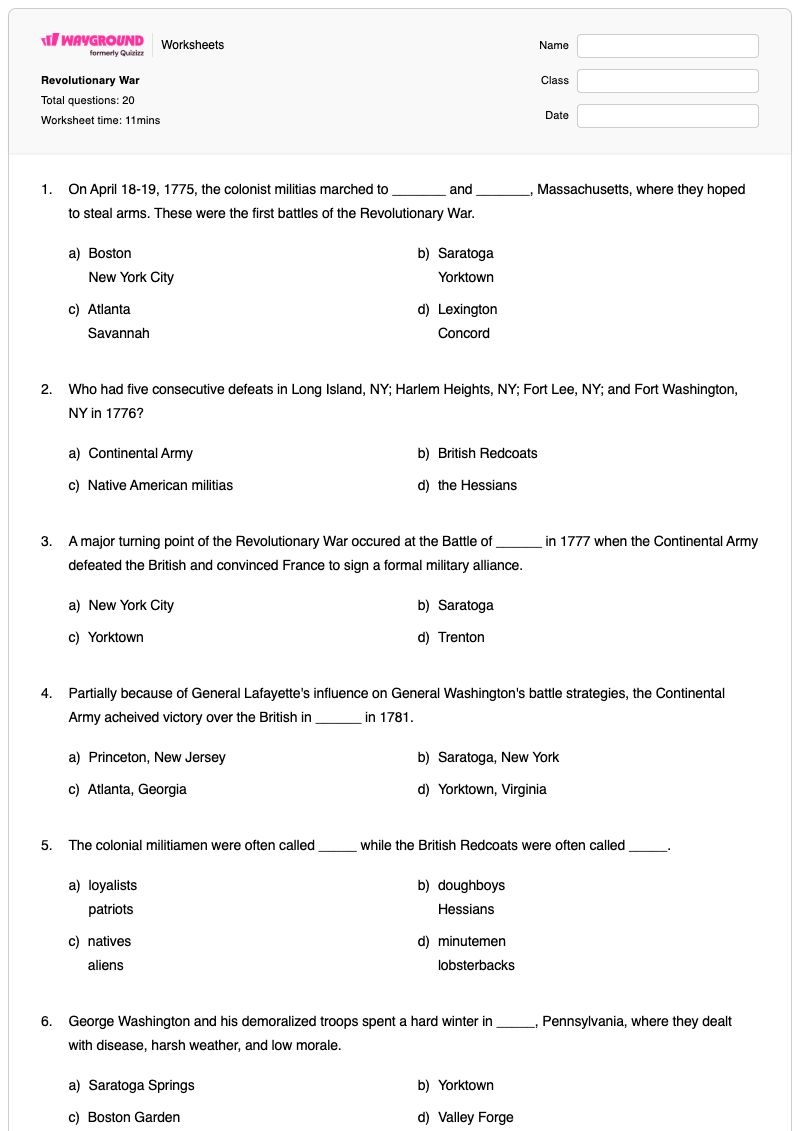
Revolutionary War is a Grade 8 social studies worksheet with 20 multiple-choice questions about the causes, major events, terminology, documents, and outcomes of the American Revolution. Students use clues to identify battles such as Lexington and Concord, Saratoga, and Yorktown; locations including Valley Forge; groups such as the Continental Army and British Redcoats; and terms such as minutemen and lobsterbacks. The worksheet also checks students’ understanding of British policies and colonial resistance, including the Proclamation of 1763, Quartering Act, Stamp Act, Intolerable Acts, and Boston Massacre. Additional questions connect the Battle of Saratoga to France’s alliance with the American side and identify the Treaty of Paris (1783) and the Declaration of Independence. This free printable worksheet includes a complete answer key for efficient review, independent practice, or assessment.

Worksheet settings

Font size

S
M
L
XL
Worksheets

Revolutionary War

Total questions: 20

Name
Class
Date
1.

On April 18-19, 1775, the colonist militias marched to _______ and _______, Massachusetts, where they hoped to steal arms. These were the first battles of the Revolutionary War.

a)

Boston

New York City

b)

Saratoga

Yorktown

c)

Atlanta

Savannah

d)

Lexington

Concord

2.

Who had five consecutive defeats in Long Island, NY; Harlem Heights, NY; Fort Lee, NY; and Fort Washington, NY in 1776?

a)

Continental Army

b)

British Redcoats

c)

Native American militias

d)

the Hessians

3.

A major turning point of the Revolutionary War occured at the Battle of ______ in 1777 when the Continental Army defeated the British and convinced France to sign a formal military alliance.

a)

New York City

b)

Saratoga

c)

Yorktown

d)

Trenton

4.

Partially because of General Lafayette's influence on General Washington's battle strategies, the Continental Army acheived victory over the British in ______ in 1781.

a)

Princeton, New Jersey

b)

Saratoga, New York

c)

Atlanta, Georgia

d)

Yorktown, Virginia

5.

The colonial militiamen were often called _____ while the British Redcoats were often called _____.

a)

loyalists

patriots

b)

doughboys

Hessians

c)

natives

aliens

d)

minutemen

lobsterbacks

6.

George Washington and his demoralized troops spent a hard winter in _____, Pennsylvania, where they dealt with disease, harsh weather, and low morale.

a)

Saratoga Springs

b)

Yorktown

c)

Boston Garden

d)

Valley Forge

7.

Which document recognized American independence, gave Americans all land east of Mississippi River and north of Florida, and evacuated forts occupied by the British?

a)

Declaration of Independence

b)

Treaty of Paris (1763)

c)

Treaty of Paris (1783)

d)

Suffolk Resolve

8.

Why did the British tax the colonies so heavily after the French and Indian War?

a)

To get extra tea and sugar

b)

To force the Patriots to surrender

c)

To create anger in the colonies

d)

To pay off war debt

9.

Which answer best describes the Intolerable Acts?

a)

gave colonists more freedom.

b)

a series of laws placed on colonists because of the Boston Tea Party.

c)

acts that the colonists placed on themselves

d)

it only closed Boston Harbor

10.

American Colonists can not settle west of the Appalachian Mountains

a)

Stamp Act

b)

Townshend Acts

c)

Proclamation of 1763

d)

The Tea Act

11.

This act required colonists to house and feed British Troops

a)

Quartering Act

b)

Townshend Acts

c)

Intolerable Acts

d)

Proclamation of 1763

12.

This act required colonists to buy a stamp each time they registered a legal document, bought newspapers, pamphlets, and almanacs.

a)

Tea Act

b)

Sugar Act

c)

Intolerable Acts

d)

Stamp Act

13.

Clash between Boston rioters and British Troops that left 5 colonists dead.

a)

Boston Tea Party

b)

Intolerable Acts

c)

Boycott

d)

Boston Massacre

14.
What country joined the American side after the Battle of Saratoga?
a)
France
b)
Spain
c)
Germany
d)
Britain
15.
What did one part of the Declaration of Independence list?
a)
The colonists still wanted to be British citizens
b)
The colonists wanted to change the British government
c)
The things the colonists thought the King did wrong
16.

What is the importance of the Declaration of Independence ?

a)

An informal commentary that a king has little more to do than make war.

b)

Government proclamation that citizens are not equal to kings or other nobilityF

c)

Public document stating that all people should live under the rule of a fair and just king.

d)

Formal announcement of America’s independence from Great Britain.

17.

What are the unalienable rights of citizens?

a)

Life, Liberty and the Pursuit of Happiness

b)

Life, Death and Taxes

c)

Life, Liberty and Justice for All

d)

Life, Death and Liberty

18.

Which of the following answers explains why the Americans won the Battle of Yorktown?

a)

They used guerilla tactics

b)

Washington surrounded the British, and the French navy blocked the bay.

c)

The Patriots fought the British on open fields of the South.

d)

It was a surprise attack on the British.

19.

What was the name of the German mercenaries hired by the British to fight in America?

a)

Pacifists

b)

Loyalists

c)

Hessians

d)

Patriots

20.

Who won the Battle of Bunker Hill?

a)

The British

b)

The Colonists

c)

The French

d)

The Natives

Answer Key

Revolutionary War

Total questions: 20

1.
d)

Lexington

Concord

2.
a)

Continental Army

3.
b)

Saratoga

4.
d)

Yorktown, Virginia

5.
d)

minutemen

lobsterbacks

6.
d)

Valley Forge

7.
c)

Treaty of Paris (1783)

8.
d)

To pay off war debt

9.
b)

a series of laws placed on colonists because of the Boston Tea Party.

10.
c)

Proclamation of 1763

11.
a)

Quartering Act

12.
d)

Stamp Act

13.
d)

Boston Massacre

14.
a) France
15.
c) The things the colonists thought the King did wrong
16.
d)

Formal announcement of America’s independence from Great Britain.

17.
a)

Life, Liberty and the Pursuit of Happiness

18.
b)

Washington surrounded the British, and the French navy blocked the bay.

19.
c)

Hessians

20.
a)

The British

FAQs

What does the Revolutionary War worksheet cover?

This Grade 8 worksheet uses 20 multiple-choice questions to assess recognition of key Revolutionary War events, locations, groups, laws, documents, and outcomes. Students match clues to answers such as Lexington and Concord, Saratoga, Yorktown, Valley Forge, the Stamp Act, the Treaty of Paris (1783), and France’s alliance with the American side, building accurate connections among major facts of the conflict.

How can I use this worksheet to teach the causes and major events of the Revolutionary War?

Introduce the worksheet by grouping its clues into causes, wartime events, and outcomes. Before students select answers, have them explain how policies such as the Proclamation of 1763, Quartering Act, Stamp Act, and Intolerable Acts contributed to colonial resistance, then discuss how Saratoga, Yorktown, and the Treaty of Paris (1783) marked turning points or results.

What mistakes should I watch for when students complete this Revolutionary War worksheet?

Students may confuse laws with the events or policies they addressed—for example, selecting the Stamp Act for the question about housing and feeding British troops instead of the Quartering Act. They may also mix up battle locations and outcomes, such as choosing Yorktown for the French alliance question rather than Saratoga, or confuse the Treaty of Paris (1783) with the Declaration of Independence.

How do I assign and grade this Revolutionary War worksheet?

The worksheet is available as a printable PDF and as a digital quiz on Wayground, and it includes a complete answer key for all 20 multiple-choice questions. For printable submissions, you can grade student work by scanning it with the Wayground for Teachers app.

How can I differentiate this Revolutionary War worksheet for my students?

Use the worksheet’s Advanced Settings to adjust font spacing or increase the font size so the multiple-choice prompts and answer options are easier to read. You can also enable a dyslexia-friendly font or translate the worksheet into another language when those options support access to its Revolutionary War questions.

Where can I find more worksheets like this on Wayground?

Wayground offers a comprehensive collection of free printable worksheets and practice problems across subjects, with downloadable PDFs and answer keys to help students master essential skills and concepts. Browse more resources at https://wayground.com/en-us/worksheets.