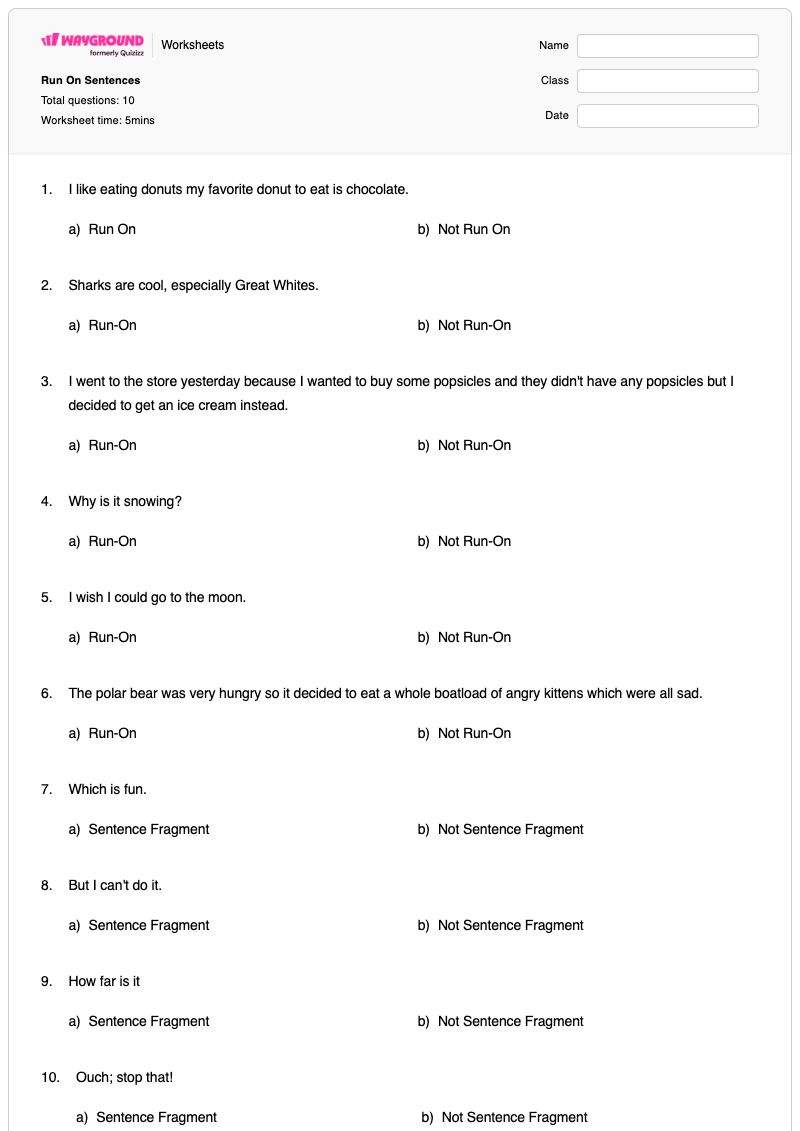
Run On Sentences is a Grade 6 English worksheet that helps students distinguish run-on sentences, complete sentences, and sentence fragments. Across 10 multiple-choice items, students classify examples such as sentences that combine several thoughts without appropriate separation and short groups of words that do not express a complete thought. The worksheet also includes complete sentences for comparison, helping students apply the distinction rather than rely only on sentence length.
Use this free printable worksheet to reinforce sentence-structure lessons, provide independent practice, or check whether students can identify fragments and run-ons in context. The clear Run-On/Not Run-On and Sentence Fragment/Not Sentence Fragment choices make it suitable for guided review, class discussion, or quick assessment. A complete answer key is included so teachers can review classifications efficiently and address errors with students.
Worksheet settings
Font size
S
M
L
XL
Worksheets
Run On Sentences
Total questions: 10
Name
Class
Date
1.
I like eating donuts my favorite donut to eat is chocolate.
a)
Run On
b)
Not Run On
2.
Sharks are cool, especially Great Whites.
a)
Run-On
b)
Not Run-On
3.
I went to the store yesterday because I wanted to buy some popsicles and they didn't have any popsicles but I decided to get an ice cream instead.
a)
Run-On
b)
Not Run-On
4.
Why is it snowing?
a)
Run-On
b)
Not Run-On
5.
I wish I could go to the moon.
a)
Run-On
b)
Not Run-On
6.
The polar bear was very hungry so it decided to eat a whole boatload of angry kittens which were all sad.
a)
Run-On
b)
Not Run-On
7.
Which is fun.
a)
Sentence Fragment
b)
Not Sentence Fragment
8.
But I can't do it.
a)
Sentence Fragment
b)
Not Sentence Fragment
9.
How far is it
a)
Sentence Fragment
b)
Not Sentence Fragment
10.
Ouch; stop that!
a)
Sentence Fragment
b)
Not Sentence Fragment
Answer Key
Run On Sentences
Total questions: 10
1.
a)
Run On
2.
b)
Not Run-On
3.
a)
Run-On
4.
b)
Not Run-On
5.
b)
Not Run-On
6.
a)
Run-On
7.
a)
Sentence Fragment
8.
a)
Sentence Fragment
9.
a)
Sentence Fragment
10.
b)
Not Sentence Fragment
140 %
Browse by subjects
Browse by grades
Browse by format
FAQs
What does the Run On Sentences worksheet cover?
This Grade 6 English worksheet uses 10 multiple-choice questions to help students identify run-on sentences and sentence fragments. Students classify examples as Run-On or Not Run-On, then distinguish Sentence Fragment from Not Sentence Fragment, building their ability to recognize whether ideas form a complete, correctly structured sentence.
How can I use this worksheet to teach run-on sentences and sentence fragments?
Begin by modeling how to read each example for a complete thought and appropriate sentence structure, then complete a few of the classification questions aloud. Ask students to explain why a long example combines multiple thoughts as a run-on and why examples such as “Which is fun” or “How far is it” are fragments. Finish with independent practice using the remaining multiple-choice items and review the answer key together.
What mistakes should I watch for when students complete this worksheet?
Students may label any long sentence a run-on without checking how its ideas are joined, or assume that a short group of words is automatically a complete sentence. Watch for confusion between the worksheet’s fragment examples, such as “But I can’t do it,” and the complete sentence “Ouch; stop that!” Students may also overlook whether an example expresses a complete thought when choosing between the two answer options.
How do I assign and grade the Run On Sentences worksheet?
The worksheet is available as a printable PDF and as a digital quiz on Wayground, and it includes a complete answer key. For printable submissions, you can scan student work with the Wayground for Teachers app to streamline grading. The PDF option also supports instruction in classrooms working to reduce screen time.
How can I differentiate this worksheet for my students?
Use the worksheet’s Advanced Settings to create an alternate version with normal, medium, or wide font spacing and font sizes from S through XL, making the multiple-choice sentence examples easier to read. You can also apply a dyslexia-friendly font or translate the worksheet into another language when that supports access to the run-on and fragment classification tasks.
Where can I find more worksheets like this on Wayground?
Wayground offers a comprehensive collection of free printable worksheets and practice problems across all subjects, with downloadable PDFs and answer keys to help students master essential skills and concepts. Browse more resources at https://wayground.com/en-us/worksheets.

 Worksheets