

Wayground
Quiz: Exotic Animals in Captivity - Printable Other, Specialty Worksheets grade 10 - Wayground

Quiz: Exotic Animals in Captivity

18 questions

10th - 12th Grade

Other, Specialty

Quiz: Exotic Animals in Captivity is a free printable worksheet for Grades 10–12 students studying animal welfare, wildlife management, or specialty animal science. Its 18 multiple-choice questions assess vocabulary such as prohibition, acclimated, welfare, exotic, and stereotypies, along with students’ understanding of disease risks, captive-animal behavior, smuggling, and the care of exotic animals. The worksheet also reviews laws and conservation measures connected to exotic animals, including the Animal Welfare Act, Wild Bird Conservation Act, Lacey Act, Endangered Species Act, and state permit requirements. Students interpret true-or-false statements, identify examples of stereotypic behavior, connect legislation with its purpose, and apply key terms to captivity scenarios. The free printable worksheet includes a complete answer key for efficient review and grading.

Worksheet settings

Font size

S
M
L
XL
Worksheets

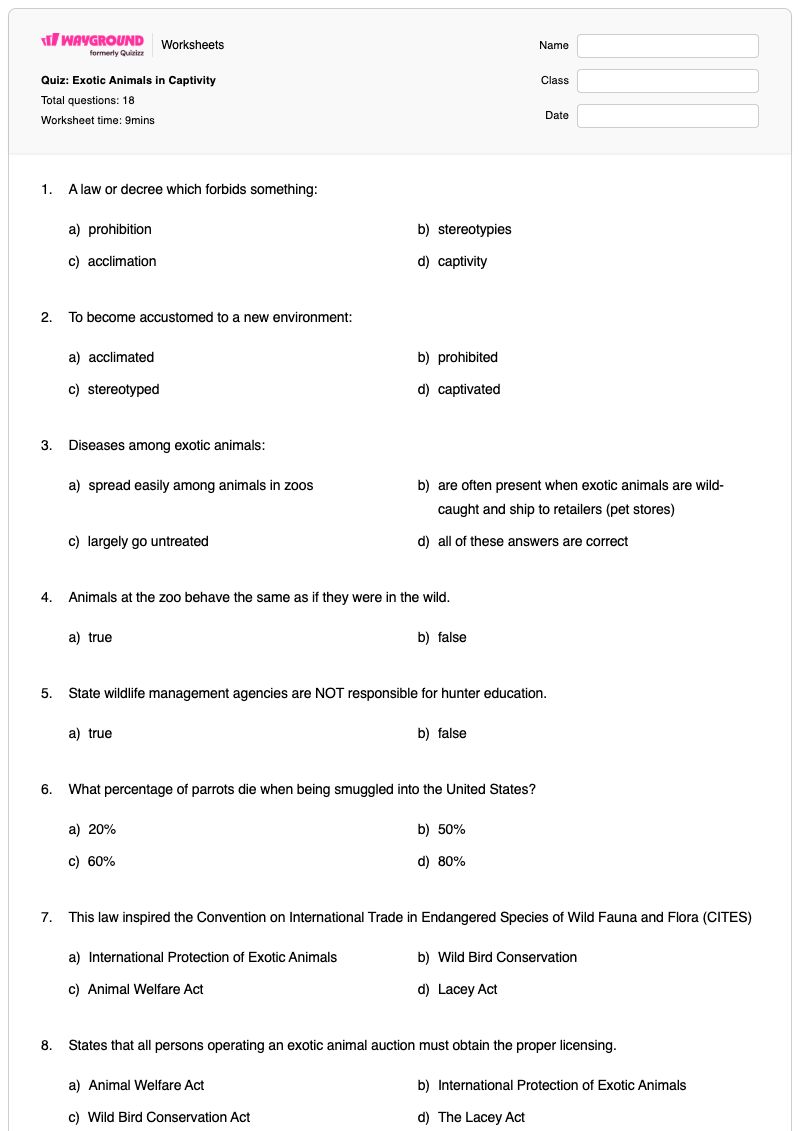
Quiz: Exotic Animals in Captivity

Total questions: 18

Name
Class
Date
1.

A law or decree which forbids something:

a)

prohibition

b)

stereotypies

c)

acclimation

d)

captivity

2.

To become accustomed to a new environment:

a)

acclimated

b)

prohibited

c)

stereotyped

d)

captivated

3.

Diseases among exotic animals:

a)

spread easily among animals in zoos

b)

are often present when exotic animals are wild-caught and ship to retailers (pet stores)

c)

largely go untreated

d)

all of these answers are correct

4.

Animals at the zoo behave the same as if they were in the wild.

a)

true

b)

false

5.

State wildlife management agencies are NOT responsible for hunter education.

a)

true

b)

false

6.

What percentage of parrots die when being smuggled into the United States?

a)

20%

b)

50%

c)

60%

d)

80%

7.

This law inspired the Convention on International Trade in Endangered Species of Wild Fauna and Flora (CITES)

a)

International Protection of Exotic Animals

b)

Wild Bird Conservation

c)

Animal Welfare Act

d)

Lacey Act

8.

States that all persons operating an exotic animal auction must obtain the proper licensing.

a)

Animal Welfare Act

b)

International Protection of Exotic Animals

c)

Wild Bird Conservation Act

d)

The Lacey Act

9.

This was enacted in response to the fact that the United States in the number one international importer of exotic birds.

a)

Wild Bird Conservation Act

b)

Animal Welfare Act

c)

Lacey Act

d)

HelpaBird Act

10.

Provides protection for many animals and their habitats to ensure they do not become extinct.

a)

The Endangered Species Act

b)

Animal Welfare Act

c)

The Lacey Act

d)

Wild Beast Act

11.

The health, happiness, and well-being of an animal.

a)

welfare

b)

rights

12.

A lion paces in his small cage, back and forth for extended amounts of time. This is a(n):

a)

stereotypie

b)

wasting disease

c)

acclimated activity

d)

normal activity for lions, captive or wild

13.

A bearded dragon and a ball python are both classified as pets that are:

a)

exotic

b)

domesticated

c)

both of the answers are true

14.

An exotic animal's nutritional needs are met and the animal is provided with plenty of space. This means that they will not exhibit stereotypies in captivity.

a)

true

b)

false

15.

Exotic animal permit requirements, rules, and regulations are the same in every state in the U.S.

a)

true

b)

false

16.

Enrichment of captive animals aims for optimal:

a)

mental well-being

b)

body well-being

c)

both of the answers are correct

d)

none of these answers are correct

17.

The phrase "born in captivity" means

a)

that no animals are ever born in the wild

b)

that animals in captivity do not have babies

c)

that an animal was not born in the wild

d)

that an animal was born to be a pet

18.

A tiger is "exotic" in the United States because

a)

most people do not know what a tiger is

b)

it comes from another part of the world

c)

it is the only animal that has stripes

d)

it doesn't look like a pet cat

Answer Key

Quiz: Exotic Animals in Captivity

Total questions: 18

1.
a)

prohibition

2.
a)

acclimated

3.
d)

all of these answers are correct

4.
b)

false

5.
b)

false

6.
d)

80%

7.
a)

International Protection of Exotic Animals

8.
a)

Animal Welfare Act

9.
a)

Wild Bird Conservation Act

10.
a)

The Endangered Species Act

11.
a)

welfare

12.
a)

stereotypie

13.
a)

exotic

14.
b)

false

15.
b)

false

16.
c)

both of the answers are correct

17.
c)

that an animal was not born in the wild

18.
b)

it comes from another part of the world

FAQs

What does the Exotic Animals in Captivity worksheet cover?

This Grade 10–12 worksheet uses 18 multiple-choice questions to assess exotic-animal captivity concepts, including welfare, acclimation, stereotypies, disease transmission, smuggling risks, and the distinction between captive and wild behavior. It also asks students to identify the purposes or names of major wildlife-protection laws and evaluate statements about permits, conservation, and state regulations.

How can I use this worksheet to teach exotic-animal captivity and wildlife protection?

Introduce the vocabulary first, especially welfare, acclimated, prohibition, exotic, and stereotypies, then have students use the lion-pacing scenario to discuss how repeated captive behavior may differ from normal wild behavior. After students complete the multiple-choice items, review the legislation questions by asking them to match each law with the issue it addresses, such as licensing, bird imports, endangered species, or habitat protection.

What mistakes should I watch for when students complete this worksheet?

Students may confuse acclimated, which describes becoming accustomed to a new environment, with captivity or stereotypies, which is the behavior concept illustrated by the pacing lion. They may also assume that meeting an animal’s nutritional and space needs automatically prevents stereotypies, or treat exotic-animal permit rules as identical in every state. In the law questions, watch for confusion among the Animal Welfare Act, Wild Bird Conservation Act, Lacey Act, and Endangered Species Act.

How do I assign and grade this exotic-animal captivity worksheet?

Wayground provides this worksheet as a printable PDF and as a digital quiz, and it includes a complete answer key for the 18 multiple-choice questions. You can grade printable submissions by scanning student work with the Wayground for Teachers app, or assign the digital quiz through Wayground for online completion and grading.

How can I differentiate this worksheet for my students?

Use the worksheet’s Advanced Settings to increase font size or adjust font spacing so the vocabulary, law names, and multiple-choice options are easier to read. You can also enable a dyslexia-friendly font or translate the worksheet into another language when language access supports students working with the exotic-animal captivity content.

Where can I find more worksheets like this on Wayground?

Wayground offers a broad collection of free printable worksheets and practice problems across subjects, with downloadable PDFs and answer keys to support mastery of essential skills and concepts. Browse more resources at https://wayground.com/en-us/worksheets.