

Wayground
Nouns as Objects - Printable English Worksheets grade 6 - Wayground

Nouns as Objects

20 questions

6th - 6th Grade

English

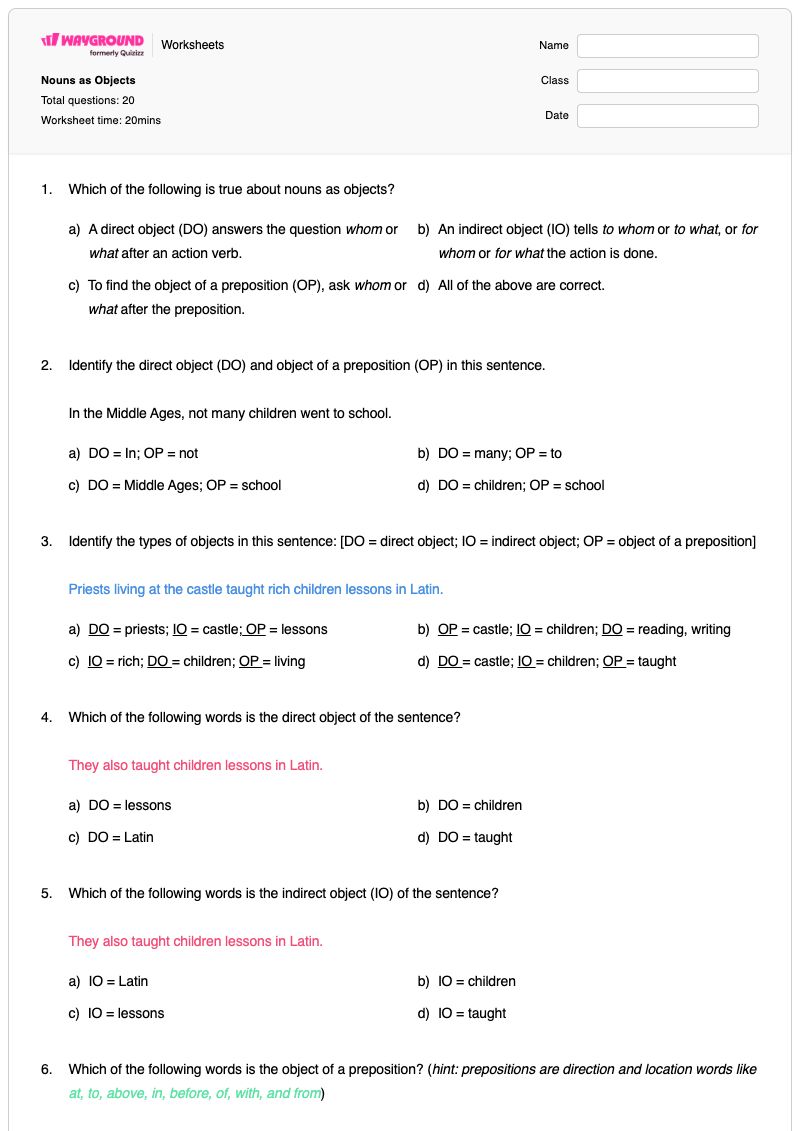
Nouns as Objects is a Grade 6 English worksheet that helps students distinguish direct objects, indirect objects, and objects of prepositions in complete sentences. Across 20 questions, students identify the noun or noun phrase receiving an action, the person or thing receiving something, and the noun that follows a preposition. The set includes 17 multiple-choice questions, 2 multiple-select questions, and 1 fill-in-the-blank item, giving students repeated practice with sentence-level analysis rather than isolated definitions. Use this free printable worksheet to reinforce object identification after direct instruction or to check whether students can apply the rules independently. The questions include sentences with more than one type of object, so students must use the role and position of each noun—not simply its location—to choose an answer. It is suitable for Grade 6 grammar practice, review, or assessment and includes a complete answer key for efficient checking.

Worksheet settings

Font size

S
M
L
XL
Worksheets

Nouns as Objects

Total questions: 20

Name
Class
Date
1.

Which of the following is true about nouns as objects?

a)

A direct object (DO) answers the question whom or what after an action verb.

b)

An indirect object (IO) tells to whom or to what, or for whom or for what the action is done.

c)

To find the object of a preposition (OP), ask whom or what after the preposition.

d)

All of the above are correct.

2.

Identify the direct object (DO) and object of a preposition (OP) in this sentence.


In the Middle Ages, not many children went to school.

a)

DO = In; OP = not

b)

DO = many; OP = to

c)

DO = Middle Ages; OP = school

d)

DO = children; OP = school

3.

Identify the types of objects in this sentence: [DO = direct object; IO = indirect object; OP = object of a preposition]


Priests living at the castle taught rich children lessons in Latin.

a)

DO = priests; IO = castle; OP = lessons

b)

OP = castle; IO = children; DO = reading, writing

c)

IO = rich; DO = children; OP = living

d)

DO = castle; IO = children; OP = taught

4.

Which of the following words is the direct object of the sentence?


They also taught children lessons in Latin.

a)

DO = lessons

b)

DO = children

c)

DO = Latin

d)

DO = taught

5.

Which of the following words is the indirect object (IO) of the sentence?


They also taught children lessons in Latin.

a)

IO = Latin

b)

IO = children

c)

IO = lessons

d)

IO = taught

6.

Which of the following words is the object of a preposition? (hint: prepositions are direction and location words like at, to, above, in, before, of, with, and from)


They also taught children lessons in Latin.

a)

OP = children

b)

OP = Latin

c)

OP = lessons

d)

OP = taught

7.

Identify the kinds of objects that are underlined. Which is a direct object, indirect object, or an object of a preposition?


Most people learned history from storytellers.

a)

History is a direct object (DO); Storytellers is an object of a preposition (OP)

b)

History is an indirect object (IO); Storytellers is a direct object (DO)

c)

History is an object of a preposition (OP); storytellers is an indirect object (IO)

d)

History and storyteller are both objects of prepositions (OP)

8.

Identify the direct object (DO), indirect object (IO), and object of a preposition (OP) from the following sentence.


Our teacher showed Sophia a new step at dance class.

a)

DO = teacher; IO = Our; OP = dance

b)

DO = showed; IO = Sophia; OP = class

c)

DO = step; IO = Sophia; OP = class

d)

DO = step; IO = dance; OP = new

9.

Identify the correct types of objects in the following sentence:


The clerk gave the customer two dollars in change.

a)

DO = gave; IO = two; OP = in

b)

DO = dollars; IO = gave; OP = customer

c)

DO = customer; IO = change; OP = dollars

d)

DO = dollars; IO = customer; OP = change

10.

Identify which type of object for the underlined noun.:


The camper watched the antics of the raccoon.

a)

direct object

b)

indirect object

c)

object of a preposition

d)

not an object

11.

Identify which type of object is the underlined noun:


The camper watched the antics of the raccoon.

a)

direct object

b)

indirect object

c)

object of a preposition

d)

not an object

12.

Identify the direct object of the following sentence:


Dan asks his brother questions constantly.

a)

Dan

b)

brother

c)

questions

d)

constantly

13.

Identify the indirect object (IO) of the following sentence:


Dan asks his brother questions constantly.

a)

Dan

b)

brother

c)

questions

d)

constantly

14.

Which of the following is the direct object (DO) of the sentence:


We will build a giant sandwich with plenty of onions.

a)

We

b)

build

c)

giant

d)

sandwich

15.

Identify the two objects of prepositions (OP) in the following sentence:


We will build a giant sandwich with plenty of onions.

a)

We, will

b)

giant, sandwich

c)

with, of

d)

plenty, onions

16.

Identify the correct types of pronouns in the following sentence:


Jacob made his little brother a sandwich for lunch.

a)

sandwich is the direct object (DO); brother is the indirect object (IO); lunch is the object of a preposition (OP)

b)

Jacob is the direct object (DO); made is the indirect object (IO); for is the object of a preposition (OP)

c)

his is the direct object (DO); little is the indirect object (IO); sandwich is the object of a preposition (OP)

d)

none of the above are correct

17.

Identify the preposition and its object noun.


My cat will not eat food in his bowl.

a)

Preposition: My; Object: cat

b)

Preposition: will; Object: eat

c)

Preposition: food; Object: his

d)

Preposition: in; Object: bowl

18.

Which of the words is a preposition? (Hint: a preposition is used to show a relationship between words)

a)

answer

b)

at

c)

because

d)

help

19.

Which of the following are prepositions?

a)

around, by, into, between

b)

house, symphony, child, game

c)

run, play, cry, wait

d)

calmly, fast, colorful, mightily

20.

Fill in the blank with a preposition that makes sense.


The cow jumped (a)   the gate and landed in the field of grass.

Answer Key

Nouns as Objects

Total questions: 20

1.
d)

All of the above are correct.

2.
c)

DO = Middle Ages; OP = school

3.
b)

OP = castle; IO = children; DO = reading, writing

4.
a)

DO = lessons

5.
b)

IO = children

6.
b)

OP = Latin

7.
a)

History is a direct object (DO); Storytellers is an object of a preposition (OP)

8.
c)

DO = step; IO = Sophia; OP = class

9.
d)

DO = dollars; IO = customer; OP = change

10.
a)

direct object

11.
c)

object of a preposition

12.
c)

questions

13.
b)

brother

14.
d)

sandwich

15.
d)

plenty, onions

16.
a)

sandwich is the direct object (DO); brother is the indirect object (IO); lunch is the object of a preposition (OP)

17.
d)

Preposition: in; Object: bowl

18.
b)

at

19.
a)

around, by, into, between

20.
over, through, across, behind, in front of

FAQs

What does the Nouns as Objects worksheet cover?

This Grade 6 English worksheet focuses on identifying direct objects, indirect objects, and objects of prepositions in complete sentences. Its 20 items—17 multiple choice, 2 multiple select, and 1 fill in the blank—ask students to classify individual nouns and combinations of objects, helping them apply grammatical definitions to sentence structure.

How can I use this worksheet to teach direct, indirect, and prepositional objects?

First model one sentence by locating the action verb, asking whom or what for the direct object, identifying the recipient for the indirect object, and checking the noun that follows a preposition. Then have students explain their choices on the worksheet, especially when a sentence contains all three object types. Use the multiple-select items as opportunities for students to justify each selected label rather than guessing from the answer choices.

What mistakes should I watch for when students complete this nouns-as-objects worksheet?

Students may label the subject or action verb as an object, confuse the direct object with the indirect recipient, or identify the preposition itself instead of its object. They may also overlook a second object in sentences containing several nouns, or select only one answer on a multiple-select item when more than one classification is required.

How do I assign and grade this Nouns as Objects worksheet?

The worksheet is available as a printable PDF and as a digital quiz on Wayground, and it includes a complete answer key. You can grade printable submissions by scanning student work with the Wayground for Teachers app, or use the digital quiz to review responses electronically.

How can I differentiate this worksheet for my students?

In the worksheet’s Advanced Settings, adjust font spacing or choose a larger font size to give the sentence-analysis items more visual room. You can also apply a dyslexia-friendly font or translate the worksheet into another language, while keeping the direct-object, indirect-object, and object-of-a-preposition practice intact.

Where can I find more worksheets like this on Wayground?

Wayground offers a comprehensive collection of free printable worksheets and practice problems across all subjects, with downloadable PDFs and answer keys to help students master essential skills and concepts. Browse more resources at https://wayground.com/en-us/worksheets.