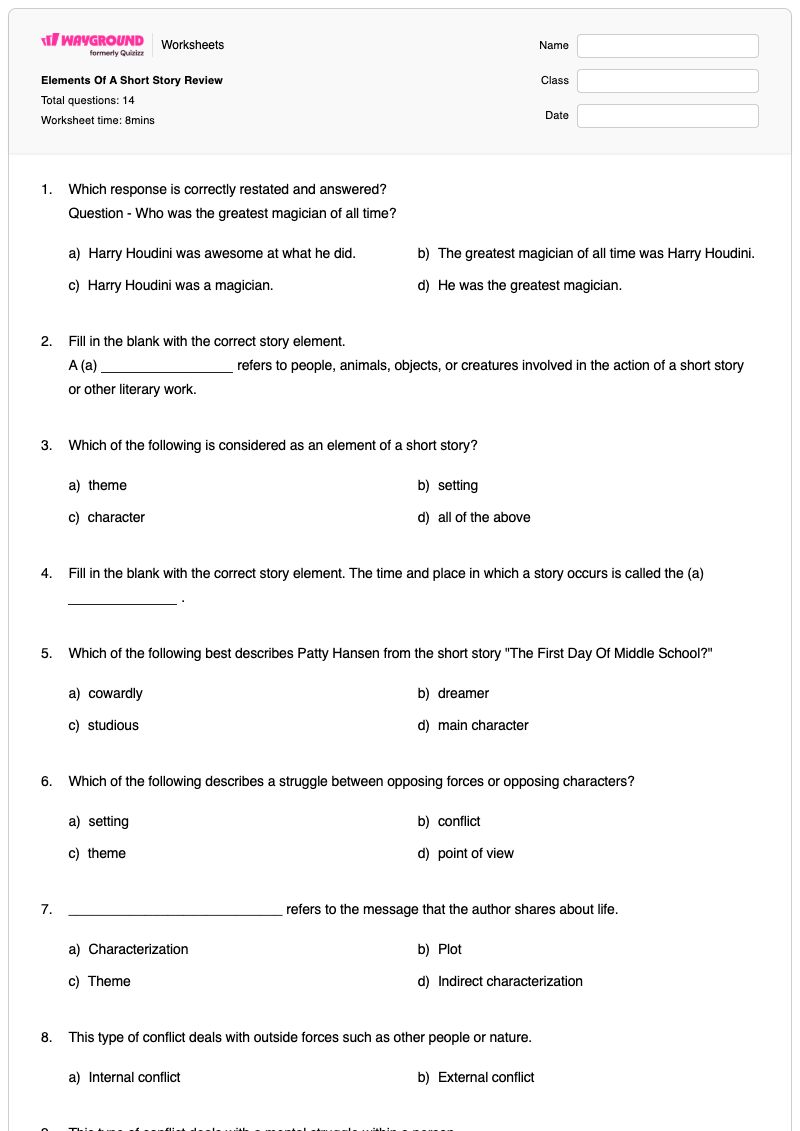
This Grade 6 English worksheet reviews the core elements of a short story through 14 questions: 12 multiple-choice items and 2 fill-in-the-blank prompts. Students identify characters, setting, theme, and conflict; distinguish internal conflict from external conflict in short scenarios; recognize a main character; and connect reading questions with purposes such as checking comprehension and asking about a title before reading. One item also asks students to restate and answer a question accurately.
Use this free printable worksheet to check whether students can apply short-story vocabulary and analyze the kind of conflict shown in a situation, rather than simply recall definitions. It works well as an independent review, guided practice, or formative assessment after introducing literary elements and before a short-story unit assessment. A complete answer key is included for efficient checking and feedback.
Worksheet settings
Font size
S
M
L
XL
Worksheets
Elements Of A Short Story Review
Total questions: 14
Name
Class
Date
1.
Which response is correctly restated and answered?
Question - Who was the greatest magician of all time?
a)
Harry Houdini was awesome at what he did.
b)
The greatest magician of all time was Harry Houdini.
c)
Harry Houdini was a magician.
d)
He was the greatest magician.
2.
Fill in the blank with the correct story element.
A (a) refers to people, animals, objects, or creatures involved in the action of a short story or other literary work.
3.
Which of the following is considered as an element of a short story?
a)
theme
b)
setting
c)
character
d)
all of the above
4.
Fill in the blank with the correct story element. The time and place in which a story occurs is called the (a) .
5.
Which of the following best describes Patty Hansen from the short story "The First Day Of Middle School?"
a)
cowardly
b)
dreamer
c)
studious
d)
main character
6.
Which of the following describes a struggle between opposing forces or opposing characters?
a)
setting
b)
conflict
c)
theme
d)
point of view
7.
____________________________ refers to the message that the author shares about life.
a)
Characterization
b)
Plot
c)
Theme
d)
Indirect characterization
8.
This type of conflict deals with outside forces such as other people or nature.
a)
Internal conflict
b)
External conflict
9.
This type of conflict deals with a mental struggle within a person.
a)
External conflict
b)
Internal conflict
10.
Tommy was late to the concert since the road was flooded and he had to take a detour. What type of conflict is this?
a)
Internal conflict
b)
External conflict
11.
Joanna did not raise her hand when the teacher asked if there were any questions. She was afraid her question would sound silly, and she could not remember if the teacher had already covered the information she didn't understand. What type of conflict is this?
a)
Internal conflict
b)
External conflict
12.
Tim was caught vandalizing a bench at the park. As a result, he had to complete 100 hours of community service. What type of conflict is this?
a)
Internal conflict
b)
External conflict
13.
We have completed the short story, "Grandfather Learns To Read." Why ask questions after reading?
a)
It keeps me interested in the text.
b)
It helps clarify what the author is saying.
c)
It helps check comprehension.
d)
It gives me a purpose for reading.
14.
When would you be most likely to ask a question about the title of a short story?
a)
Before reading
b)
During reading
c)
After Reading
d)
None of the above
Answer Key
Elements Of A Short Story Review
Total questions: 14
1.
b)
The greatest magician of all time was Harry Houdini.
2.
character
3.
d)
all of the above
4.
setting
5.
d)
main character
6.
b)
conflict
7.
c)
Theme
8.
b)
External conflict
9.
b)
Internal conflict
10.
b)
External conflict
11.
a)
Internal conflict
12.
b)
External conflict
13.
c)
It helps check comprehension.
14.
a)
Before reading
140 %
Browse by subjects
Browse by grades
Browse by format
FAQs
What does the Elements of a Short Story Review worksheet cover?
This Grade 6 English worksheet uses 12 multiple-choice questions and 2 fill-in-the-blank items to review character, setting, theme, and conflict. Students also classify examples as internal or external conflict, identify when to ask a question before or after reading, and select an accurately restated response. These tasks build students’ ability to recognize story elements and apply literary vocabulary to brief situations.
How can I use this worksheet to teach short story elements and internal versus external conflict?
Introduce character, setting, theme, and conflict with a short story, then model how to distinguish a mental struggle from a problem caused by another person, nature, or another outside force. Complete the two fill-in-the-blank definition items together before having students work through the multiple-choice conflict scenarios, such as a flooded road or a character worrying about asking a question. Ask students to explain which words in each scenario signal internal or external conflict and finish by discussing why readers ask questions before, during, or after reading.
What mistakes should I watch for when students complete this short story review?
Students may confuse setting with character, theme, or conflict, or choose a conflict type without identifying whether the struggle occurs inside a person or involves an outside force. They may also select a personality trait instead of the role of main character when describing Patty Hansen, and confuse a story’s message with its plot or characterization. Watch for students choosing a loosely related sentence instead of the fully restated answer and misidentifying the purpose of post-reading questions as maintaining interest rather than checking comprehension.
How do I assign and grade this short story worksheet?
On Wayground, assign the worksheet either as a printable PDF or as a digital quiz. It includes a complete answer key for the 12 multiple-choice questions and 2 fill-in-the-blank items, and printable submissions can be graded by scanning student work with the Wayground for Teachers app. The printable format also supports classrooms that are reducing screen time.
How can I differentiate this short story elements worksheet for my students?
Use the worksheet’s Advanced Settings to adjust font spacing and font size so the story-element definitions and conflict scenarios are easier to read. You can also enable a dyslexia-friendly font or translate the worksheet into another language when appropriate. These options apply to the worksheet itself, including its multiple-choice and fill-in-the-blank items.
Where can I find more worksheets like this on Wayground?
Wayground offers a comprehensive collection of free printable worksheets and practice problems across subjects, with downloadable PDFs and answer keys to help students master essential skills and concepts. Browse more resources at https://wayground.com/en-us/worksheets.

 Worksheets