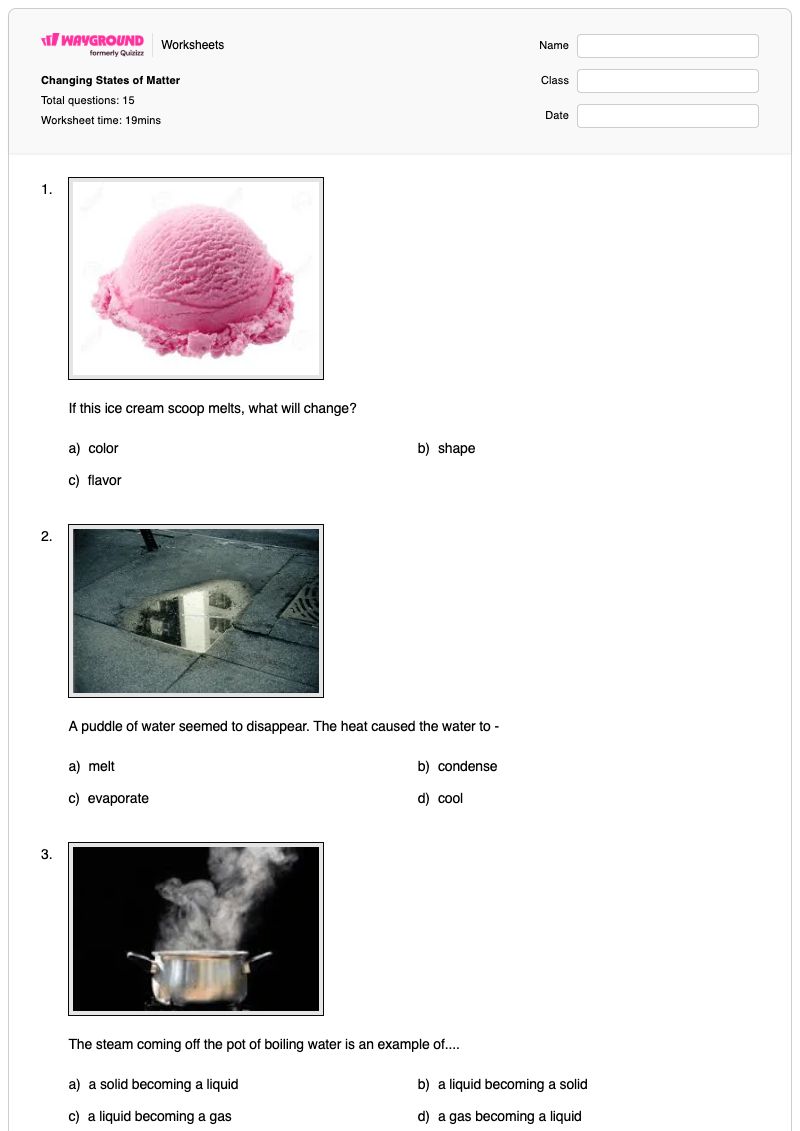
This free printable Grade 5 Chemistry worksheet with an answer key helps students identify how matter changes between solid, liquid, and gas states. Through 15 multiple-choice questions, students connect heating and cooling to changes such as melting, evaporation, and boiling, using familiar examples including ice cream, puddles, steam, and juice placed in a freezer.
The worksheet also introduces thermal and electrical conductors and insulators. Students classify materials and objects such as metal, rubber, Styrofoam cups, and logs, then apply the terms conductor and insulator to definitions about how easily heat and electricity pass through a material. It is useful for introducing or reviewing changes of state and material properties before a class discussion, experiment, or formative assessment.
Worksheet settings
Font size
S
M
L
XL
Worksheets
Changing States of Matter
Total questions: 15
Name
Class
Date
1.
If this ice cream scoop melts, what will change?
a)
color
b)
shape
c)
flavor
2.
A puddle of water seemed to disappear. The heat caused the water to -
a)
melt
b)
condense
c)
evaporate
d)
cool
3.
The steam coming off the pot of boiling water is an example of....
a)
a solid becoming a liquid
b)
a liquid becoming a solid
c)
a liquid becoming a gas
d)
a gas becoming a liquid
4.
Which state of matter does ice start as (before you cool it)?
a)
liquid
b)
solid
c)
gas
5.
True or False: Matter can changes states by adding heat or cooling.
a)
True
b)
False
6.
Which will change state if you put it in the freezer?
a)
sand
b)
a bowl
c)
a pencil
d)
juice
7.
What is a example of a conductor?
a)
wood
b)
metal
c)
rubber
d)
rock
8.
What is a example of a insulator?
a)
metal
b)
rubber
c)
water
9.
Material that allow heat and electricity to pass through them easily are called _________
a)
Conductors
b)
Insulators
c)
D-cell
10.
Material that do not allow heat and electricity to pass through them easily are called _________
a)
Conductors
b)
Insulators
c)
D-Cell
11.
Conductors are made out of _________
a)
Metal
b)
plastic
c)
wood
12.
Styrofoam Cup
a)
conductor
b)
insulator
13.
Log
a)
Conductor
b)
Insulator
14.
An object that heat can move through easily is known as:
a)
an insulator
b)
a conductor
c)
conduction
d)
insulation
15.
An object that doesn't conduct heat well is known as:
a)
a conductor
b)
an insulator
c)
conduction
d)
insulation
Answer Key
Changing States of Matter
Total questions: 15
1.
b) shape
2.
c) evaporate
3.
c) a liquid becoming a gas
4.
a) liquid
5.
a) True
6.
d) juice
7.
b) metal
8.
b) rubber
9.
a) Conductors
10.
b) Insulators
11.
a) Metal
12.
b)
insulator
13.
b)
Insulator
14.
b) a conductor
15.
b) an insulator
140 %
Browse by subjects
Browse by grades
Browse by format
FAQs
What does the Changing States of Matter worksheet cover?
This Grade 5 Chemistry worksheet uses 15 multiple-choice questions to assess two connected skills: identifying changes between solid, liquid, and gas when matter is heated or cooled, and distinguishing conductors from insulators. Students apply these ideas to everyday examples such as melting ice cream, evaporating puddles, boiling water, frozen juice, metal, rubber, Styrofoam, and logs.
How can I use this worksheet to teach changes of state and material properties?
Introduce the worksheet by asking students to describe what happens to water when it is heated or cooled, then use the ice cream, puddle, steam, and freezer examples as discussion prompts. After students complete the state-change questions, have them sort the listed materials and objects into conductors and insulators and explain how heat or electricity moves through each group. Use the multiple-choice items as guided practice before assigning the full worksheet independently.
What mistakes should I watch for when students complete this worksheet?
Students may confuse evaporation with melting or condensation, especially when interpreting the disappearing puddle and steam examples. They may also focus on a material's appearance instead of recognizing that a melted ice cream scoop changes shape, not color or flavor. For the conductor and insulator items, watch for students who reverse the definitions or classify metal, rubber, Styrofoam, and a log incorrectly.
How do I assign and grade this Changing States of Matter worksheet?
The worksheet is available as a printable PDF and as a digital quiz on Wayground, and it includes a complete answer key for all 15 multiple-choice questions. You can grade printable submissions by scanning student work with the Wayground for Teachers app. The printable format also gives schools an option for practicing changes of state and conductors versus insulators with less screen use.
How can I differentiate this worksheet for my students?
For the 15 multiple-choice questions, use Advanced Settings to adjust font spacing and font size so the answer choices and material examples are easier to read. You can also enable a dyslexia-friendly font or translate the worksheet into another language through Advanced Settings, depending on students' reading needs.
Where can I find more worksheets like this on Wayground?
Wayground offers a comprehensive collection of free printable worksheets and practice problems across all subjects, with downloadable PDFs and answer keys to support essential skills and concepts. Browse more resources at https://wayground.com/en-us/worksheets.


 Worksheets


