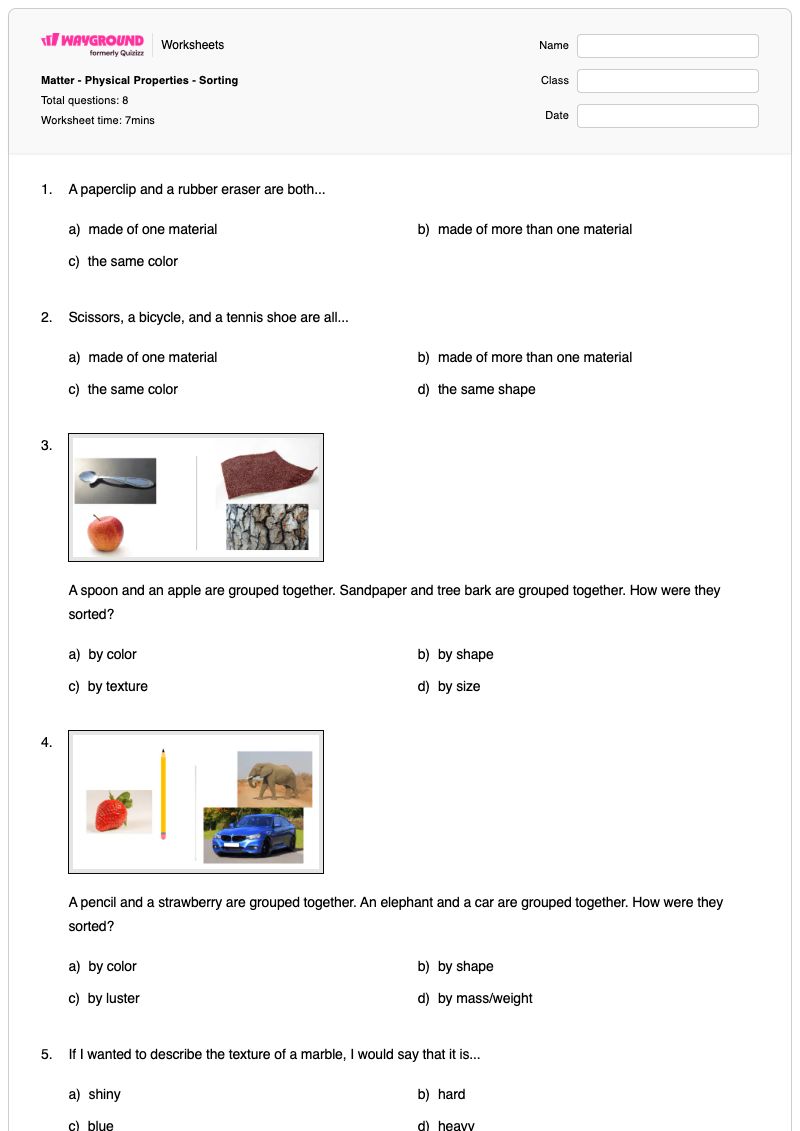
Matter – Physical Properties – Sorting is a free printable Grade 3 science worksheet that helps students identify and classify matter by observable physical properties. Across 8 multiple-choice questions, students determine whether objects are made of one or more materials, sort examples by texture and mass/weight, identify texture descriptions, and distinguish changes in size and shape when an object is broken. The worksheet also reinforces that matter has mass and takes up space and that properties such as texture, size, color, shape, and luster describe matter.
Use this worksheet for guided practice, independent review, or a quick assessment after introducing physical properties. Its object-based examples—including paperclips, erasers, scissors, bicycles, fruit, and everyday materials—ask students to connect vocabulary with how objects can be observed and sorted. A complete answer key is included, making this free printable worksheet easy to check and use for Grade 3 science instruction.
Worksheet settings
Font size
S
M
L
XL
Worksheets
Matter - Physical Properties - Sorting
Total questions: 8
Name
Class
Date
1.
A paperclip and a rubber eraser are both...
a)
made of one material
b)
made of more than one material
c)
the same color
2.
Scissors, a bicycle, and a tennis shoe are all...
a)
made of one material
b)
made of more than one material
c)
the same color
d)
the same shape
3.
A spoon and an apple are grouped together. Sandpaper and tree bark are grouped together. How were they sorted?
a)
by color
b)
by shape
c)
by texture
d)
by size
4.
A pencil and a strawberry are grouped together. An elephant and a car are grouped together. How were they sorted?
a)
by color
b)
by shape
c)
by luster
d)
by mass/weight
5.
If I wanted to describe the texture of a marble, I would say that it is...
a)
shiny
b)
hard
c)
blue
d)
heavy
6.
If I break a piece of candy, what changes?
a)
texture and size
b)
shape and luster
c)
size and shape
d)
luster and mass
7.
Anything that has mass and takes up space is called...
a)
matter
b)
solids
c)
physical properties
d)
liquids
8.
texture, size, color, shape, and luster are all used to describe matter and this is called...
a)
states of matter
b)
physical properties
c)
materials
d)
hypothesis
Answer Key
Matter - Physical Properties - Sorting
Total questions: 8
1.
a)
made of one material
2.
b)
made of more than one material
3.
c)
by texture
4.
d)
by mass/weight
5.
b)
hard
6.
c)
size and shape
7.
a)
matter
8.
b)
physical properties
140 %
Browse by subjects
Browse by grades
Browse by format
FAQs
What does this worksheet cover about sorting matter by physical properties?
This Grade 3 science worksheet uses 8 multiple-choice questions to practice sorting and describing matter by physical properties. Students classify objects by the number of materials they contain, texture, and mass/weight; identify a marble as hard; determine that breaking candy changes its size and shape; and connect mass and space to matter and descriptive traits to physical properties.
How can I use this worksheet to teach physical properties and sorting?
Introduce one property at a time by having students observe classroom objects and describe their texture, size, color, shape, luster, or mass/weight. Then use the worksheet’s grouped-object questions to ask students which property explains each grouping and discuss why the other choices do not fit. Finish by connecting the candy item to the distinction between a change in size or shape and properties such as luster or mass.
What mistakes should I watch for on this physical properties worksheet?
Students may confuse a material’s texture with its appearance, choosing “shiny” for the marble item even though the question asks about texture. They may also select color or shape instead of texture or mass/weight when explaining how objects were sorted, or confuse “matter” with “physical properties.” Check that students recognize that breaking the candy changes its size and shape, not its luster or mass.
How do I assign and grade this matter and physical properties worksheet?
On Wayground, assign it as a digital quiz or download the printable PDF for students to complete on paper. The worksheet includes a complete answer key for all 8 multiple-choice questions, and printable submissions can be graded by scanning student work with the Wayground for Teachers app. The printable format can also support schools that are reducing screen time.
How can I differentiate this worksheet for my students?
Use the worksheet’s Advanced Settings to adjust font spacing or increase the font size so the object descriptions and answer choices are easier to read. You can also apply a dyslexia-friendly font or translate the worksheet into another language, which can help students access the physical-properties vocabulary and sorting questions.
Where can I find more free worksheets like this from Wayground?
Wayground offers a comprehensive collection of free printable worksheets and practice problems across subjects, with downloadable PDFs and answer keys to help students master essential skills and concepts. Browse more resources at https://wayground.com/en-us/worksheets.

 Worksheets
