
Wayground
Properties of Matter - Printable Science Worksheets 6th - 6th Grade - Wayground

Properties of Matter

Shelby Lucero

By Shelby Lucero

20 questions

6th - 6th Grade

Science

323 plays

Updated Nov 2025

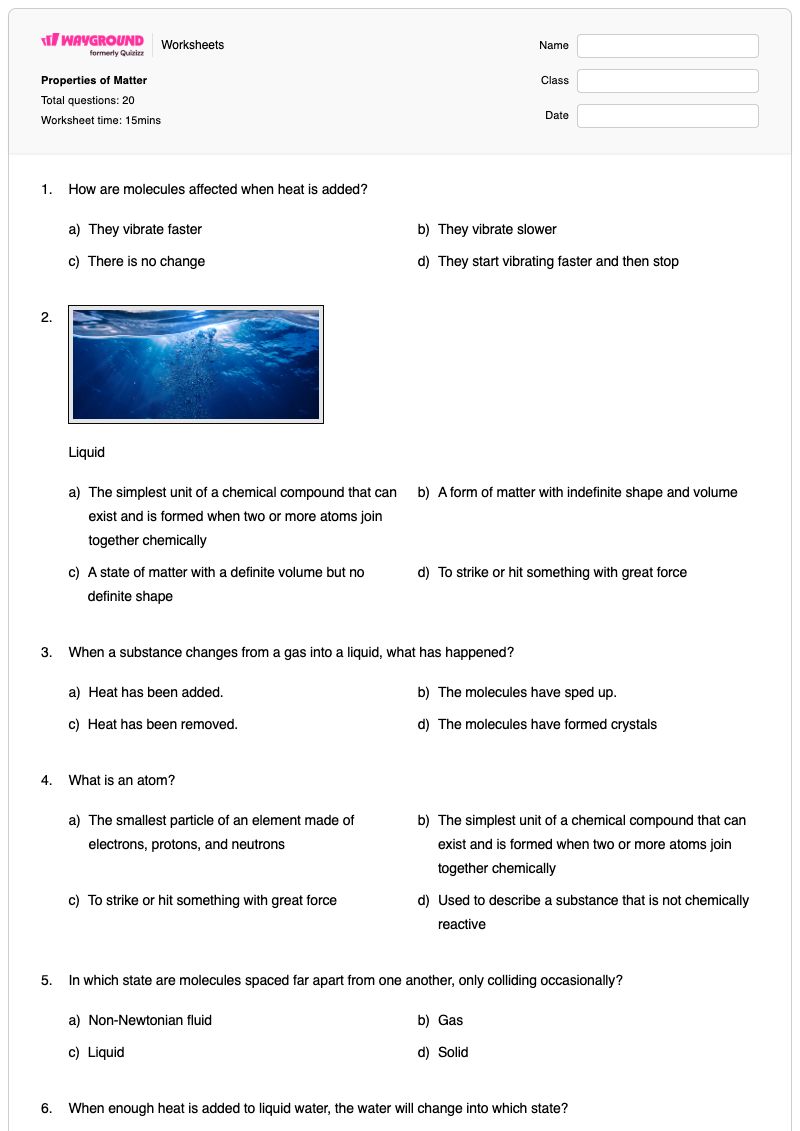
This Grade 6 science worksheet builds understanding of matter at the particle level. Students answer 20 multiple-choice questions about atoms, molecules, and the defining properties of solids, liquids, and gases, including particle spacing, movement, shape, and volume. Several items use particle diagrams that ask students to identify the state of matter represented. The worksheet also connects thermal energy to molecular behavior and changes of state. Students determine how heating affects molecular vibration, predict that liquid water becomes a gas when enough heat is added, identify that gas-to-liquid changes involve heat removal, and recall water’s freezing and boiling points. It is a free printable worksheet with a complete answer key for Grade 6 science instruction, review, or assessment.

Worksheet settings

Font size

S
M
L
XL
WaygroundWorksheets

Properties of Matter

Total questions: 20

Name
Class
Date
1.

How are molecules affected when heat is added?

a)

They vibrate faster

b)

They vibrate slower

c)

There is no change

d)

They start vibrating faster and then stop

2.
Liquid

Liquid

a)

The simplest unit of a chemical compound that can exist and is formed when two or more atoms join together chemically

b)

A form of matter with indefinite shape and volume

c)

A state of matter with a definite volume but no definite shape

d)

To strike or hit something with great force

3.

When a substance changes from a gas into a liquid, what has happened?

a)

Heat has been added.

b)

The molecules have sped up.

c)

Heat has been removed.

d)

The molecules have formed crystals

4.

What is an atom?

a)

The smallest particle of an element made of electrons, protons, and neutrons

b)

The simplest unit of a chemical compound that can exist and is formed when two or more atoms join together chemically

c)

To strike or hit something with great force

d)

Used to describe a substance that is not chemically reactive

5.

In which state are molecules spaced far apart from one another, only colliding occasionally?

a)

Non-Newtonian fluid

b)

Gas

c)

Liquid

d)

Solid

6.

When enough heat is added to liquid water, the water will change into which state?

a)

Gas

b)

ice

c)

Solid

d)

It will remain a liquid

7.
As thermal energy is added to a substance, which of the following changes can be predicted?

As thermal energy is added to a substance, which of the following changes can be predicted?

a)

Spacing between particles will decrease

b)

Vibration and temperature of individual particles will increase

c)

Temperature of the substance will decrease

d)

The pressure of the air around the substance will increase

8.
What state does the image represent?

What state does the image represent?

a)

solid

b)

liquid

c)

gas

9.
What state does the image represent?

What state does the image represent?

a)

solid

b)

liquid

c)

gas

10.
What state of matter does the image represent?

What state of matter does the image represent?

a)

solid

b)

liquid

c)

gas

11.

In a gas particles are packed....

a)

Tightly, no movement

b)

Not packed as tight, with a little movement

c)

loosely packed, particles move freely

12.

In a liquid particles are packed....

a)

Tightly, no movement

b)

Not packed as tight, with a little movement

c)

loosely packed, particles move freely

13.

In a solid particles are packed....

a)

Tightly, no movement

b)

Not packed as tight, with a little movement

c)

loosely packed, particles move freely

14.
As thermal energy increases, what happens to the movement of the molecules?
a)
Increases
b)
Decreases
c)
Stays the same 
15.
What are the freezing and boiling points of water?

What are the freezing and boiling points of water?

a)

-10C and 110C

b)

0C and 110C

c)

10C and 100C

d)

0C and 100C

16.

What is the best definition of temperature?

a)

How hot or cold something is

b)

A measure of how fast the molecules are moving in a substance

c)

How hot or cold something feels to a person

17.

As temperature increases, what happens to particles?

a)

They speed up

b)

They slow down

18.
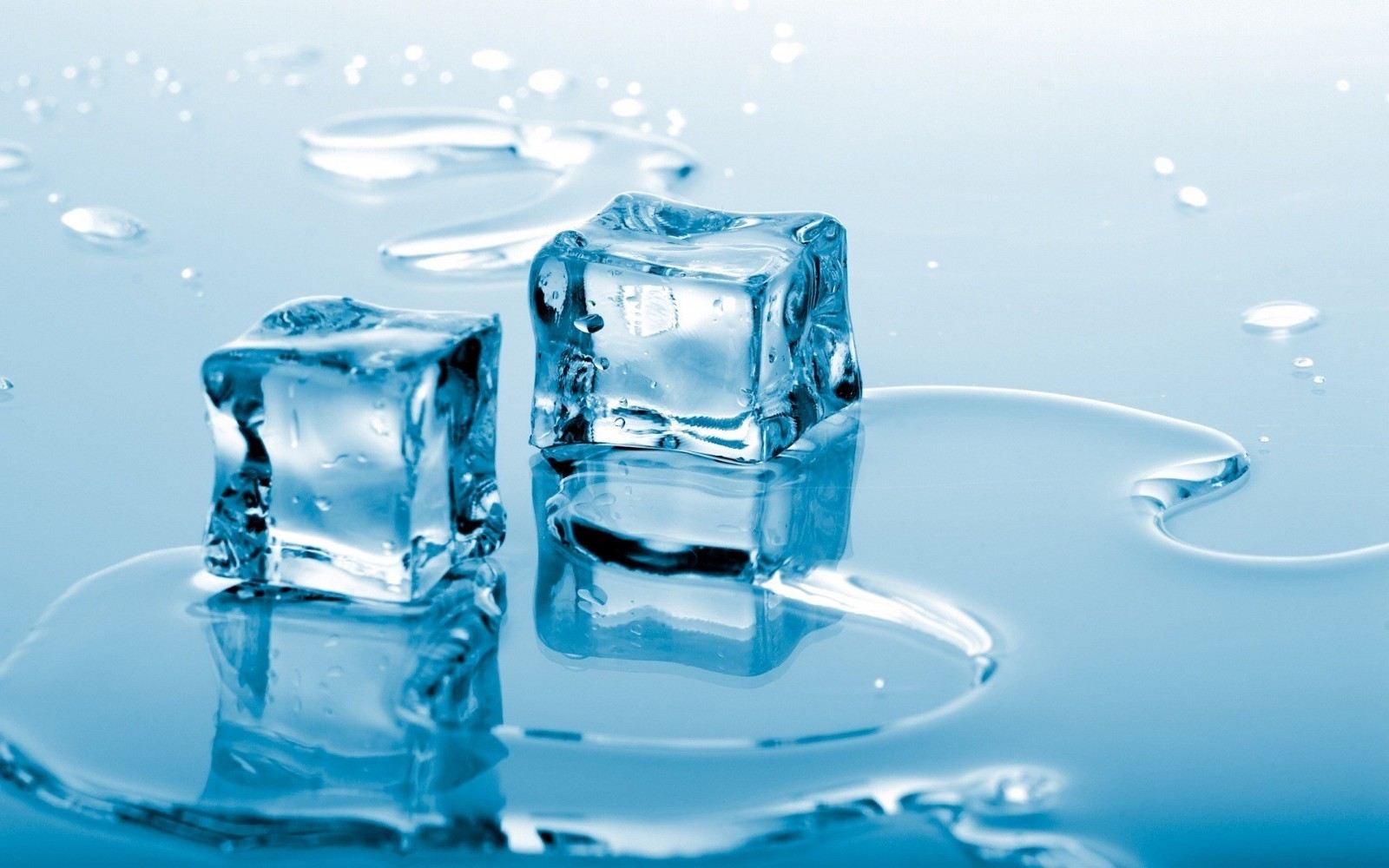
What is happening in this picture of ice melting?

What is happening in this picture of ice melting?

a)

Molecules are speeding up

b)

Molecules are slowing down

19.
What happens when my glass of water is sitting in the sun and disappears into a gas?
a)
evaporation
b)
burning
c)
melting
d)
freezing
20.
Molecules are closest together in a 
a)
Solid
b)
Liquid
c)
Gas
d)
plasma
WaygroundAnswer Key

Properties of Matter

Total questions: 20

1.
a)

They vibrate faster

2.
c)

A state of matter with a definite volume but no definite shape

3.
c)

Heat has been removed.

4.
a)

The smallest particle of an element made of electrons, protons, and neutrons

5.
b)

Gas

6.
a)

Gas

7.
b)

Vibration and temperature of individual particles will increase

8.
a)

solid

9.
b)

liquid

10.
c)

gas

11.
c)

loosely packed, particles move freely

12.
b)

Not packed as tight, with a little movement

13.
a)

Tightly, no movement

14.
a) Increases
15.
d)

0C and 100C

16.
b)

A measure of how fast the molecules are moving in a substance

17.
a)

They speed up

18.
a)

Molecules are speeding up

19.
a) evaporation
20.
a) Solid

FAQs

What does the Properties of Matter worksheet cover?

This Grade 6 science worksheet uses 20 multiple-choice questions to assess how particle spacing and movement distinguish solids, liquids, and gases. Students also interpret particle diagrams, define atoms and molecules, and predict how added or removed thermal energy changes molecular motion and states of matter.

How can I use this worksheet to teach particle behavior and changes of state?

Introduce the worksheet by modeling how particles are arranged and move in each state, then demonstrate how heating increases molecular vibration and can change liquid water into a gas. Have students explain their reasoning for the particle-diagram items and discuss why gas changing to liquid indicates that heat was removed before they complete the multiple-choice questions independently.

What mistakes should I watch for when students complete this worksheet?

Students may confuse a liquid’s definite volume and indefinite shape with the properties of a gas, or select tightly packed particles for every state. Watch for reversals in thermal-energy questions, especially choosing added heat when a gas changes to a liquid, and for confusion between an atom and the simplest unit of a chemical compound. Students may also misread the solid, liquid, and gas particle diagrams or confuse water’s 0°C freezing point with its 100°C boiling point.

How do I assign and grade this Properties of Matter worksheet?

This worksheet is available as a printable PDF and as a digital quiz on Wayground, with a complete answer key for all 20 multiple-choice questions. For printable submissions, you can grade student work by scanning it with the Wayground for Teachers app.

How can I differentiate this states-of-matter worksheet for my students?

Use the worksheet’s Advanced Settings to adjust font spacing and font size so the particle-property questions and diagram-based items are easier to read. You can also apply a dyslexia-friendly font or translate the worksheet into another language when those options support access to the matter vocabulary and thermal-energy questions.

Where can I find more worksheets like this on Wayground?

Wayground offers a broad collection of free printable worksheets and practice problems across subjects, including downloadable PDFs and answer keys that help students master essential skills and concepts. Browse more resources at https://wayground.com/en-us/worksheets.