

Wayground
Science 8 Chapter 8 States of Matter - Printable Science Worksheets 8th - 8th Grade - Wayground

Science 8 Chapter 8 States of Matter

Julie Schwertz

By Julie Schwertz

28 questions

8th - 8th Grade

Science

Updated Oct 2021

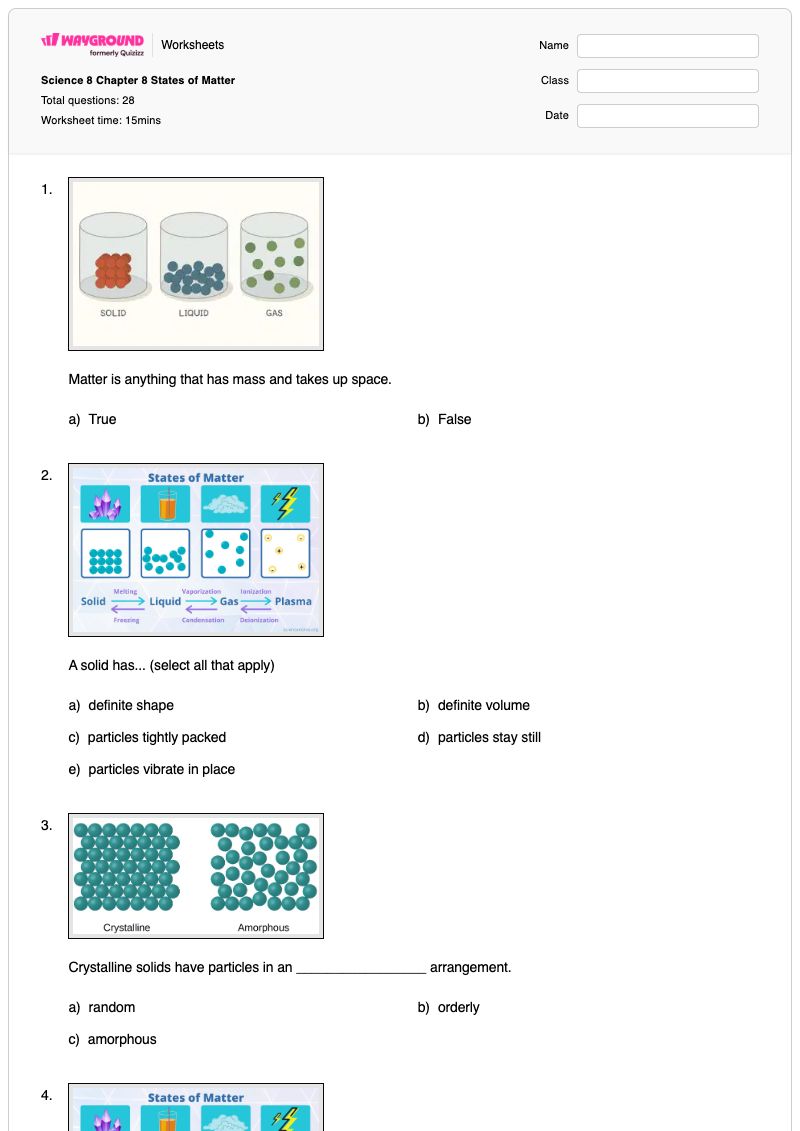
Science 8 Chapter 8 States of Matter is a free printable worksheet for Grade 8 science that checks students’ understanding of matter and the properties of solids, liquids, gases, and plasma. Across 28 questions—16 multiple choice and 12 multiple select—students identify particle arrangement and motion, distinguish definite shape from definite volume, and apply vocabulary such as crystalline, viscosity, water vapor, and plasma. The worksheet also connects particle motion and energy to kinetic energy, temperature, and thermal energy, then asks students to classify phase changes by direction and energy transfer. Students select the characteristics of melting, freezing, vaporization, and evaporation, including evaporation as a surface-only change from liquid to gas. A complete answer key supports quick review, independent practice, homework, or assessment.

Worksheet settings

Font size

S
M
L
XL
WaygroundWorksheets

Science 8 Chapter 8 States of Matter

Total questions: 28

Name
Class
Date
1.
Matter is anything that has mass and takes up space.

Matter is anything that has mass and takes up space.

a)

True

b)

False

2.
A solid has... (select all that apply)

A solid has... (select all that apply)

a)

definite shape

b)

definite volume

c)

particles tightly packed

d)

particles stay still

e)

particles vibrate in place

3.
Crystalline solids have particles in an _________________ arrangement.

Crystalline solids have particles in an _________________ arrangement.

a)

random

b)

orderly

c)

amorphous

4.
Liquids have... (select all that apply)

Liquids have... (select all that apply)

a)

definite volume

b)

definite shape

c)

particles are stuck together

d)

particles move freely past each other

5.
______________________ is the measure of a liquid's resistance to flow.

______________________ is the measure of a liquid's resistance to flow.

a)

Surface tension

b)

Free flow

c)

Viscosity

6.
A gas has... (select all that apply)

A gas has... (select all that apply)

a)

definite shape

b)

definite volume

c)

particles are at a standstill

d)

particles are far apart and move freely

7.
What is the gaseous state of substances that are typically solids or liquids?

What is the gaseous state of substances that are typically solids or liquids?

a)

Water vapor

b)

Viscosity

c)

Crystalline

8.
What gas-like state of matter is usually found in space and has positive and negative charged particles?

What gas-like state of matter is usually found in space and has positive and negative charged particles?

a)

Gas

b)

Solid

c)

Plasma

9.
What is the energy of motion?

What is the energy of motion?

a)

temperature

b)

thermal energy

c)

kinetic energy

10.
_____________________ is the measure of the average amount of kinetic energy.

_____________________ is the measure of the average amount of kinetic energy.

a)

Thermal

b)

Celsius

c)

Temperature

11.
What is the total amount of energy (both kinetic and potential)?

What is the total amount of energy (both kinetic and potential)?

a)

Temperature

b)

Matter

c)

Thermal

12.
What are the characteristics of melting ?

What are the characteristics of melting?

a)

solid to a liquid

b)

liquid to a solid

c)

gains energy

d)

loses energy

13.
What are the characteristics of freezing ?

What are the characteristics of freezing?

a)

gas to a solid

b)

liquid to a solid

c)

gains energy

d)

loses energy

14.
What are the characteristics of vaporization ?

What are the characteristics of vaporization?

a)

liquid to a gas

b)

gas to a liquid

c)

gains energy

d)

loses energy

15.
What are the characteristics of evaporation ?

What are the characteristics of evaporation?

a)

gas to liquid

b)

liquid to gas (surface only)

c)

gains energy

d)

loses energy

16.
What are the characteristics of boiling ?

What are the characteristics of boiling?

a)

liquid to a gas

b)

gas to a liquid

c)

gains energy

d)

loses energy

17.
What are the characteristics of condensation ?

What are the characteristics of condensation?

a)

liquid to a gas

b)

gas to a liquid

c)

gains energy

d)

loses energy

18.
What are the characteristics of sublimation ?

What are the characteristics of sublimation?

a)

solid to a gas

b)

gas to a solid

c)

gains energy quickly

d)

loses energy quickly

19.
What are the characteristics of deposition ?

What are the characteristics of deposition?

a)

solid to a gas

b)

gas to a solid

c)

gains energy quickly

d)

loses energy quickly

20.
The smell of coffee is an example of vaporization.

The smell of coffee is an example of vaporization.

a)

True

b)

False

21.
After you go swimming, water is left on your skin but eventually disappears. This is an example of evaporation.

After you go swimming, water is left on your skin but eventually disappears. This is an example of evaporation.

a)

True

b)

False

22.
What happens when a water bottle "sweats?"

What happens when a water bottle "sweats?"

a)

Condensation

b)

Evaporation

c)

Vaporization

23.
Frost forming on a car window during winter is an example of deposition.

Frost forming on a car window during winter is an example of deposition.

a)

True

b)

False

24.
The ________________________ of Mass means that both mass and energy are conserved, or stay the same amount.

The ________________________ of Mass means that both mass and energy are conserved, or stay the same amount.

a)

Change

b)

Conservation

c)

Separating

25.
What are characteristics of Kinetic Molecular Theory (select all that apply)?

What are characteristics of Kinetic Molecular Theory (select all that apply)?

a)

Large particles make up all matter

b)

Particles are in constant, random motion

c)

Particles will collide with each other

d)

No energy is lost

e)

Small particles make up all matter

26.
Pressure is the amount of __________________ per unit of area.

Pressure is the amount of __________________ per unit of area.

a)

space

b)

mass

c)

force

27.
Which law states that volume is inversely related to pressure (the opposite)?

Which law states that volume is inversely related to pressure (the opposite)?

a)

Boyle's Law

b)

Grubbs's Law

c)

Charles's Law

28.
Which law states that volume is directly related to temperature (so as one goes up, the other goes up...as one goes down,…

Which law states that volume is directly related to temperature (so as one goes up, the other goes up...as one goes down, the other goes down)?

a)

Boyle's Law

b)

Charles's Law

c)

Burns's Law

WaygroundAnswer Key

Science 8 Chapter 8 States of Matter

Total questions: 28

1.
a)

True

2.
a)

definite shape

, b)

definite volume

, c)

particles tightly packed

, e)

particles vibrate in place

3.
b)

orderly

4.
d)

particles move freely past each other

, a)

definite volume

5.
c)

Viscosity

6.
d)

particles are far apart and move freely

7.
a)

Water vapor

8.
c)

Plasma

9.
c)

kinetic energy

10.
c)

Temperature

11.
c)

Thermal

12.
a)

solid to a liquid

, c)

gains energy

13.
d)

loses energy

, b)

liquid to a solid

14.
a)

liquid to a gas

, c)

gains energy

15.
b)

liquid to gas (surface only)

, c)

gains energy

16.
c)

gains energy

, a)

liquid to a gas

17.
d)

loses energy

, b)

gas to a liquid

18.
c)

gains energy quickly

, a)

solid to a gas

19.
b)

gas to a solid

, d)

loses energy quickly

20.
a)

True

21.
a)

True

22.
a)

Condensation

23.
a)

True

24.
b)

Conservation

25.
b)

Particles are in constant, random motion

, c)

Particles will collide with each other

, d)

No energy is lost

, e)

Small particles make up all matter

26.
c)

force

27.
a)

Boyle's Law

28.
b)

Charles's Law

FAQs

What does the Science 8 Chapter 8 States of Matter worksheet cover?

This worksheet uses 16 multiple-choice and 12 multiple-select questions to assess how students identify the properties and particle behavior of solids, liquids, gases, and plasma. It also has students connect kinetic energy, temperature, and thermal energy to phase changes such as melting, freezing, vaporization, and surface evaporation.

How can I use this worksheet to teach states of matter and phase changes?

Introduce the worksheet by having students compare particle spacing, motion, shape, and volume for each state of matter, then discuss why liquid particles move past one another while gas particles move freely. Use the multiple-select items to prompt students to justify every selected characteristic, and follow the phase-change questions with an energy-flow discussion about why melting and vaporization gain energy while freezing loses energy.

What mistakes should I watch for when students complete this states of matter worksheet?

Students may select that solid particles stay still instead of recognizing that they vibrate in place, or confuse a liquid’s definite volume with a definite shape. Watch for confusion between temperature as the average kinetic energy and kinetic energy as energy of motion, as well as errors that reverse the energy changes for melting, freezing, vaporization, and evaporation.

How do I assign and grade this states of matter worksheet?

You can assign this states of matter worksheet as a printable PDF or as a digital quiz on Wayground, and it includes a complete answer key for the 28 multiple-choice and multiple-select questions. For printable submissions, scan student work with the Wayground for Teachers app to help grade responses efficiently.

How can I differentiate this states of matter worksheet for my students?

Use the worksheet’s Advanced Settings to adjust font spacing and font size so the particle-property and phase-change questions are easier to read. You can also apply a dyslexia-friendly font or translate the worksheet into another language while preserving its multiple-choice and multiple-select format.

Where can I find more worksheets like this on Wayground?

Wayground offers a broad collection of free printable worksheets and practice problems across subjects, with downloadable PDFs and answer keys to support essential skills and concepts. Browse more resources at https://wayground.com/en-us/worksheets.