This Grade 5–12 science worksheet uses 10 multiple-choice questions to build foundational probability skills. Students identify probability as the chance of an event, determine coin-toss and two-dice probabilities, compare likelihood based on quantities, and connect probability with bell curves, car insurance, lottery odds, and scientific predictions. The questions also reinforce vocabulary such as likely, average, and prediction.
The worksheet is useful for introducing or reviewing how probability describes chance in familiar and mathematical situations. Students must select precise answers, interpret simple numerical odds such as 1 in 2 and 1 in 6, and apply probability ideas to real-world examples. This free printable worksheet includes a complete answer key, making it suitable for independent practice, a science lesson check, homework, or review before an assessment.
Worksheet settings
Font size
S
M
L
XL
Worksheets
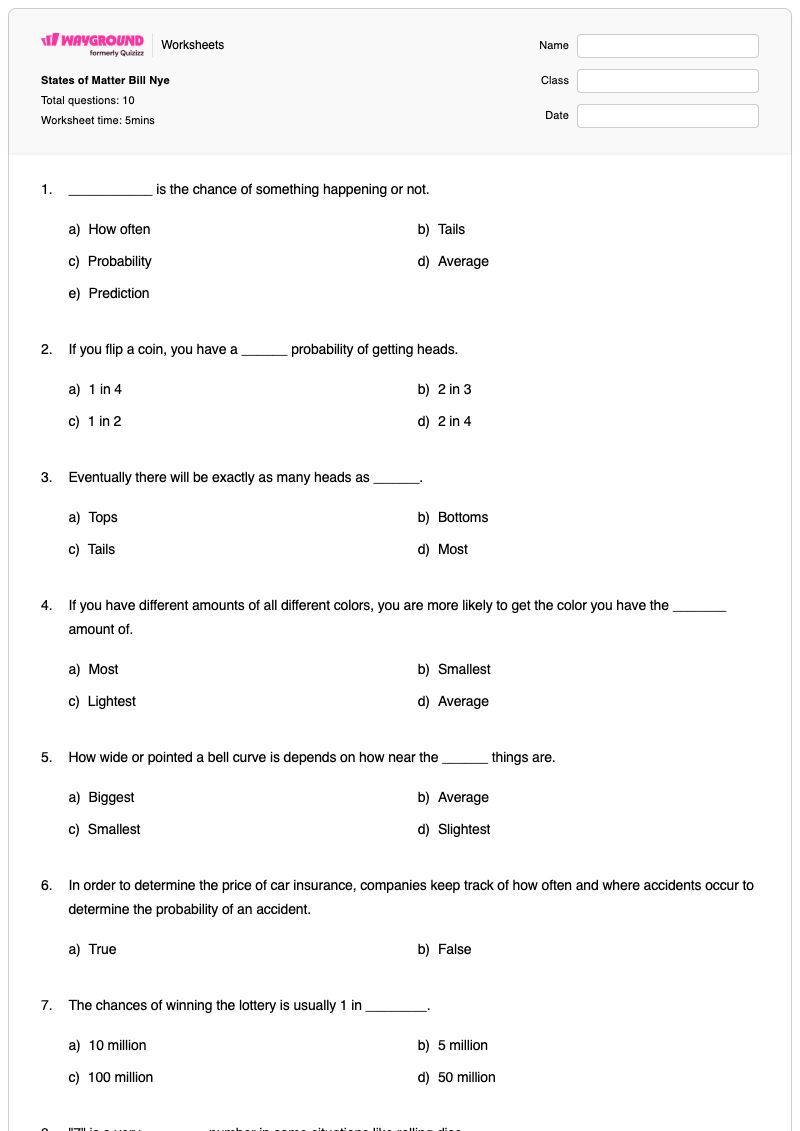
States of Matter Bill Nye
Total questions: 10
Name
Class
Date
1.
___________ is the chance of something happening or not.
a)
How often
b)
Tails
c)
Probability
d)
Average
e)
Prediction
2.
If you flip a coin, you have a ______ probability of getting heads.
a)
1 in 4
b)
2 in 3
c)
1 in 2
d)
2 in 4
3.
Eventually there will be exactly as many heads as ______.
a)
Tops
b)
Bottoms
c)
Tails
d)
Most
4.
If you have different amounts of all different colors, you are more likely to get the color you have the _______ amount of.
a)
Most
b)
Smallest
c)
Lightest
d)
Average
5.
How wide or pointed a bell curve is depends on how near the ______ things are.
a)
Biggest
b)
Average
c)
Smallest
d)
Slightest
6.
In order to determine the price of car insurance, companies keep track of how often and where accidents occur to determine the probability of an accident.
a)
True
b)
False
7.
The chances of winning the lottery is usually 1 in ________.
a)
10 million
b)
5 million
c)
100 million
d)
50 million
8.
"7" is a very ________ number in some situations like rolling dice.
a)
Likely
b)
Unlikely
c)
Average
d)
Impossible
9.
You have a ___________ chance of rolling a "7" when rolling two dice.
a)
2 in 8
b)
1 in 10
c)
3 in 11
d)
1 in 6
10.
Scientists use probability to make ____________ about the future.
a)
Suggestions
b)
Answers
c)
Discoveries
d)
Predictions
Answer Key
States of Matter Bill Nye
Total questions: 10
1.
c)
Probability
2.
c)
1 in 2
3.
c)
Tails
4.
a)
Most
5.
b)
Average
6.
a)
True
7.
b)
5 million
8.
a)
Likely
9.
d)
1 in 6
10.
d)
Predictions
140 %
Browse by subjects
Browse by grades
Browse by format
FAQs
What does this worksheet cover about probability?
This worksheet covers basic probability and likelihood through 10 multiple-choice questions. Students define probability, interpret coin-toss odds, compare the likelihood of colors based on quantity, identify a likely dice outcome, calculate the chance of rolling a 7 with two dice, and connect probability with predictions and real-world decisions.
How can I use this worksheet to teach basic probability?
Introduce probability with a coin toss, asking students to explain why the worksheet gives heads a 1-in-2 chance. Then use the multiple-choice items to discuss how quantities affect which color is most likely, why 7 is a likely sum when rolling two dice, and how probability supports predictions such as insurance risk estimates. Review the answer choices after completion so students explain their reasoning rather than relying only on recognition.
What mistakes should I watch for on this probability worksheet?
Students may confuse probability with a prediction, average, or a general statement about how often something happens. Watch for errors in interpreting ratios, especially selecting 1 in 2 for a coin toss without understanding equal outcomes or missing that the chance of rolling a 7 with two dice is 1 in 6. Students may also choose an extreme option instead of the color with the greatest quantity or misread likely and unlikely.
How do I assign and grade this probability worksheet?
The worksheet is available as a printable PDF and as a digital quiz on Wayground, and it includes a complete answer key for the 10 multiple-choice questions. You can grade printable submissions by scanning student work with the Wayground for Teachers app. The printable format also gives schools an option for reducing screen time.
How can I differentiate this probability worksheet for my students?
Use the worksheet’s Advanced Settings to adjust font size or spacing so the probability definitions, numerical odds, and answer choices are easier to read. You can also enable a dyslexia-friendly font or translate the multiple-choice worksheet into another language when that support is useful.
Where can I find more free worksheets like this from Wayground?
Wayground offers a broad collection of free printable worksheets and practice problems across subjects, with downloadable PDFs and answer keys to help students master essential skills and concepts. Browse more resources at https://wayground.com/en-us/worksheets.

![Erik ES]](https://lh3.googleusercontent.com/a/AGNmyxZfvjQL_2ZhStQWyHOItykjLCylTtcysJdCKizj=s96-c)
 Worksheets