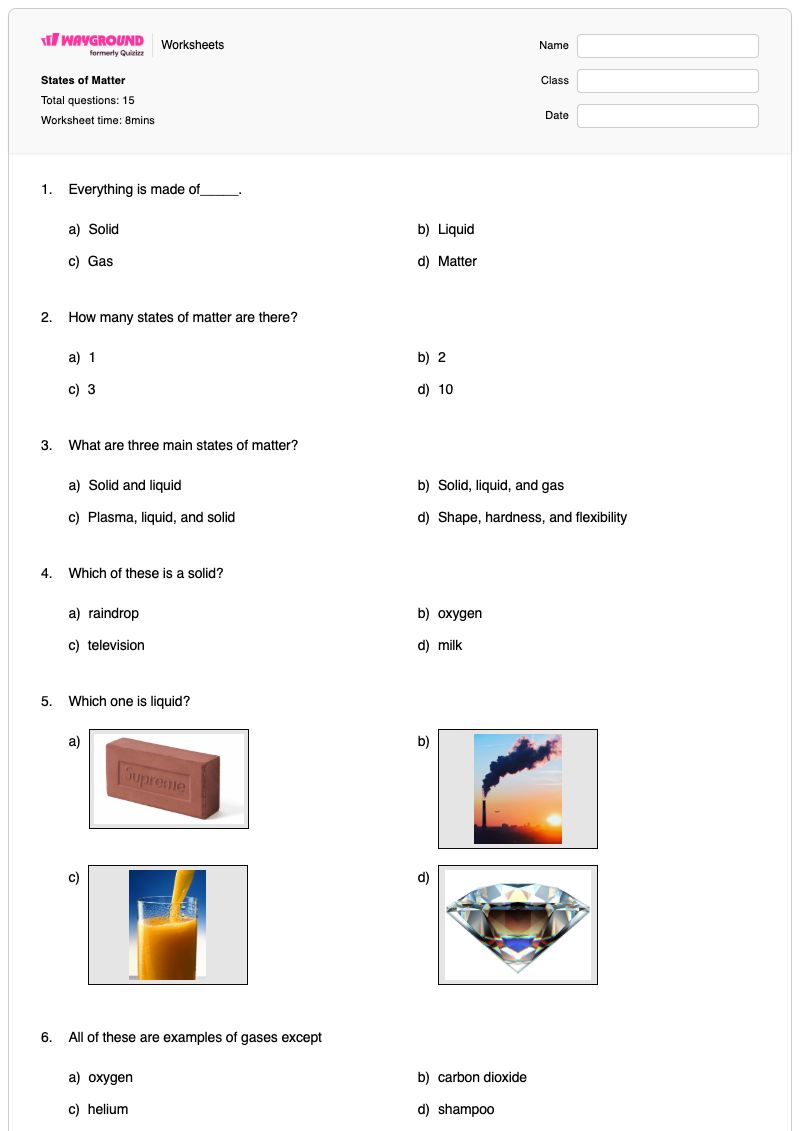
States of Matter is a Grade 3 science worksheet with 15 multiple-choice questions that introduces matter and compares its three main states: solid, liquid, and gas. Students identify everyday examples, recognize that matter makes up objects, air, water, and living things, and match each state to its defining properties. Questions address definite shape, taking the shape of a container, pourability, and particle spacing, including items that use images to represent solids and gases.
The worksheet also checks students’ understanding of basic changes of state by asking what happens when an ice cube melts. It provides a focused way to review vocabulary, observable properties, and simple particle-level descriptions before or after classroom instruction. This free printable worksheet is designed for Grade 3 science practice, review, or formative assessment and includes a complete answer key for efficient checking.
Worksheet settings
Font size
S
M
L
XL
Worksheets
States of Matter
Total questions: 15
Name
Class
Date
1.
Everything is made of_____.
a)
Solid
b)
Liquid
c)
Gas
d)
Matter
2.
How many states of matter are there?
a)
1
b)
2
c)
3
d)
10
3.
What are three main states of matter?
a)
Solid and liquid
b)
Solid, liquid, and gas
c)
Plasma, liquid, and solid
d)
Shape, hardness, and flexibility
4.
Which of these is a solid?
a)
raindrop
b)
oxygen
c)
television
d)
milk
5.
Which one is liquid?
a)
b)
c)
d)
6.
All of these are examples of gases except
a)
oxygen
b)
carbon dioxide
c)
helium
d)
shampoo
7.
Everything around us is made of matter, from the air we breathe, to the water we drink. Even our bodies.
a)
True
b)
False
8.
A _____________ is matter that has a definite shape and takes up a definite amount of space.
a)
Solid
b)
Liquid
c)
Gas
d)
Particles
9.
A _______ takes the shape of the container it is in, and can be poured.
a)
Solid
b)
Liquid
c)
Gas
10.
Which state of matter is represented in this image?
a)
Solid
b)
Liquid
c)
Gas
11.
Which state of matter is represented in this image?
a)
Solid
b)
Liquid
c)
Gas
12.
Which state of matter has particles (atoms) that are very close together
a)
solid
b)
liquid
c)
gas
13.
What does this picture represent?
a)
Solid
b)
Liquid
c)
Gas
14.
Which state of matter has particles that are very far apart from each other
a)
solid
b)
liquid
c)
gas
15.
When an ice cube ______, it becomes a liquid.
a)
Condensation
b)
Evaporation
c)
Freezes
d)
Melts
Answer Key
States of Matter
Total questions: 15
1.
d)
Matter
2.
c)
3
3.
b)
Solid, liquid, and gas
4.
c)
television
5.
c)
6.
d) shampoo
7.
a)
True
8.
a)
Solid
9.
b)
Liquid
10.
c)
Gas
11.
a)
Solid
12.
a)
solid
13.
c)
Gas
14.
c)
gas
15.
d)
Melts
140 %
Browse by subjects
Browse by grades
Browse by format
FAQs
What does the States of Matter worksheet cover?
This Grade 3 science worksheet uses 15 multiple-choice questions to build understanding of matter and its three main states: solid, liquid, and gas. Students identify examples, connect solids with definite shape and closely packed particles, recognize that liquids take the shape of their containers, identify gases and widely spaced particles, interpret state-of-matter images, and determine that melting changes ice into a liquid.
How can I use this worksheet to teach the three states of matter?
Introduce the worksheet after students observe classroom examples such as a solid object, a pourable liquid, and air or another gas. Have students explain the property behind each answer—such as definite shape, taking a container’s shape, or particle spacing—rather than choosing from memory alone. Use the image-based questions and the final melting question as prompts for students to connect visible examples with changes of state.
What mistakes should I watch for when students complete this states of matter worksheet?
Students may confuse an object’s material with its state, select liquid for any substance that can be seen, or overlook that a liquid takes the shape of its container rather than having a definite shape. They may also reverse the particle-spacing descriptions for solids and gases, misidentify image-based examples, or choose freezing or evaporation instead of melting when ice becomes liquid.
How do I assign and grade the States of Matter worksheet?
Wayground provides this states-of-matter worksheet as a printable PDF and as a digital quiz, so you can use the 15 multiple-choice items for paper practice or online assessment. A complete answer key is included for checking responses, and printable submissions can be graded by scanning student work with the Wayground for Teachers app. The printable format also offers an option for schools that are reducing screen time.
How can I differentiate this states-of-matter worksheet for my students?
Use the worksheet’s Advanced Settings to adjust font spacing or choose a larger font size so the multiple-choice options, particle descriptions, and image-based questions are easier to read. You can also enable a dyslexia-friendly font or translate the worksheet into another language when that better supports access to the states-of-matter vocabulary.
Where can I find more worksheets like this on Wayground?
Wayground offers a comprehensive collection of free printable worksheets and practice problems across subjects, with downloadable PDFs and answer keys to help students master essential skills and concepts. Browse more resources at https://wayground.com/en-us/worksheets.


 Worksheets


